
• Skip to main content
  • Skip to primary sidebar
Tiktok
Work With Us
Work With Us
The Humble Penny
Menu
  • Home
  • Shop
  • Books
    • THE WEALTH HABIT
    • Financial Joy
  • Courses
    • One Grand Plus
    • Take Control Bootcamp Planner
    • Make Money Monthly With Affiliate Marketing
    • Budget For Life
    • Super Simple Investing
    • FIRE Superpower
    • Rocket Your Income
    • Value Bundle
  • Coaching
    • 121 Coaching
    • Financial Freedom Coaching
    • Financial Joy Academy (FJA) Membership
    • Architect Programme
    • Financial Joy Academy (FJA) VIP
  • Workshops
  • About
    • About Us
    • Contact
  • Blog
  • Free
    • Free Courses
    • Start a Blog Tutorial
    • Best Resources
    • Books We Love
Order Now
The Humble Penny
  • Home
  • Shop
  • Books
    • THE WEALTH HABIT
    • Financial Joy
  • Courses
    • One Grand Plus
    • Take Control Bootcamp Planner
    • Make Money Monthly With Affiliate Marketing
    • Budget For Life
    • Super Simple Investing
    • FIRE Superpower
    • Rocket Your Income
    • Value Bundle
  • Coaching
    • 121 Coaching
    • Financial Freedom Coaching
    • Financial Joy Academy (FJA) Membership
    • Architect Programme
    • Financial Joy Academy (FJA) VIP
  • Workshops
  • About
    • About Us
    • Contact
  • Blog
  • Free
    • Free Courses
    • Start a Blog Tutorial
    • Best Resources
    • Books We Love
  • Home
  • Shop
  • Books
    • THE WEALTH HABIT
    • Financial Joy
  • Courses
    • One Grand Plus
    • Take Control Bootcamp Planner
    • Make Money Monthly With Affiliate Marketing
    • Budget For Life
    • Super Simple Investing
    • FIRE Superpower
    • Rocket Your Income
    • Value Bundle
  • Coaching
    • 121 Coaching
    • Financial Freedom Coaching
    • Financial Joy Academy (FJA) Membership
    • Architect Programme
    • Financial Joy Academy (FJA) VIP
  • Workshops
  • About
    • About Us
    • Contact
  • Blog
  • Free
    • Free Courses
    • Start a Blog Tutorial
    • Best Resources
    • Books We Love
  • Home
  • Shop
  • Books
    • THE WEALTH HABIT
    • Financial Joy
  • Courses
    • One Grand Plus
    • Take Control Bootcamp Planner
    • Make Money Monthly With Affiliate Marketing
    • Budget For Life
    • Super Simple Investing
    • FIRE Superpower
    • Rocket Your Income
    • Value Bundle
  • Coaching
    • 121 Coaching
    • Financial Freedom Coaching
    • Financial Joy Academy (FJA) Membership
    • Architect Programme
    • Financial Joy Academy (FJA) VIP
  • Workshops
  • About
    • About Us
    • Contact
  • Blog
  • Free
    • Free Courses
    • Start a Blog Tutorial
    • Best Resources
    • Books We Love
Pre-order Now

7 Ways To Build Generational Wealth For The UK Black Community

7 Ways To Build Generational Wealth For The UK Black Community

October 26, 2023 by The Humble Penny 11 Comments

This post is focused on educating Black and non-Black people about the causes of ethnicity wealth gaps and proposes solutions for the black community to build generational wealth. Please read with an open mind no matter your ethnicity.

Economic inequality and race are inextricably linked, and the statistics paint a stark picture of this painful truth.

For the Black community in the UK, this is a reality that cannot be ignored.

According to the ONS Wealth and Assets Survey (WAS), Black Africans and Caribbeans are worth, on a median basis, £34,300 and £85,900, only 10% and 27% of White British households respectively.

When compared to the median total wealth for a household in Great Britain of £286,600, those numbers become 12% and 30% respectively.

In addition, Resolution Foundation (RF) analysis of the ONS WAS data on financial fragility showed that 60% and 49% of Black Africans and Caribbeans households respectively, had less than £1,000 in savings compared to 28% for White British households.

These shocking statistics underscore the economic inequalities that Black people in the UK have been dealing with for generations.

It affects everything from the quality of education to career advancement, wealth creation opportunities and retirement outcomes.

So why is this the case?

What can Black people do to build wealth faster? And what examples can we look to from other ethnicities that have built wealth in the UK?

To start, it’s important to acknowledge historical issues of slavery, colonialism and institutional racism that have contributed to economic inequality.

Also, there are present-day structural inequalities in housing, employment and education that have made it harder for Black people to get access to the resources and opportunities for wealth creation.

Building generational wealth for the black community uk

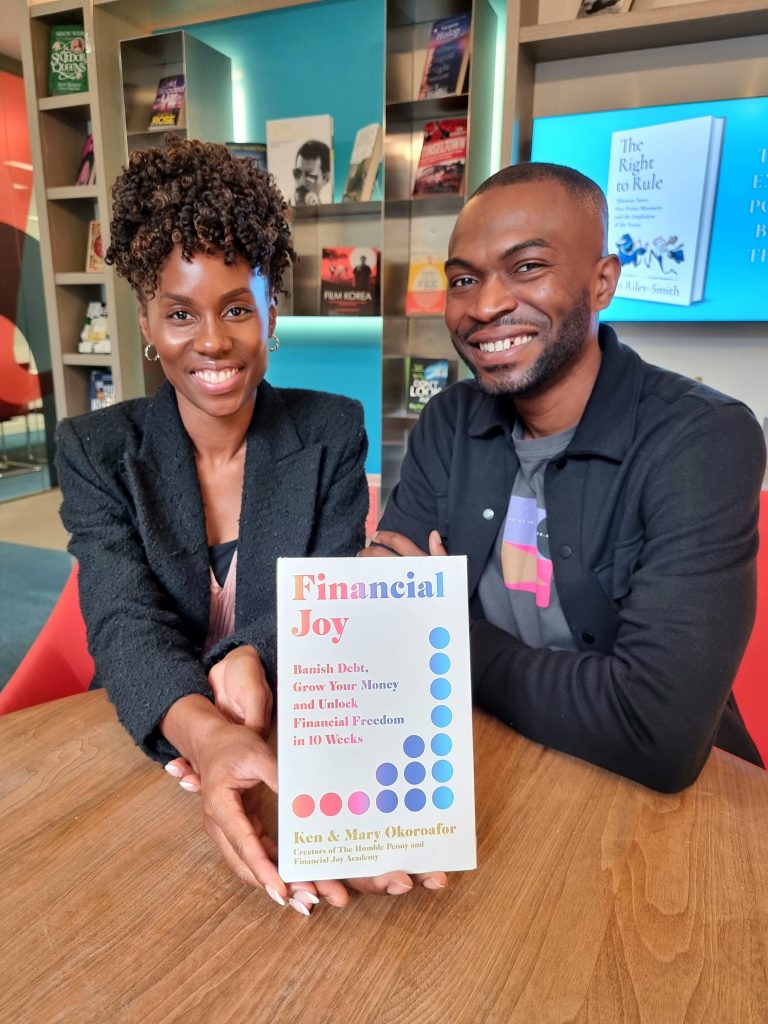
Order our debut book, Financial Joy, a 10-week plan to help you Banish Debt, Grow Your Money and Unlock Financial Freedom.

It is written from our lived experience of achieving Financial Independence aged 34, including mortgage-free in 7 years.

Table of Contents

Toggle
  • Why Black People Struggle to Build Generational Wealth
  • 1. Immigration
  • 2. Educational Attainment and Poverty of Background
  • 3. Lower Income
  • 4. Property Ownership and Tenure
  • 5. Sending Money “Back Home”
  • 6. Debt Burden
  • 7. Inheritance
  • How Black People Can Build Generational Wealth
  • 1. Get Educated About Personal Finance
  • 2. Invest and Own Property
  • 3. Lifestyle Simplification and Saving More
  • 4. Create Business Opportunities to Earn More
  • 5. Focus on Debt Freedom
  • 6. Network and Collaboration
  • 7. Cultural Values and Community Support
  • Conclusion

Why Black People Struggle to Build Generational Wealth

Here are other contributors to the wealth disparities:

1. Immigration

Households headed by recent immigrants tend to have lower wealth outcomes because they have not had the time to accumulate wealth.

This is especially apparent when you compare the wealth of Black Africans versus people from India, who have mainly had the last 30 years to build wealth.

2. Educational Attainment and Poverty of Background

Chinese and Indians have the highest proportion of working adults educated to a degree level or higher in the UK.

Whilst 36% of Black Africans are educated at a degree level or above, this has not always translated into higher incomes.

Relative to other migrants, the Hong Kong Chinese, for example, often come from affluent backgrounds and have access to financial resources that can help them establish themselves in the UK.

They also often arrive in the UK with strong social networks that can provide them with job opportunities and other forms of support.

3. Lower Income

Whilst there has been progress in closing the ethnicity pay gaps, the gaps remain very wide.

According to DWP data, households of Indian ethnicity, for example, receive more than twice the average weekly earnings per adult for Black Caribbeans.

4. Property Ownership and Tenure

There is a strong positive correlation between property ownership and having higher wealth.

Over the last 25 years, total UK wealth has risen from 4x to 7x the level of GDP driven partly by falling interest rates, which led to capital and valuation gains in assets already held.

Indians, Pakistanis and White British people have benefitted the most with typical homeownership rates of around 70% to 80%, compared to 10% to 25% for Black Africans and 40% to 55% for Black Caribbeans according to DWP data.

In terms of wealth composition, Indians and Pakistanis have the biggest proportion of their wealth in net property, 47% and 57% respectively, compared to 33% and 38% for Black Africans and Caribbeans.

5. Sending Money “Back Home”

‘Black Tax’ refers to the financial burden that Black people in the UK (and other parts of the world) often face due to the cultural and familial expectation that they will provide financial support to their families and communities.

This support can take many forms, including paying for family members' education or helping to cover the cost of living expenses for extended family members.

Black Tax can have a significant impact on the wealth of Black people in the UK, as it can limit their ability to save and invest in their own financial futures.

It also leads to intergenerational poverty as parents can pass on the same expectations to their children, leading to a cycle of financial burden and limited wealth creation.

6. Debt Burden

Black households have a significantly higher ratio of debt to assets, leading to the cost of servicing debt often being a hindrance to building wealth.

7. Inheritance

ONS data shows that whilst White British and Indian people receive on average inheritance and gifts of £3,068 and £1,958, Black Africans and Caribbeans on average receive £1 and £778 respectively.

Inherited wealth exacerbates the wealth gap issue.

How Black People Can Build Generational Wealth

The government clearly needs to do much more to close these gaps.

But there is also plenty that Black people themselves can do to improve their financial prospects and start accumulating wealth.

1. Get Educated About Personal Finance

One of the most powerful ways of improving the financial situation of the Black community in the UK is to focus on financial education.

Every household needs to have a basic understanding of budgeting and saving as well as investing and debt management strategies.

In addition to the many resources online, there needs to be a more intentional effort on a community level to financially educate not only the adults of today but also their children.

Financial education should begin at home and we shouldn’t just wait for schools to teach us about money.

Recommended Book: Financial Joy: Banish Debt, Grow Your Money and Unlock Financial Freedom In 10 Weeks

2. Invest and Own Property

Property is important for building wealth long term.

If money is short for a deposit, people can start small and aim to pool resources with friends and family to invest in property together.

3. Lifestyle Simplification and Saving More

Adopting the mindset that wealth is mostly unseen and focusing on living a simpler lifestyle will help a lot of people live within their means and avoid lifestyles sponsored by expensive debt.

Prioritising saving and investing at least 10% to 20% per month into Stocks and Shares ISAs combined with Lifetime ISAs will help families build considerable wealth over time.

This provides some growth potential and liquidity (during times of loss of income) as Black people in the UK have the highest proportion of their wealth locked away in inaccessible pensions.

4. Create Business Opportunities to Earn More

Research by the Resolution Foundation found that all things being equal, a £1 increase in household income is associated with household wealth being £16 higher.

Entrepreneurship is a powerful tool for wealth creation, especially for Black people who have historically faced barriers in the job market.

Starting a business allows individuals to create their own opportunities and build their own wealth.

This is not without its challenges as we’ve seen with issues of access to funding for Black entrepreneurs.

Whilst we continue to work on improving funding outcomes for black entrepreneurs, we should keep learning from the examples of successful Indian and Pakistani business owners who have relied on family and community connections to secure funding and find customers.

5. Focus on Debt Freedom

With rising interest rates, debt will continue to be a big problem for families that are over-leveraged.

A big portion of disposable incomes for Black households should be focused on paying off expensive debts and where possible, overpaying on mortgages for better interest terms.

This mindset of investing in property coupled with repaying loans and not borrowing recklessly is a big part of what helped Pakistanis accumulate large property portfolios over the years.

6. Network and Collaboration

Trust is a huge issue in the black community.

There should be a focus on building long-lasting relationships with other Black people in the business world through networking events, professional organisations and mentorship opportunities.

7. Cultural Values and Community Support

Many ethnic minority communities have a strong sense of identity and culture that has helped them to build solidarity and support for one another.

Black people should look to their own cultural heritage and values as a source of strength and inspiration for building their own wealth.

Examples of such heritage and values include creativity, community, education, identity, spirituality and resilience.

The cultural heritage and values of Black people in the UK are rich and diverse, reflecting the unique experiences and contributions of people of African and Caribbean descent to British society.

Conclusion

Whilst it’s essential for policymakers to pay attention to current policies and trends in order to narrow the wealth gap, it’s also important for Black people to take practical steps to own their own stories and re-write the wealth narrative one household at a time.

Generational wealth is a possibility and our lived experience of achieving Financial Independence in our 30s even with many of the challenges highlighted, gives us hope that others can do the same too.

Order our debut book, Financial Joy, a 10-week plan to help you Banish Debt, Grow Your Money and Unlock Financial Freedom.

Financial Joy is accessible to everyone and it is available to you now, not later. Start today to create a life you love.

More posts to read on building generational wealth:

  • 5 Signs You'll Become Wealthy 10 Years From Now
  • If You Have £5,000 In The Bank, Do These 5 Things
  • How Much Money Do I Need To Retire Comfortable?

Watch the video on version on building generational wealth:

What are your thoughts on the proposals to help the Black Community build generational wealth given current and historic challenges? We welcome thoughts and contributions from anyone of any ethnicity as a comment below.
5 Signs You’ll Become Wealthy 10 Years From Now

October 8, 2023 by The Humble Penny 4 Comments

5 Signs You'll Become Wealthy 10 Years From Now

Did you know that most people do not build wealth in their lifetimes not because of things they can’t control but because of things they can control? 🤔

For some people, “wealth” means being able to pay their bills without worry and for others it means good health and Financial Freedom.

Whatever your definition of wealth, everything we share in this post will help to shift your thinking so that you can go from where you are now to where you ultimately want to be.

Buy Our Bestselling Book:

Financial Joy: Banish Debt, Grow Your Money and Unlock Financial Freedom In 10 Weeks

Become wealthy in 10 years as you achieve Financial Joy
 We're so honoured to have written our own book. Seeing it become a bestseller is absolutely mind-blowing. HUGE Thank you for your love and support :). It's available now on Amazon and other retailers.

Table of Contents

Toggle
  •  
  • 5 Signs You'll Become Wealthy 10 Years From Now
  • 1. You're Not Doing Everything Yourself
  • 2. You're Not Living With Expensive Debts
  • 3. You're Not Listening To Too Many Voices
  • 4. You're Not Waking Up Without A Goal And A Plan
  • 5. You're Not Standing In Your Own Way
  • Conclusion


5 Signs You'll Become Wealthy 10 Years From Now

Here are 5 everyday things you need to stop in order to actually build wealth.

1. You're Not Doing Everything Yourself

The idea of doing everything yourself is borne out of scarcity.

In our lived experiences, one of the most effective ways to achieve your goal is to do it through other people.

Let’s say you want to own certain assets one day, e.g. property.

Combining effort, ideas and money with other people will help you get there faster.

Apart from examples of this in our own lives with family, we’ve had our community members a Financial Joy Academy put money together to buy a property.

They were only able to do this because they’d over time built trust and their mindsets were aligned.

The same goes for building a business or side hustle successfully. You need other people.

In addition to running The Humble Penny, we own a nursery business with other family members.

Although we don’t get involved day to day, we benefit from that business even though it is run by other people each day.

Making these successful moves in various asset classes required a subtle shift in mindset from only thinking of yourself as the source of your future success but instead thinking of others to come along with you.

If you take this deeper, you’ll realise that wealth building is rooted in creativity and creativity is rooted in connection to others.

Action Step: Stop doing everything by yourself. You’ll get further faster with other people.

2. You're Not Living With Expensive Debts

The UK, US and other similar major economies are built on debt with Debt to GDP ratio in excess of 100% for all of them.

This normalisation of debt can also be seen with the rise of household debts in the UK and similar economies.

Many households rely on expensive debt to afford their lifestyles.

Although some people need debt because of the challenges of the cost of living crisis, for most people, the issue of debt is driven by bad money habits.

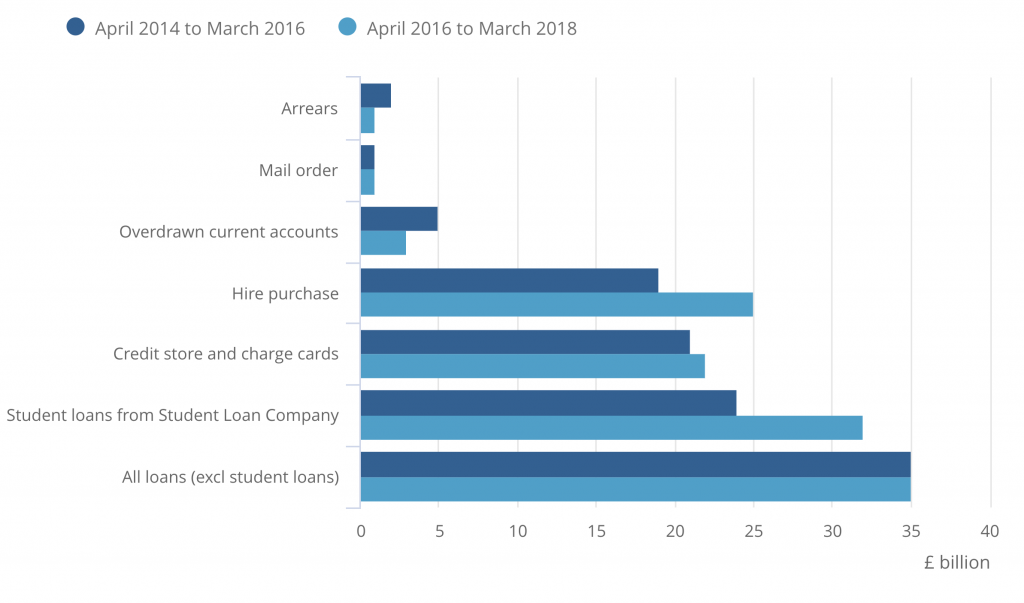
Here is the UK household debt picture:

Become wealthy for financial joy

Outside of student loans, credit cards and hire purchase debt remain a huge growing problem for households.

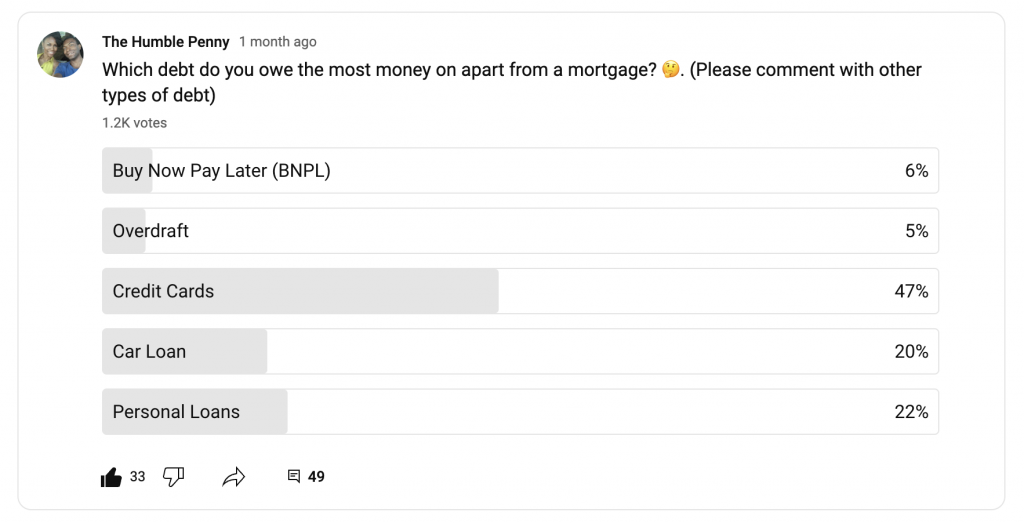
We even asked The Humble Penny community what their debts looked like aside from a mortgage, and here is what they shared:

Become wealthy and design a life of financial joy

The trend is pretty similar to the national picture.

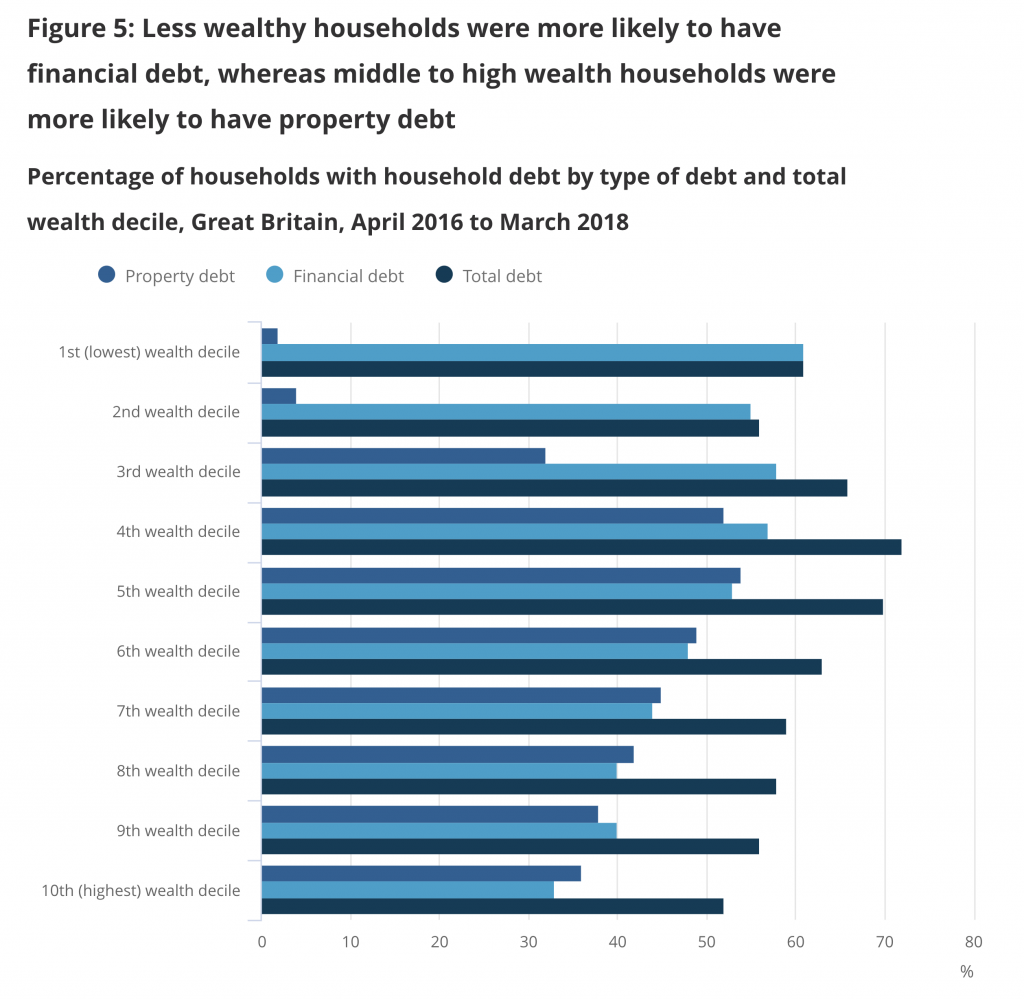
Not all debt is bad though. The way that wealthy and less wealthy households use debt is different according to research.

The Wealth and Assets Survey (ONS), shows that wealthier households use cheaper debt to acquire assets (e.g. property) that appreciate with inflation:

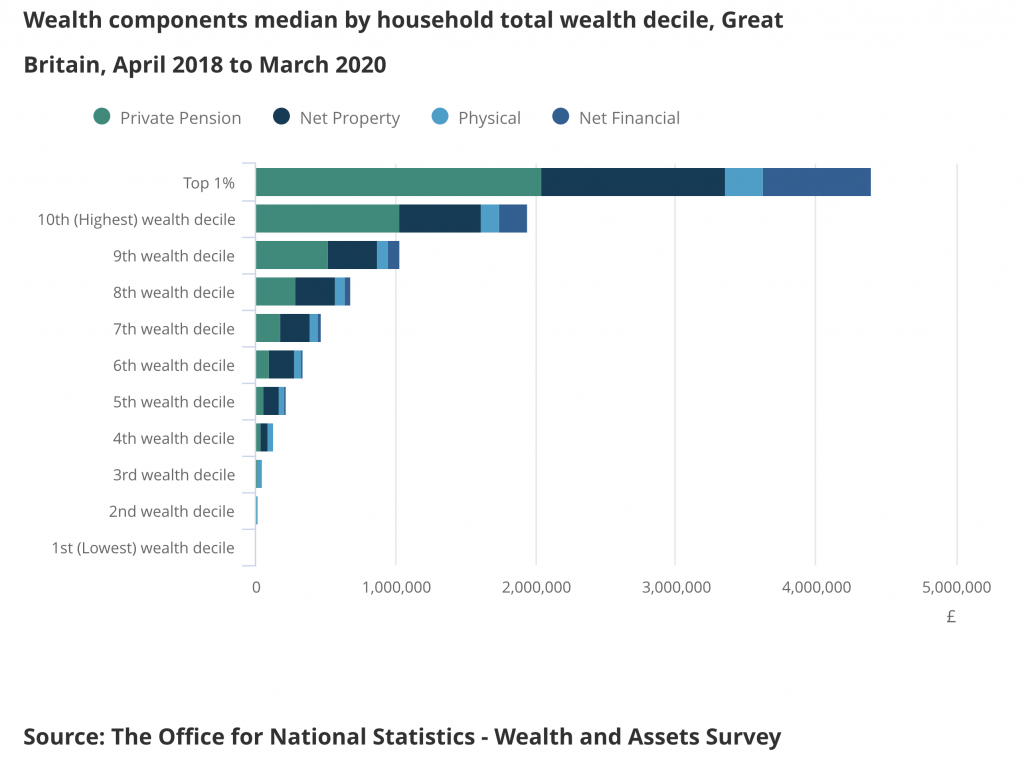
Wealthy households also have lots of pensions and financial wealth.

Here is the wealth picture by decile:

In our experience, acquiring wealth is possible (over time) but only once you've gotten rid of a reliance on expensive debts.

Action Step: You need to work on the root cause of your bad money habits. It’s only when you fully stop relying on expensive debts that investing in assets becomes a focus.

3. You're Not Listening To Too Many Voices

The chances are, you might be getting poorer right now simply because of who you listen to.

Since 2020 when we were all locked down and hooked to the internet, the number of people sharing information online has exploded.

Whilst this is great for creativity, it unfortunately also means that there is a lot of incorrect, scammy and poor-quality information out there.

Be very careful.

Before actioning anything you learn from people, do more due diligence yourself.

Action Step: Choose 1 – 3 people you listen to and make sure they have the credentials and lived experience.

4. You're Not Waking Up Without A Goal And A Plan

What is your current goal right now? 🤔

Too many of us wake up daily and go into autopilot and yet, we expect certain outcomes in our financial lives.

Having a goal and plan gives you focus, belief and a sense of purpose.

It also means that you’ll get better at saying NO to random ideas, business or career opportunities if they do not align with your plan.

Action Step: Write your goal and plan down in a notepad (not your phone) and look at it daily without fail. Make sure it relates to the vision you want for your life.

5. You're Not Standing In Your Own Way

We love the Napoleon Hill quote:

“Whatever your mind can conceive and believe, your mind can achieve”.

The problem is, that most people don’t give themselves enough ME time to conceive anything.

If you can’t conceive anything, how will you believe in anything?

If you don’t believe in anything, how will you achieve anything?

You need to get out of your own way.

Action Step: Make more ME time just to think about what you specifically want to achieve in your life. Then, ask yourself, who can get me there faster? This is one way to get out of your own way.

Conclusion

Wealth building is like doing admin.

It’s about shifting resources (time, skill and money) including other people’s time, skill and money to good opportunities.

Zooming out, wealth building requires a radical shift in mindset, a desire to improve your skillset and a need for you to follow a tried and tested toolset and plan.

One such toolset and plan is our step-by-step 10-week plan to help you banish debts, grow your money and unlock Financial Freedom.

In a world of uncertainty and high cost of living, many people need to know how to build wealth whilst enjoying life and prioritising their well-being.

This is why we decided to write our book from the lived experience of a couple with children who actually have a lived experience of achieving financial independence.

We know what it feels like to start from ground zero and try to build wealth with so many day-to-day challenges.

Financial Joy will help you to turn your life around from small beginnings and design a life of Financial Freedom filled with the small experiences that bring you joy.

Financial Joy is for everybody and is accessible to you now, not later. Start today to grow your money and create a life you love 😍.

Huge thank you to everyone who helped to make our book a number 1 bestseller on Amazon within 24 hours. We appreciate you 🙂

Pre-order our book here


Become wealthy in 10 years as you achieve Financial Joy

Other things to read on how to become wealthy:

  • If You Have £5,000 In The Bank, Do These 5 Things
  • Why Your First £100k Is The Magical Number For £1m
  • How To Break The Employee Mindset And Build Wealth

Which of the 5 signs you'll become wealthy from today's post resonated with you the most? Comment below and share some thoughts.

If You Have £5000 In The Bank DO THESE 5 Things

September 5, 2023 by The Humble Penny 2 Comments

How to invest £5000 – If You Have £5000 In The Bank Do These 5 Things

So you've got £5000 or $5000 in the bank.

What exactly should you be doing with that money today to get the biggest bang for your buck? 🤔

Today, we'll unpack how to invest £5000 in 5 ways to get the best returns for your money.

This is especially important in a world of higher-than-average inflation as we all navigate a higher cost of living whilst trying to balance that with preparation for the future.

Our goal is to give focus to your money so that it can grow for your future enjoyment as well as reduce anxiety and worry.

how to invest £5000

Recommended: Turn Your Existing Skills Into Recurring Monthly Income In 12 Weeks

Table of Contents

Toggle
  • How To Invest £5000 – Do These 5 Things
  • 1. Pay Off Expensive Debts
  • 2. Rethink Your Savings
  • 3. Invest Low-Risk For High Returns 
  • 4. Protect Your Assets
  • 5a. Beat The Fear of Failure 
  • 5b. Upskill and Learn, Learn, Learn
  • Conclusion

How To Invest £5000 – Do These 5 Things

Alright, let's jump straight in. In no particular order, here are 5 things we'd do with £5000.

You can either split the £5000 across some of these ideas or pick just one thing to invest it in.

1. Pay Off Expensive Debts

The first thing we would do if we had £5000 in the bank is to pay off expensive debts.

One reason I love asking people to work out their financial net worth is that when you do so, some really obvious things stick out to you.

But often when you have it all in your head, it's not very obvious.

if you have £5000 in the bank, invest in these 5 things - how to invest £5000
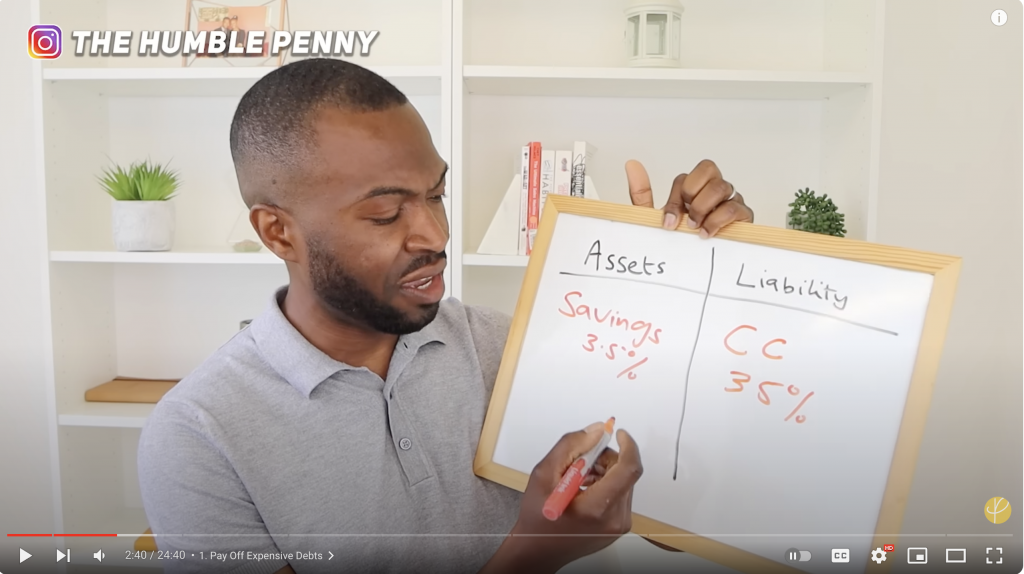
Here I'm comparing making a 3.5% return in a savings account to having credit card debt with 35% APR. What would you rather do?

A net worth is simply, looking at the assets in your life (e.g. savings, property, etc.) and comparing that to your liabilities (e.g. credit cards, overdrafts, etc.).

You add them up and take the total liabilities away from the total assets to get one number, which is your net worth.

Let's say you've got £5000 in savings and it's generating, say, 3.5% in interest for you.

But on the other hand, you have a credit card, which if you read very closely in your paperwork, is probably charging north of about 35%.

If you've got savings of £5000 in the bank, why would you leave the savings there generating 3.5% whilst having credit card debt where the credit card company is generating up to 35% in returns from you?

The first thing we would do if we had £5000 would be to take those savings and get ourselves a guaranteed return by paying off the credit card debt.

But the bigger point we want to make beyond using those savings to pay down credit card debt is to question, how did we get there in the first place?

Too many of us over-rely on using credit cards to sponsor our lifestyles.

We get it, some of us don't do it just because we feel like it. We do it because it's a necessity and a lot of people are struggling.

To get out of the debt spiral, one thing that can help you is to learn ways in which you can take control of your finances, and then look for ways to grow your money.

If that's something you want to learn to do practically, with step-by-step guidance, we have a free one-year programme that you can join as a starting point.

Every single week, depending on when you sign up once a week, you get a specific email, with the core goal of helping you become that person who:

  • Stops relying on expensive debt,
  • Takes control of their finances,
  • Learns to grow their money.

So check that out, if it's something that you think will be useful to you.

Recommended: How to Pay Off Debts Fast On Low-Income

2. Rethink Your Savings

The reason I've come back to savings is because you might not have any debts at all.

You might be at a point where money is just sitting in your current account.

The very first thing to do is consider whether you've got enough of an emergency fund for when your car stops working, your boiler breaks down or you lose your job, etc.

I'd keep about £1000 to £2000 at minimum to cover those random things that you don't expect.

On top of that, I'd want to build that £1000 or £2000 to around 3 to 6 months of essential living expenses over time.

You are then prepared for what's to come. Look at recent trends. A lot of tech companies have been sacking people.

One day you feel like you've got job security, the next day you've been laid off.

You can also use that money to put into an easy-access account where you generate some returns.

At the time of writing, you might be able to get about 4.93% AER for your money according to Money Facts.

Or you can lock that money away in a fixed-rate savings account that can give you north of about 5% to 6% if you lock it away for about a year.

You can even split that money by having some in easy access and some in a fixed return account.

Obviously, with inflation being so high, your real return on that money remains negative.

Ultimately, what you want to do by having this safety cushion is to protect your well-being when misfortune inevitably takes place.

Recommended: How to Invest and Beat Inflation

3. Invest Low-Risk For High Returns 

The third thing I would do with my £5000 in the bank is to explore investing.

Note that I've gone from talking about getting rid of expensive debt first before we look at investing.

Some things might seem obvious to you, but for some people, it might not be as straightforward.

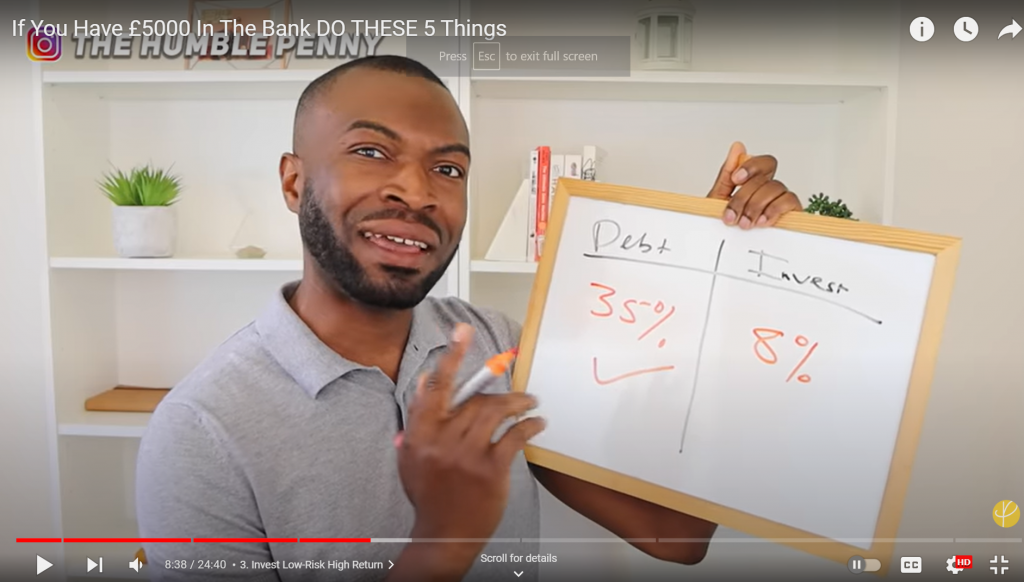
Let me just illustrate. Imagine we've got two possibilities.

One is you have expensive debts (costing 35% APR) and the other is that you could invest your money and potentially generate a return of 8%.

It sounds obvious, but I want to just share this because, without illustrating it this way, it doesn't sink in for some people.

if you have £5000 in the bank, do these 5 things - How to invest £5000
If you have expensive debts, it makes sense to pay these off first over investing in the stock market.

Although investing continues to grow in popularity, when you invest your money, you are doing so at risk. However, without risk, there's no return.

Paying off extensive debts first in this scenario is a no-brainer.

If, however, you've paid off this expensive debt, then investing money without worry becomes the next logical thing you should be doing.

Even though investing makes sense, a lot of people have the fear of actually losing their money.

That fear is usually born out of scarcity and that's okay. However, building any kind of wealth requires moving beyond that fear.

If you haven't started investing yet, provided you have paid off all expensive debt, start small.

Take £100 out of that £5000 and begin there. This is how we started investing. 

One thing I know with investing is that once you begin with £100, although it might not feel like fireworks are going off, you are now investing.

Something psychological happens when you invest that first £100. You would have had to do some research, decide on what to invest in, etc.

To avoid losing your money, I would say begin with passive investing and keep it simple.

There is natural volatility that comes with investing i.e. it will go up and down, as different assets have different levels of volatility.

For example, assets that have almost no risk have very low volatility.

Examples of high-risk investing are individual stocks that have lots of volatility.

Whereas, index funds and ETFs have volatility as well but they're driven by market conditions, as well as by the specific risk in the basket of stocks they're investing in.

Their volatility is not as wild as putting all your money into one stock.

If you are a beginner, stay away from picking individual stocks, because you're reducing the chances of you losing your hard-earned money.

Our ultimate goal as wealth builders is to protect our money and make it grow.

4. Protect Your Assets

Next is to protect your assets. A lot of the time our efforts are typically focused on how to make that money 💰.

Whereas in a lot of our lives, there are certain small things we know exist, that we need to do to protect our money, which we leave as an afterthought.

“I'll get to that thing later”, when in fact, if things go wrong, we could be in a lot of problems, and could even lose all the wealth we've built 😤.

The core goal of protecting our assets here is that we know it's harder to keep that money than it is to make that money.

Two ways to protect your assets are to look at insurance and estate planning.

There are of course different forms of insurance:

  • Home insurance
  • Car insurance
  • Life insurance
  • Critical illness insurance, etc.

And then there's estate planning, writing wills, and so on.

Good quality insurance is vital and I have a lived experience of this through family loss where life insurance was needed.

I've also been through my mother almost dying from a brain aneurysm, where good quality travel insurance became extremely important.

These have been real-life traumatic experiences, but if we did not have good quality insurance we would have been in a lot of problems.

So I'm sharing this straight from the heart to say to you, if you have any money right now, in your bank account, ask yourself, do I have adequate coverage? 🤔

You might say, “I've got that coverage from my job.”

That's good that you've got some coverage. But I've known someone, again, very dear to me, who unfortunately got made redundant.

Out of that redundancy came the loss of the life insurance, loss of all those covers that their employer provided.

Perks which all sounded nice and are provided by big companies.

And of course, it became too late to get actual cover for themselves individually.

Don't Rely On Employer Insurance!

Think very carefully about yourself right now.

Everybody knows where they've got a gap in their lives, but they always brush it away or push it to the back of their minds.

Ask yourself:

  • Where in my life right now have I got a gap?
  • How do I protect that gap right now?

Go and do something about it. If you want to learn about Life Insurance, watch the video below and take action:

With regards to other forms of insurance, do some research on them i.e. home, travel, critical illness, health insurance, life insurance, etc.

5a. Beat The Fear of Failure 

The fifth thing I'd put money into is to beat the fear of failure. Let's talk about it.

I want to hear from you because I can admit it, I've had feelings of failure on so many levels.

Comment and tell us how the fear of failure affects you.

When I had my corporate job, I was the only black man in the room working as a CFO and at board level being in those boardrooms surrounded by mainly white males.

In addition, everybody was older than me, and I felt like “What am I doing in this room?”.

I had serious impostor syndrome and a serious fear of failure on so many levels 😅.

One way I've learned to gradually overcome the fear of failure over time is to begin a passion project or a smart side hustle.

Start something. I hear too many people saying, “I'm gonna do X”, “I'm going to do this”, “I'm going to start this…”, etc.

Too much of this language of talking and not doing.

You need to put a line through the “I am gonna” and start the thing already.

It's quite similar to my point about investing earlier and starting with the £100 or £500 investment.

Start small, create a budget with your £5000 in the bank, to explore something you have always talked about.

The key is to actually do it now rather than put it off again by deciding what idea or opportunity you'll put that money into.

Then everything else will rely on your:

  • Sweat energy
  • Skills and abilities
  • Perseverance, etc.

My point here is, that it's not even that you're starting the thing to try and make money from it straight away, although that would be a great outcome.

Fear Can Paralyse Action Taking

The reason why I will use some of my £5000 in the bank towards this, is to use it to reduce or eliminate the fear of failure.

I feel so much more fearless in my life now because I have explored things. I've gone beyond just talking about them I've done them many times, in different spheres, at different risk and return levels.

We all need to get away from being a generation of people who are just fearful.

Not only are we lonely, but we are so fearful that we don't get anything done.

That fear paralyses us and crushes our generation. We need to let go of that fear by actually taking action.

👉🏽 Why do you think it's acceptable for you to rely on only your employer for your livelihood? 🤔

I just want to put that out there.

  • Whose idea was that?
  • Who sowed that idea in your mind that your employer should be your only provider?

Yes, your employment contract tells you this is all you should do. But when you think about it, is it all you should be doing? For real.

From my experience and those of the people who write to us or DM us to share their stories, it's not. 

Don't put all your eggs in one basket. We teach this with investing, why are you doing it with your day job?

What I'm saying is to use some of your £5000 in the bank to actually do something that brings together your areas of skill and passion.

The second part of this fifth point is that I would use some of that £5000 in the bank to level up my learning.

5b. Upskill and Learn, Learn, Learn

I want to talk about this because a lot of people think that your education ends when you finish in the education system.

You go to school, then college, then university and you're finished. 

When in fact, if you think about it, all that schooling stuff, which is all very important, in different ways, is the beginning of your real education.

I see education as a lifelong thing. It doesn't stop. Why doesn't it stop?

You should be growing as an individual and expanding your capacity.

Only then do you grow the wings that are necessary for you to take off so you can stop relying on other people to create your income for you.

I'd suggest learning high-income skills that will remain in demand in an AI world: 

  • Sales
  • Marketing
  • Creating a digital business
  • Public speaking
  • Content creating
  • Web development
  • AI prompting, etc

My expectation of the future is that it will be made up of portfolio work i.e. doing a mixture of a job and other side businesses or interests.

So the more you acquire a diverse skill set and stay relevant, the more you'll sustain your earning potential.

I personally focus on learning from other people directly through coaching, reading books, being a part of communities of like-minded people or going to in-person events.

This approach has improved my skills beyond my core training in accountancy, finance and investing. I've developed skills in public speaking, digital marketing, sales, teaching, etc.

In addition, because I'm living and breathing these skills weekly doing my own thing, I explore them more deeply than people paid for these skills in their jobs.

The Future is Self Generated Income

There is definitely a shift happening. I believe that in the next 7 – 10 years, we'll see a greater trend towards portfolio work as the norm.

You will be doing a lot more to create your own income than you might be doing today.

Now is the time to do everything you can to acquire some specialised knowledge in a particular area that's fairly AI-proof.

Recommended: Use Your Existing Skills To Make Recurring Monthly Income In Only 12 Weeks

Conclusion

In conclusion, the best investment you can make with £5,000 or $5,000 is to invest in yourself as the number one asset in your life.

Without doing that, all that will happen is one day, you get one of those mysterious emails asking you to come for a meeting at 2 p.m. with your manager and HR manager, and you know what's about to go down.

I know it because I've received one of those emails and thank God I was prepared 🙏🏽.

I hope that everything I've shared today has given you not just something to think about but something to do right now 😀.

What To Read Next on How To Invest £5000:

  • How Andy Makes £4,596 Per Month Online Doing What He Loves
  • 5 Easiest Online Ideas To Make An Extra £1,000 A Month
  • Best Index Funds and ETFs For Financial Independence

What To Watch Next on How To Invest £5000:

Which of the 5 ideas would you invest in and why? Please comment below to share or ask a question.

Do please share this post if you found it useful, and remember, in all things be thankful and Seek Joy.

Why Your First £100k Is The MAGICAL Number For Reaching £1m

August 7, 2023 by The Humble Penny 16 Comments

Why Your First £100k Is The Magical Number For Reaching £1m | Charlie Munger

I want to explain to you mathematically why saving and investing your first 100k is the magical number that will snowball your wealth towards £1m or $1m.

Charlie Munger, a business partner to Warren Buffett and billionaire investor, has been credited for saying that 100k is what you need to save first in order to build wealth 😀.

Several years ago, at an event, a young man asked Charlie Munger for some advice, because he was struggling to save, invest and see his net worth grow.

Charlie Munger said saving that first 100k is challenging, but necessary. Specifically, he said:

It’s a b****, but you gotta do it, I don’t care what you have to do — if it means walking everywhere and not eating anything that wasn’t purchased with a coupon, find a way to get your hands on $100,000. After that, you can ease off the gas a little bit.

Table of Contents

Toggle
  • Why Your First 100k is Necessary
  • Scenarios To Reach Your First 100k
  • Reaching Your First 100k
  • How Every £100k Grows Quicker
  • Impact of 5% Growth on 100k
  • Why Your First £100k Matters So Much
  • 1. Exponential Growth
  • 2. Larger Portfolio Size
  • 3. Healthy Money Habits
  • Mental Shift To Achieve Your First £100k
  • Why You Should Stay Realistic
  • What If Your Stocks Have Been Falling?
  • Conclusion

Why Your First 100k is Necessary

I want to explore why this number matters.

You might be thinking, “Ken, £100k seems impossible. It's pretty much like trying to climb Mount Everest.”

We recently shared a case study of how Jenny, a member of The Humble Penny community, saved her first £100k through diligent saving, investing and trying to earn more.

Now, even if you are super far away from 100k, my goal for today is to inspire you and give you an aim.

If you know what it takes to get to 100k, it should motivate you to try and do everything possible to save and invest till you get there.

Scenarios To Reach Your First 100k

To show you why this 100k really matters, I'm going to be doing a couple of scenarios.

I will look at saving and investing £10,000 per year at a return of 7% and 5%.

Now in case you're thinking to yourself 7% is an unrealistic return to achieve.

I've written a detailed blog post that I want you to go and check out in your own time.

It shows you the different places where you might be able to invest to achieve that kind of return.

But remember, that return is over a long period of time, so potentially decades down the line.

But to keep things realistic, I'll also be looking at a 5% return scenario.

Reaching Your First 100k

Imagine Emily is 30 years old, she's got a 40-year investment horizon.

She's looking to invest about £10,000 per year (£833 per month).

Let's assume an average annual return of 7%.

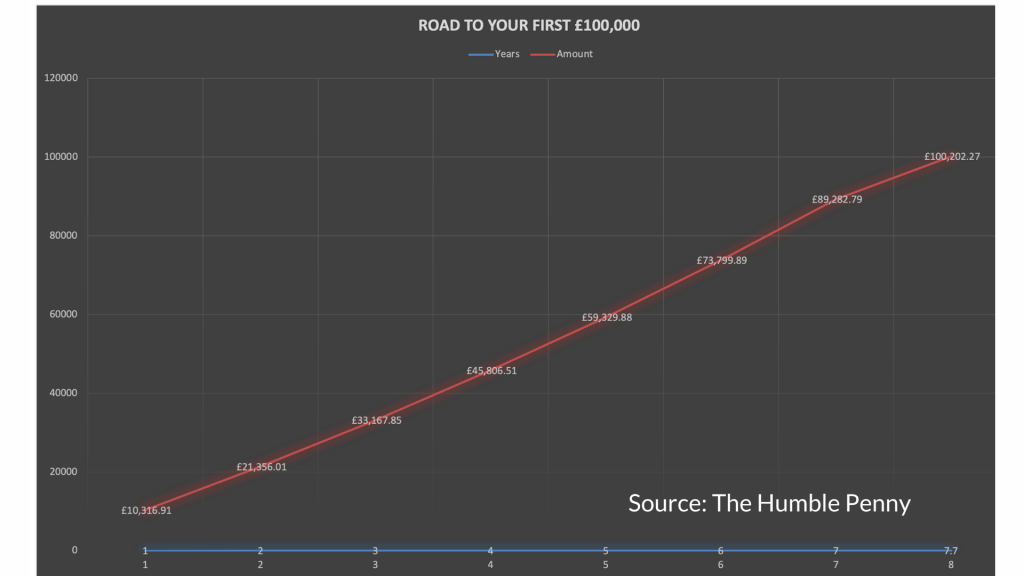
Here is what hitting that first 100k looks like for Emily:

Why Your First £100k Is The Magical Number For Reaching £1m

As you can see, it will take her around 7.7 years to reach her first 100k.

She starts with £10k and the effects of compounding then start to kick in to get her to £100k.

How Every £100k Grows Quicker

Now assuming that she carried on investing £10,000 per year, something pretty powerful happens, based on a 7% return.

I will also do another scenario with a 5% return.

What happens next is pretty remarkable.

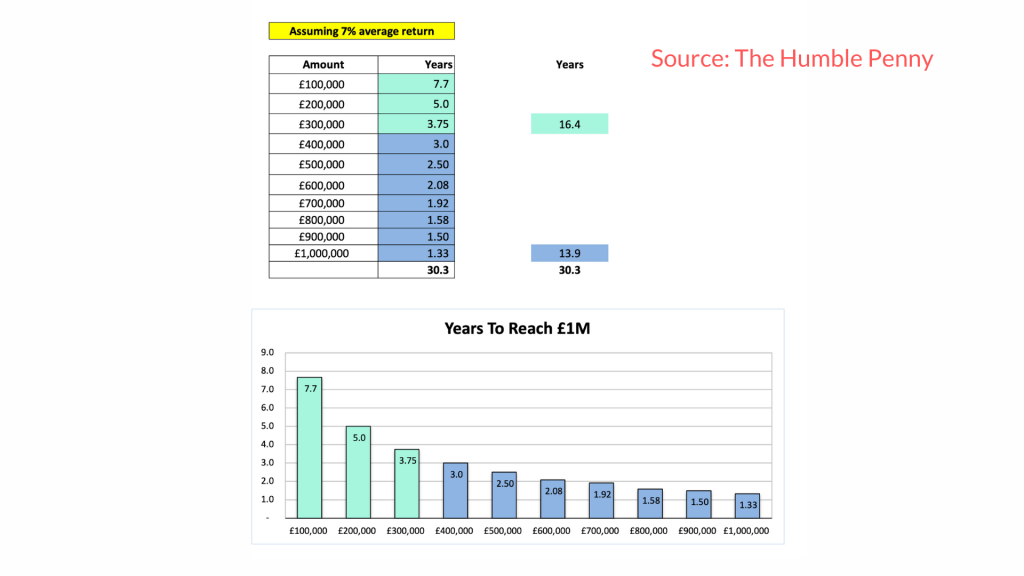
Her first 100k as we saw earlier took 7.7 years.

The next 100k if she carried on investing £10k per year will take 5 years to happen.

Then the next one will take 3.75 years to happen and so on 🤯.

It will carry on like that, notice how the years are decreasing.

The most difficult and longest period to acquire the first £100k took 7.7 years, compared to the last £100k, which would take 1.33 years giving a total of 30.3 years to reach £1m.

Here is a summary for you:

Why Your First £100k Is The Magical Number For Reaching £1m

I thought that was remarkable until I took a much closer look at the numbers to see the power of compounding at work.

Notice that the first 300k takes 16.4 years, more years than the last 700k, which takes 13.9 years to happen.

This speaks to the importance of starting to invest early and time being the asset that's required for you to create wealth.

Impact of 5% Growth on 100k

We saw above the impact of 7% growth on £100k.

In case you're thinking to yourself, “Ken, 7% seems a bit ambitious, what about a lower number, something that might seem a bit more realistic?”

By the way, I think 7% is pretty realistic if you think of the many, many years ahead of us, decades down the line.

If we look at the 5% return scenario, the pattern remains the same.

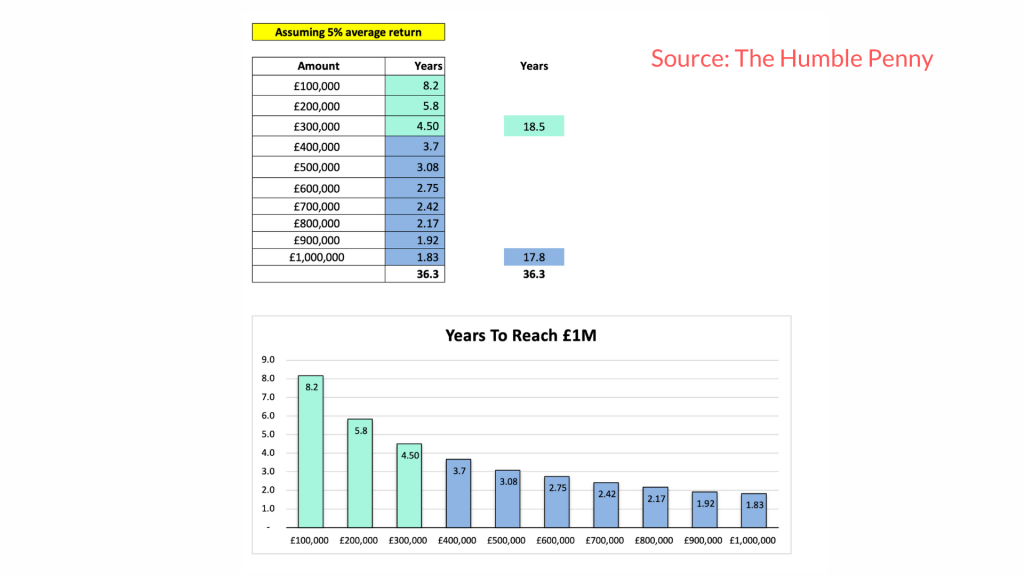
The first £100k will take 8.2 years,

The next would take 5.8 years.

Then the next 100k to get us to 300k will take 4.5 years and so on.

You can see that it carries on decreasing year after year to a very low 1.83 years to go from 900k to that 1 million pounds.

However, note that the first 300k takes 18.5 years which is more time than the remaining 700k, which takes 17.8 years to bring us to that total of 36.3 years.

Why Your First £100k Is The Magical Number For Reaching £1m

Why Your First £100k Matters So Much

I've shown you what happens once you hit that very first 100k.

You might be thinking to yourself, why does that happen? Let us unpack that right now.

1. Exponential Growth

The first reason why you see that big shift in the number of years dropping significantly every year is because of exponential growth.

This comes from compound interest.

To illustrate the power of compound interest, let's look at two scenarios.

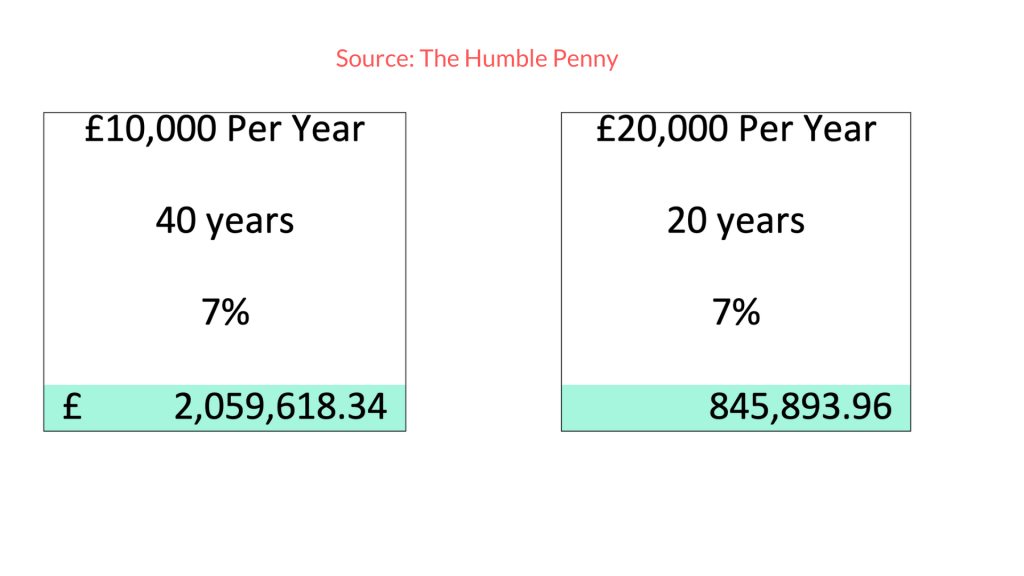
Let's say that you were saving and investing 10k a year at 7% average returns and you left that running for 40 years.

You might think to yourself that you'd get the same returns if you doubled the amount you're investing, so go from 10k per year to 20k per year.

But rather than leaving it for 40 years, you invest it for 20 years, instead.

Again, the same 7% return. Have a guess what happens from a returns perspective.

The £10k per year, over 40 years at 7% turns out to be £2,059,618.
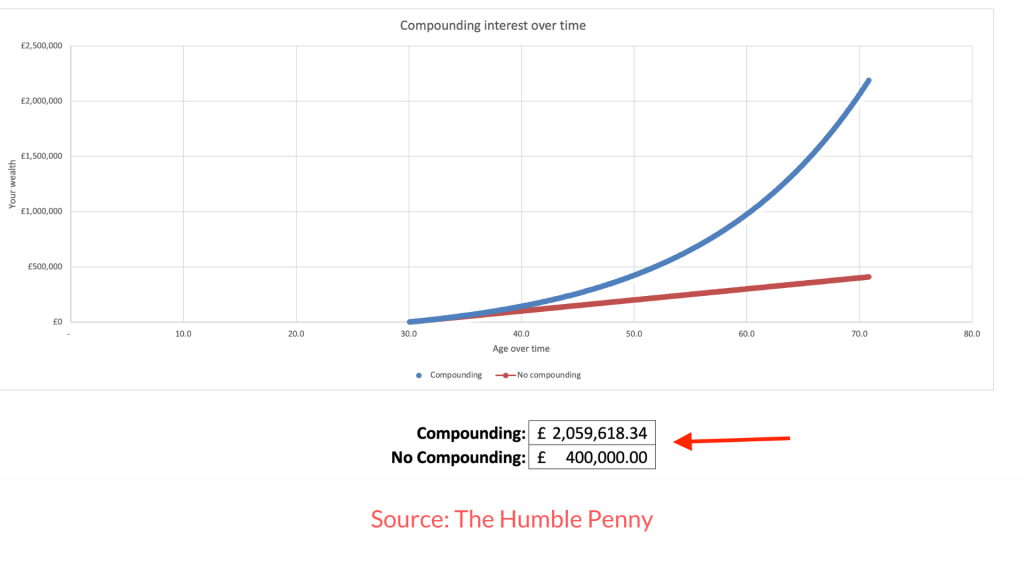

Whereas your £20k, which is twice the amount invested for half the time of 20 years at the same return of average 7% only leads to £845,893.

This tells us that the power of compounding requires time to work, the longer you leave that money invested, the more you see the power of compounding truly at work.

Just to illustrate this, I've got a chart up for you to look at:

On that chart, you can see I've got two lines there of us investing £10,000 per year 7% return over a period of 40 years.

If you left your money compounding and reinvesting your dividends, you'd end up with over £2 million as I mentioned before (see blue line).

But if you just left your money in your bank account, that money just goes on a straight line and never grows (see red line).

In fact, the purchasing power of that money is reduced by the impact of inflation.

So the beauty of compounding is actually what happens when that curve goes upwards.

It's indicating that there's a greater acceleration of your money, and you are building wealth a lot faster because money is working on money.

The second reason why every additional £100k after your first £100k takes a lot less time to achieve is that you began with a much larger portfolio size.

2. Larger Portfolio Size

This particular one explains why the rich get richer.

Take a practical example, imagine you had £100K and you invested that and generated a 7% return.

A 7% return on £100k is £7,000.

That's money you've just received as a return on your investment for doing nothing apart from having your money invested in the right environment.

And then the very next year, that £100k plus that £7k (i.e. £107k) then generates another 7% return, and so on.

A £7k addition to your original £100k is a significant amount, which itself then goes on to generate even more of a return.

So the £100k that you started with creates a snowball effect, as the years pass by subsequent £100ks are being generated faster, taking a smaller amount of time to achieve.

In summary, a combination of the exponential growth that comes from the compounding and the fact that you started with a much larger portfolio size creates that faster snowball effect.

3. Healthy Money Habits

There's a third reason that leads to you getting to this outcome.

That third reason is all the various things that you needed to have achieved first, to get to your very first £100k.

As we've explained previously, to get to that very first £100k, a number of things need to happen.

You of course need to:

  • Live below your means,
  • Budget every month,
  • Increase your income level to save and invest a significant amount on a monthly basis.
  • Minimise your lifestyle such that you are able to create a much bigger buffer to save and invest.
  • Automated your investing and live on what's left over after you have invested.

There are so many changes in your habits and your behaviours that happen as an individual.

This led to you becoming that person who gradually and painstakingly over many years gets to that point where you've saved and invested your very first 100k.

That change in your habits, behaviours, money mindset, and so on effectively built a really solid foundation.

Mental Shift To Achieve Your First £100k

You become that person who not only saves and invests £100k, one day, but you likely become that person who sees their wealth grow consistently over time 💪🏽.

That's because you have managed to maintain those money habits that you've developed in that painstaking journey to building that very first £100k.

I want to wrap up by saying that getting to your very first £100k is very difficult.

Make no mistake about it. It will take years and that's ok! it's a possibility for you if you set it as a goal.

One of the biggest reasons why a lot of people don't achieve a lot in their lives financially is because they don't set them as goals in the first place.

My hope is that I have encouraged you by giving you insight into why getting to £100k matters from a wealth-building perspective.

I want to give you hope that although it takes a long time to get to that very first 100k…

What you expect to happen after is a very clear roadmap towards building wealth, and ultimately achieving financial freedom.

Why You Should Stay Realistic

Make sure that you are keeping all your assumptions reasonable.

I looked at a 7% return and then I looked at a 5% return, for example.

With everything to do with the stock market, things never go up in a straight line, which is why these are purely illustrations.

What If Your Stocks Have Been Falling?

The beauty of investing is that we know that things go up and down.

But history has shown that over time, the stock market tends to go upwards overall.

So let that encourage you because I know there'll be people who say, actually, in the last two years, my stocks have fallen and I've actually lost money and so on.

That's because we're looking at things in a very narrow frame of time.

Think long-term when it comes to your investing. Stay diligent, consistent, and keep things automated to see your money grow over time.

And of course, don't forget the effects of inflation, which will play a role in reducing the purchasing power of your money over time.

Conclusion

Starting that investing journey gives you the best possible chance of beating inflation, and seeing your wealth grow over time 😀.

Your goal doesn't need to be £1m either.

Even if you barely have £1000 in your bank account right now, don't be discouraged.

Start by aiming to save and invest that first £1,000 followed by the next £1,000.

The key is to start and not get defeated before you've even begun.

Choose today to invest your money consistently and give yourself the best chance of achieving financial freedom sooner rather than later.

Recommended: Gain investing confidence in only 12 days

How far away are you from your first 100k? Jump in the comments and let us know.

Read More Why Your First £100k Is The Magical Number For Reaching £1m:

  • How To Become A MILLIONAIRE Investing £10 PER DAY!
  • 7 Ways To Reduce Your Tax Legally In The UK
  • 10 Tips For Smarter Investing

Watch More Why Your First £100k Is The Magical Number For Reaching £1m:

Do please share this post if you found it useful, and remember, in all things be thankful and Seek Joy.


How To Break The EMPLOYEE MINDSET and Build Wealth

July 13, 2023 by The Humble Penny 7 Comments

How to Break Out of the EMPLOYEE MINDSET and Build Wealth

The employee mindset is something that we all get trained into as we grow up.

Most people wait for payday to come once a month.

Whose idea was it that you should earn an income once a month, rather than your income coming in a few times a month or even daily? 🤔

As an employee, you wait for someone to direct you, guide you, tell you, this is the piece of work you need to do and these are your areas of responsibility, and so on.

I am not here to bash employees, because most people are employees and will remain so.

For most of my working life, I've been an employee and I enjoyed my time as an employee, even though there were many challenges that I had faced.

I've realised that being an employee, there is a mindset that a lot of people have that's holding them back from their future potential or where they might be able to get to if they adopted a slightly different mindset.

Breaking the employee mindset with these 5 steps is key to growing your money and creating a path to Financial Freedom.

Table of Contents

Toggle
  • How to Break the Employee Mindset and Build Wealth
  • Step 1. Limiting Beliefs
  • Step 2. Develop a Growth Mindset
  • Step 3. Take Calculated Risks
  • Step 4. Seek Feedback and Learn From Failures
  • Step 5. Network and Build Relationships
  • Conclusion

How to Break the Employee Mindset and Build Wealth

I thought about today's post for two reasons.

i) Employee Mindset – Being Disciplined

The first one is that a few days ago, it became three years since I moved from working in corporate to being self-employed.

It was a personal choice to start to do what I do today, creating content for The Humble Penny and Financial Joy Academy.

I've realised that in those three years, I've become a radically different person 😀.

My outlook is different, the way I approach things and the way I make decisions.

I did a Live recently on our Instagram and someone said to me: “Ken, you appear to be so disciplined.”

And I thought that was interesting and a lot of that has come from letting go of my previous employee mindset.

Employee Mindset – Location Independence

The second reason I thought about making today's post is because I spoke to a friend of mine.

Marielle and I were having a chat, and she told me, “Ken, do you know what, I'm a bit tired of living in the UK at the moment, I want to just move out, I'm going to head over to the USA.”

So she moved to the USA for a short period of time and didn't really like it, so she came back to the UK.

During another conversation, she said, “You know what, I'm going to try and move to Ghana and consider other warm countries to live in.”

Now if had she been tied to one location in her job, had she only had that typical employee mindset, she'll be restricted and not be able to go anywhere else.

So it made me realise letting go of that core employee mindset that we're all trained into, really then opens up the world.

The world feels a lot bigger, the opportunity set feels so much bigger, and you feel so much more empowered to do a lot more with your life.

how to break the employee mindset and build wealth

Step 1. Limiting Beliefs

The first thing I'd say when I look at this whole idea of breaking the employee mindset is to identify your limiting beliefs.

What are some of the limiting beliefs holding you back as an employee? 🤔. In many cases, stopping you from exploring beyond what you might be doing today.

Do you have a fear of failure?

You might be stuck in a bit of a rut at the moment at work and thinking, I've got much more potential, I might want to start my own side hustle or business.

Or I might even want to become an entrepreneur and explore different opportunities within my work environment.

A lot of people have limiting beliefs that hold them back and make them believe they're not good enough for something.

One of those limiting beliefs could be thinking that you don't have the skills or what it takes.

For example, starting a business might be considered too risky and that might be your limiting belief.

A way to turn that limiting belief on its head and reframe it is for you to realise that you've got transferable skills from your job right now.

Those are very useful skills and can be applied in other areas.

Your skills can be applied to:

  • Your passions,
  • Something new that gives you joy,
  • Using your talent and ability to create an opportunity.

A limiting belief for you could be your gender or ethnicity. You might say I am a woman, a man, black or an ethnic minority and I don't feel that I have what it takes.

I used to have some of these limiting beliefs.

When I was going into the world of personal finance, I didn't see many people who looked like me.

Someone I could point to and say “I want to listen to him, because he looks like me, or I can relate to his cultural background or his journey.”

There was nobody like that back in 2017.

I had to gradually overcome that limiting belief by seeking evidence around me for the type of outcome that I wanted in my life.

Step 2. Develop a Growth Mindset

A growth mindset is the belief that you can develop your abilities and improve over time, through hard work and dedication.

  • How are you pushing yourself outside of your comfort zone at work?
  • Are you pushing yourself to learn more or acquire new skills?
  • Using your existing skills in a completely different way?

One thing that helped me a lot from this growth mindset perspective, is putting myself in communities where other people who had the mindset I wanted existed.

In my case, it was a community of entrepreneurs.

I wanted to spend time with people who are having an impact online.

This helped me to see how they:

  • Thought about things and solved problems,
  • Approached complex situations,
  • Made money.

So putting yourself in those environments, and joining specific groups, is a gradual way for you to develop your growth mindset 😀.

Also, exposing yourself to books, in my office I am surrounded by books.

I read lots of books on different topics, things that just help me to expand my imagination.

And doing that expands my mindset from a growth perspective.

Recommended: Learn more and join our community

Step 3. Take Calculated Risks

When I worked as an employee, the mindset I had there was I did enough of what I needed to do to just get by, or to get paid.

Calculated risks put you in the driving seat of ownership.

When working for an employer, you are on their balance sheet, making mistakes on their money and budget.

However, when you take a calculated risk on your money, you've assessed the return you might get from it and the potential for failure, and so on.

Taking that calculated risk on your own money helps you to develop a different mindset, which is much superior to the typical employee mindset.

For example, start a side hustle and practice doing something else that diversifies your income.

In your place of work take steps to create value, beyond just doing what's necessary as per your contract to earn your income.

Develop the hunter instinct

I saw this with salespeople who were paid a base salary in addition to a commission.

They had a hunter instinct in that they were always out there, trying to create new opportunities or close deals.

So what you want in order to break free from the employee mindset is to ask yourself, how can I do a bit more of what a salesperson does?

You can do this without becoming a salesperson.

It's about becoming an intrapreneur, looking for opportunities and creating them in your place of work.

Step 4. Seek Feedback and Learn From Failures

A lot of people see seeking feedback as something that they're afraid of.

People think that when they seek feedback, it will hurt their feelings.

In fact, to break free from that employee mindset, seeking feedback should be seen as an asset that will help you to improve.

Feedback is an opportunity to grow by learning how you can improve in different ways.

Another way of seeking feedback is in the failures you might experience when it comes to running a side hustle.

A lot of people start stuff, it doesn't work out and then they give up, when in fact, you should see that thing you started as a way of learning.

There is no failure, everything's about learning.

See the experience of trying things out, or even failing, as a way for you to seek feedback.

Another way you can do this is to volunteer for leadership roles at work or even to seek additional responsibilities.

Again, this is a way of putting yourself in a place of responsibility.

I remember using the expression “Get your feet wet” or “Put your feet to the fire.”

Meaning you should not hide behind, instead put yourself in front.

This is what happens in the world of entrepreneurship. You are the person who has to create the opportunity, to go out there to network and build relationships.

So by taking on those bits of responsibility, you are breaking free from that core, employee mindset.

how to break the employee mindset and build wealth

Step 5. Network and Build Relationships

Networking is everything. 

Every day I wake up, I'm thinking about what relationships I can build.

  • Where can I network?
  • What opportunities can I create?

Networking and relationship building has to come from a place of love.

You have to care about the people you are trying to build relationships with and go above and beyond.

It's not just about trying to get something from people, it's about how you can sow into their lives.

Start by appreciating that you bring a great deal of value into the world.

So never feel that you do not bring a lot to the table.

Someone said to me during a live on our Instagram, that they felt intimidated when they went to do networking.

That intimidation comes from a place of lack of self-awareness because the more you are clear on who you are and what you bring to the world, the more you can approach anybody.

I feel that I can speak to anyone, whether they're a prime minister, president, manager or even somebody I just met on a bus, for example.

I can speak to them from a place of comfort because I understand who I am and what value I bring to the world.

I'd say with networking, focus on understanding who you are, first, that core self-awareness is important.

  • What value do you bring to the potential business relationship?
  • Then how can you sow into their lives and how can they sow into yours?

Practically, the way to do this is to join private members' clubs, and online communities where there are people who have a similar mindset.

So it could be focused on topics like entrepreneurship, personal finance, etc.

There are lots of communities online, find one where you feel people have a similar mindset. We have a community called Financial Joy Academy, feel free to check it out.

Go and do the research yourself and find the places you want to hang out.

I can tell you that if you make the effort to get yourself into spaces where you're networking, you will find yourself growing as an individual.

When you combine that with taking risks you will develop a growth mindset.

By challenging your limiting beliefs you find ultimately that over time, and it will take some time, you will eventually break free from that mindset that an employee typically has.

I.e. where they are waiting to be handed everything, given orders, waiting for the paycheck and so on.

Instead, you be that person creating your own opportunities.

Conclusion

I delivered this message straight from my heart.

As I said from the beginning, I'm not writing this post to tell you not to be an employee.

What I wanted to do was challenge the mindset you have.

Even if you carried on as an employee, you can take these steps to shift your mindset and create opportunities in different spheres 😊.

Realising your future potential and escaping the employee mindset will help you create a more guaranteed path to Financial Freedom.

What To Read Next Next About the EMPLOYEE MINDSET and Build Wealth

  • How To Start a Business: 10-Step Guide
  • Growth Mindset: How to Start Your Day With Purpose
  • 6 Millionaire Habits That Changed My Life

What To Watch Next Next About the EMPLOYEE MINDSET and Build Wealth 

Do you recognise signs of the employee mindset in yourself? Which of these 5 steps will you take to break that mindset? Jump in the comments and let us know.

Do please share this post if you found it useful, and remember, in all things be thankful and Seek Joy.


This Is Why You SHOULDN’T BUY A House!

July 4, 2023 by The Humble Penny 10 Comments

This Is Why You SHOULDN'T BUY A House!

If you're like us, you've probably been sold the dream that buying a house at all times and at all costs is what you need to do 😅.

Many people see renting as “dead money” and as such, will go as far as blindly buying a house at a time when property prices remain high and interest rates continue to rise.

We're big advocates for owning a house that becomes a home, provided you buy it sensibly at a price that makes sense and you have a game plan to become mortgage free fast.

Even though we love and promote the idea of homeownership, we're also fully aware that for some people, renting could be a smarter option for some people over time. 

In the current economic circumstances, it might make sense not to buy a house depending on your personal circumstances.

Table of Contents

Toggle
  • Advantages Of Buying a House
  • 1. Retirement
  • 2. Security
  • 3. Wealth 
  • Why You Should Not Buy a House
  • 1. You Can't Afford It
  • 2. You Aren't Prepared For Ongoing Maintenance
  • 3. You Want Flexibility
  • 4. You're Not Ready To Settle Down
  • 5. You're Buying a House To Get Rich
  • Conclusion

Advantages Of Buying a House

Here are some advantages of buying a house:

1. Retirement

One reason we worked hard to pay off our house in 7 years is to give us the option of never having to think about paying a mortgage at retirement.

Given most people are not saving enough for retirement, having housing costs to worry about in addition is not ideal.

2. Security

The peace and security that you have with owning your own home cannot be quantified in financial terms.

You can do as you wish. Paint and decorate it, etc. Plus, it is a great way to raise a family with stability and so on.

3. Wealth 

There is a direct link between owning a home and building wealth over time. 

If you look at the stats on Ethnicity Wealth Gaps in the UK, one of the key reasons for wealth differentials is the degree to which different ethnicities own houses.

White and Asian households have homeownership rates of over 80%, whereas, Black households typically have ownership rates of around 25% and 45% according to the ONS.

When you own a house, you build equity over time that you can release in the future by remortgaging or downsizing.

Plus, it can be passed on to the next generation.

this is why you shouldn't buy a house
We love owning a house but it ain't cheap at all! It can feel overwhelming at times but we also get a lot of joy from a place we call home for us and our children.
  • Need coaching for your finances? Book a Power Hour

Why You Should Not Buy a House

In the current climate, here are reasons why you should not buy a house.

It might be better off for you to rent and build up your savings and then reassess things as time passes.

1. You Can't Afford It

The average house price in the UK is around £286,000. A 10% deposit is £28,600, which many people struggle to raise on their own.

On top of that, you take on a phenomenal amount of debt, thanks to the high prices of the last few years.

If you earn, say, £3,000 a month and live near a major city, the least you'll pay for a mortgage is £1,000 a month.

On top of that, interest rates have hit over 6% for a 2-year fixed rate and the Bank of England is expected to raise the base rates further.

If you're buying in London, expect to pay over £500,000 for a property. Think carefully about what that means for the debt you'll take on.

Marathon Mortgages are becoming the norm now with people extending their mortgages from 25 years to 35 years or more.

Most of those people don't fully understand the implications, and in some cases, the interest over the term of their mortgages rises by over £100,000.

Then there are all the costs of buying that you'll never recover e.g. Stamp duty, legal fees, arrangement fees, etc.

If you do choose to buy a house, aim for your mortgage payments to be a maximum of 25% before any overpayments.

2. You Aren't Prepared For Ongoing Maintenance

When you rent, if your boiler breaks or the washing machine stops, you call the landlord to fix it.

If you own a home, all unforeseen costs are on you.

You not only have to create a space in your budget for these additional costs, but you also have to think about renovations.

If you own a flat, it gets even worse. You have the problem of uncontrollable service charges to think about. 

3. You Want Flexibility

When you rent a house, you have the flexibility to move for a new opportunity in a new city or country, or if costs rise too much where you are.

If you own your own house, you're usually stuck there and it is not as easy to move.

Take the example of having bad neighbours. When you own your own house, you'll have to live with that or sell or buy another house.

When you rent, you serve notice and move if you need to.

4. You're Not Ready To Settle Down

I've lived as a single person who was a homeowner and paid high-interest rates of 5.99% for 5 years.

It is very difficult to have all the costs on you and a lot of the time, you feel like you have no money left over.

Buying a house when you're ready to settle down always works out better because you can share the costs and you have the benefit of double income potentially.

Of course, if you're single and want to remain single and can afford to buy a house, go ahead. 

Otherwise, it makes sense to rent until you're ready.

5. You're Buying a House To Get Rich

Buying a residential property as a path to getting rich is not the best thing to do. It's not the right motivation for doing it.

Yes, property prices do rise over time, however, when you've factored in all the other costs, it might not be the wisest thing to do.

In addition, that house is really the bank's as it's an asset on their balance sheet until you own it outright.

For some, it will work out, but overall, property is usually a way for preserving wealth.

Conclusion

👉🏽Buying a house is a good idea if you can comfortably afford it, buy sensibly without too much debt and have a plan for mortgage freedom sooner not later 😀.

However, it is not the only game in town and you should not feel forced socially to own one or feel unsuccessful if you're not on the property ladder.

Although not perfect, it is ok to rent and in many parts of the world, it is the norm.

It also allows you to invest what you're not putting into a property and build wealth.

We need to let go of the obsession in this country to own a home at all costs and question our deep-rooted programming.

If you do manage to get on the property ladder, great! 🙌🏽

Do everything you can to resist extending the term and if anything, focus on becoming mortgage free faster because it is life-changing.

Read more on buying a house:

  • Need coaching for your finances? Book a Power Hour
  • I Wish I Knew This Before Getting a Mortgage
  • How To Buy a House In 14 Steps
  • Remortgage Explained: How To Remortgage (Step-By-Step)

Watch more on buying a house:

What are your thoughts on buying a house vs renting? Do you own a house or rent? Comment below with your experience.

 
  • « Go to Previous Page
  • Go to page 1
  • Interim pages omitted …
  • Go to page 6
  • Go to page 7
  • Go to page 8
  • Go to page 9
  • Go to page 10
  • Interim pages omitted …
  • Go to page 49
  • Go to Next Page »

Primary Sidebar

About-the-humble-penny

We are Ken and Mary Okoroafor, founders of The Humble Penny®.

Learning how to take control of our finances, grow our money and develop healthy money habits has transformed our lives since our early days as a young couple with little money having started out as immigrants. It enabled us to become mortgage-free in 7 years and also achieve Financial Independence aged 34!

Today we live purposefully to help others achieve Financial Freedom and ultimately create meaningful lives of Financial Joy.

Follow us

  • mail
  • facebook
  • twitter
  • instagram
  • youtube

Popular Posts

  • BEST SIDE HUSTLE IDEAS UK | 50 Ways to Make Extra 1000 a Month
  • 7 Guaranteed Ways On How To Make An Extra £1000 A Month (2022)
  • 12 Best Income Generating Assets for Passive Income (2022)
  • How To Prepare For a UK Recession 2022 (ACT NOW)
  • BEST VANGUARD FUNDS: ETFs and Index Funds For Financial Independence
  • How To Start An Online Business In 7-DAYS

Create a financial life you love. Subscribe via email:

Menu
  • HOME PAGE
  • About
    • About Us
  • Blog
  • Course
  • Programmes
  • Workshops
  • Free Resources
    • Free Courses
    • Start a Blog Tutorial
    • Best Resources
    • Books We Love
  • PRIVACY POLICY
  • COOKIE DISCLOSURE
  • DISCLAIMER
  • CONDITIONS OF USE
  • Contact Us
Tiktok

To help you remove money stress and achieve financial independence

logo fja

Create a financial life you love.
Subscribe via email:

Menu
  • HOME PAGE
  • About
    • About Us
  • Blog
  • Course
  • Programmes
  • Workshops
  • Free Resources
    • Free Courses
    • Start a Blog Tutorial
    • Best Resources
    • Books We Love
  • PRIVACY POLICY
  • COOKIE DISCLOSURE
  • DISCLAIMER
  • CONDITIONS OF USE
  • Contact Us
Tiktok