
• Skip to main content
  • Skip to primary sidebar
Tiktok
Work With Us
Work With Us
The Humble Penny
Menu
  • Home
  • Shop
  • Books
    • THE WEALTH HABIT
    • Financial Joy
  • Courses
    • One Grand Plus
    • Take Control Bootcamp Planner
    • Make Money Monthly With Affiliate Marketing
    • Budget For Life
    • Super Simple Investing
    • FIRE Superpower
    • Rocket Your Income
    • Value Bundle
  • Coaching
    • 121 Coaching
    • Financial Freedom Coaching
    • Financial Joy Academy (FJA) Membership
    • Architect Programme
    • Financial Joy Academy (FJA) VIP
  • Workshops
  • About
    • About Us
    • Contact
  • Blog
  • Free
    • Free Courses
    • Start a Blog Tutorial
    • Best Resources
    • Books We Love
Order Now
The Humble Penny
  • Home
  • Shop
  • Books
    • THE WEALTH HABIT
    • Financial Joy
  • Courses
    • One Grand Plus
    • Take Control Bootcamp Planner
    • Make Money Monthly With Affiliate Marketing
    • Budget For Life
    • Super Simple Investing
    • FIRE Superpower
    • Rocket Your Income
    • Value Bundle
  • Coaching
    • 121 Coaching
    • Financial Freedom Coaching
    • Financial Joy Academy (FJA) Membership
    • Architect Programme
    • Financial Joy Academy (FJA) VIP
  • Workshops
  • About
    • About Us
    • Contact
  • Blog
  • Free
    • Free Courses
    • Start a Blog Tutorial
    • Best Resources
    • Books We Love
  • Home
  • Shop
  • Books
    • THE WEALTH HABIT
    • Financial Joy
  • Courses
    • One Grand Plus
    • Take Control Bootcamp Planner
    • Make Money Monthly With Affiliate Marketing
    • Budget For Life
    • Super Simple Investing
    • FIRE Superpower
    • Rocket Your Income
    • Value Bundle
  • Coaching
    • 121 Coaching
    • Financial Freedom Coaching
    • Financial Joy Academy (FJA) Membership
    • Architect Programme
    • Financial Joy Academy (FJA) VIP
  • Workshops
  • About
    • About Us
    • Contact
  • Blog
  • Free
    • Free Courses
    • Start a Blog Tutorial
    • Best Resources
    • Books We Love
  • Home
  • Shop
  • Books
    • THE WEALTH HABIT
    • Financial Joy
  • Courses
    • One Grand Plus
    • Take Control Bootcamp Planner
    • Make Money Monthly With Affiliate Marketing
    • Budget For Life
    • Super Simple Investing
    • FIRE Superpower
    • Rocket Your Income
    • Value Bundle
  • Coaching
    • 121 Coaching
    • Financial Freedom Coaching
    • Financial Joy Academy (FJA) Membership
    • Architect Programme
    • Financial Joy Academy (FJA) VIP
  • Workshops
  • About
    • About Us
    • Contact
  • Blog
  • Free
    • Free Courses
    • Start a Blog Tutorial
    • Best Resources
    • Books We Love
Pre-order Now

7 Ways To Reduce Your Tax Legally In The UK

7 Ways To Reduce Your Tax Legally In The UK

March 22, 2023 by The Humble Penny 4 Comments

7 Ways To Reduce Your Tax legally In The UK

Have you ever wondered how much tax you actually pay?

With Personal Allowances currently frozen at £12,570 in the UK until 2028, we're all silently getting poorer 😤.

More and more people will want to keep more of their hard-earned money each month.

Paying tax is of course, important.

However, there are certain government schemes that reward you from a tax perspective when you defer gratification, save and invest more for future events like retirement, etc.

Today we're going to look at different legal ways that you can reduce your taxes in the UK.

This is not a guide on how to evade taxes because that's completely illegal.

Everything I'm sharing today are things that you can find publicly on the government's website.

7 ways to reduce your tax legally in the UK

Table of Contents

Toggle
  • 7 Ways To Reduce Your Tax Legally In The UK
  • 1. Invest More Into ISAs
  • 2. Contribute More To Pensions
  • 3. Marriage Allowance
  • 4. Salary Sacrifice
  • 5. Sharing Assets
  • 6. Gifting Assets
  • 7. Invest In Venture Capital Trusts (VCT) and Enterprise Investment Schemes (EIS)
  • 8. Move Abroad
  • Conclusion

7 Ways To Reduce Your Tax Legally In The UK

Let's look at these 7 ways to reduce your tax legally.

1. Invest More Into ISAs

Saving and investing in an ISA (Individual Savings Account) is more important now than ever before.

Investments outside of an ISA or a pension are under attack.

The capital gains tax-free allowance (currently £12,300 per year) is being cut to £6,000 in April 2023, then being cut to £3,000 in April 2024.

This means that the more of your £20,000 ISA allowance you use up, the better.

There was also recent research by the Resolution Foundation recommending that the ISA should be capped at £100,000 tax-free as a lifetime limit.

All this points to ISAs potentially coming under fire at some point in the not-too-distant future.

So you should use up as much of your ISA allowance as you can or lose it.

Everything that you save and invest into an ISA is free from tax (income tax and capital gains tax), including any gains that you generate.

If you're looking to buy your property and you're a first-time buyer (below the age of 40), then you need to be looking at investing your money into a Lifetime ISA (LISA).

This is great because not only does it give you tax-free growth, but you also get 25% bonus contributions by putting money into a Lifetime ISA.

Alternatively, you can use a LISA to save for retirement.

If you use up the £4,000 annual allowance, it still leaves you with up to £16,000 to save into other ISAs e.g. Stocks and Shares ISA.

To learn more about the pros and cons of the Lifetime ISA, see our detailed video below:

2. Contribute More To Pensions

You can either contribute to your pension as an employee or as somebody who owns a business or a bit of both.

Reduce Your Tax As An Employee

Pensions naturally attract tax relief.

So if you're a basic rate taxpayer, if you put £80 into a pension, as an example, you get £20 back again.

If you're a higher taxpayer, for example, and contribute £80, you'd get £40 back, and so on for additional rate taxpayers.

So you can see that it's definitely in your interest to put money into a pension.

You also expect to get 25% of your pension pot as a tax-free lump in the future, and then the rest gets taxed at your prevailing tax rate.

You can also contribute to a pension even if you're not working.

For anyone who has the means and who has a partner, you can put money into your partner's pension, and they will get tax relief up to £3,600 per year.

You would need to put £2,880 in and the government will top it up by £720. 

Recommended: Watch our complete guide to pensions in the UK below:

Reduce Your Tax As A Business Owner

You can now contribute up to £60,000 a year from your business or side hustle into your personal pension.

This would usually be a tax-deductible expense for your business.

The fact that you're making an income from your salary does not count towards that because you've contributed that straight from your business.

In addition to that, you can backdate your pension contributions provided a pension scheme has been in place.

You can go as far back as three years and can usually get up to £40,000 per year.

Although I'm speaking to a very small group of people who have the means with this point, I hope that having the knowledge can serve as an aspiration for others for the future.

3. Marriage Allowance

This is only relevant to those married or in a civil partnership.

There are over 2 million people in the UK right now who qualify for this marriage allowance, but who are currently not claiming it yet.

The marriage allowance allows a spouse who is not using up all their personal allowances to allocate 10% of it to their husband or wife or civil partner.

To qualify for this, you need to meet these conditions:

  • You're married or in a civil partnership,
  • You don't pay tax or you earn below the Personal Allowance, currently £12,570,
  • Your partner pays the basic rate of tax or earns below £50,270.

If you meet these conditions, you save £252 a year i.e. £12,570 x 10% = £1257.

Then, 20% of that will give you £251.40.

Although it might not sound like a lot, every little helps in the current economic climate.

4. Salary Sacrifice

This is where the government allows you to give up a portion of your salary to be spent on things such as your pension, a bike-to-work scheme, etc.

There are big advantages when it comes to using salary sacrifice, which your employer has to offer, for your pension purposes.

The first advantage is that you pay less National Insurance and so does your employer i.e. they pay less Employers' National Insurance Contributions (NIC).

Recommended: Here is a detailed video on how salary sacrifice works:

The reason why you pay less National Insurance is because you're being taxed on a lower taxable income.

When salary sacrifice your gross income, it goes straight into your pension. So the amount subject to taxes is, therefore, smaller.

That smaller gross amount is subject to taxes and results in less national insurance and tax and so on.

One of the most standout reasons for doing salary sacrifice is for those people who are earning in the middle income, for example, anyone earning just over £50k.

At that stage of income, it starts to affect your child benefit, i.e government benefits that you can claim for your children.

Example: Let's say you earn £55,000.

If you salary sacrifice £5,000 it brings you down below that £50,270 higher rate tax band.

Doing this will help you to receive the full Child Benefit, which can be worth quite a lot for families.

Example: Let's say you earn £130,000.

The other advantage to salary sacrifice is for people who are earning over £100,000, for example.

From 6th April 2023, If you're earning £125,000 and above, you'll become subject to the additional rate of tax at 45%.

By salary sacrificing some of your gross income, not only do you have more of that money going into your pensions, you also bring yourself back into the 40% tax bracket from 45%.

People who earn over £100,000, start to lose some of their personal allowances.

They lose £1 for every £2 above £100,000.

So for anybody who earns around £125,000, they lose 100% of their personal allowances.

The more you salary sacrifice some of your gross salary into a pension, the more you recover some of your personal allowances.

This is huge if you think about it.

Now I know the big restriction is that you might have gotten yourself accustomed to a particular lifestyle.

So readjusting your life such that you bring down your lifestyle a little bit, can be quite hard for some people because they are already maxing out on their lifestyles.

This is something to work out for yourself.

If you can do it, you might find that earning £99k might even be better for you compared to earning £125k.

It gets even more powerful if your employer is also matching your pension contribution. 

5. Sharing Assets

This spousal exemption means that assets that produce income, for example, can be shared between spouses without actually triggering a tax bill.

By doing this, you can max out on all your allowances. So here, I'm talking about your

  • Income tax allowances
  • Capital gains tax allowance
  • Dividends allowances
  • Savings allowances

With our personal allowances being frozen and with capital gains and dividend allowances being slashed, now is the time to make the most of these.

Have that discussion with your partner (if you have one) and max out on all your allowances.

6. Gifting Assets

The sixth way in which you can reduce your tax bill is through gifting.

Here I'm specifically speaking to inheritance tax.

There's a 7-year rule when it comes to inheritance tax.

If you gift an asset to somebody and you remain alive after 7 years of gifting that asset, that asset falls outside of what's known as your estate, for inheritance tax purposes.

You have to keep records and things like that to document that you have gifted this asset at a particular time.

But this helps massively because inheritance tax is levied at a rate of 40% on any gifts you give 3 years before death.

Note that the seven-year rule is on a sliding scale. It's on what's known as a taper relief scale.

Number of years between gift and death:

  • Less than 3 years (40% tax is paid)
  • 3 to 4 years (32% tax is paid)
  • 4 to 5 years (24% tax is paid)
  • 5 to 6 years (16% tax is paid)
  • 6 to 7 years (8% tax is paid)
  • 7 or more years (0% tax is paid)

Inheritance tax is levied on estates above the tax-free or nil rate band, which is £325,000.

This amount can also be increased to £500,000 if you're passing on a home.

There's also an annual £3000 exemption for gifts. So that's also something worth mentioning.

But there's a lot to talk about here when it comes to inheritance tax.

Recommended: Inheritance Tax: How Should You Prepare?

7. Invest In Venture Capital Trusts (VCT) and Enterprise Investment Schemes (EIS)

Venture Capital Trusts (VCTs) are companies that offer investors tax breaks, such as a 30% income tax rebate on the amount invested.

In addition, you also get tax-free dividends.

VCTs continue to be extremely popular, especially for the mass affluent i.e. those who can easily invest £20k to £30k in such investments. 

However, note that VCTs are very risky!

You also have to hold your shares for 5 years to get the full tax benefits.

If you want to invest in a VCT, I'd highly suggest focusing on a high-quality VCT with an established track record.

In addition to VCTs, you can also consider Enterprise Investment Schemes (EIS) and Seed Enterprise Investment Schemes (SEIS).

These offer up to 30% and 50% income tax reliefs respectively, as well as capital gains tax exemption.

Again, these are government-backed and offer tax breaks for investments in small, high-risk companies.

This naturally, won't be for everyone, so please do your research well before investing.

8. Move Abroad

This is a bonus point and a bit of a wildcard.

In all honesty, if I was in my 20s and had to do life again, I'd seriously consider moving abroad for a few years.

I'd do it primarily for the experience and secondly, the opportunity to build wealth more quickly.

Would you do it? Or have you done it? 🤔. Comment below.

I've got friends who have taken a leap.

They've gone to the Middle East (Dubai, Qatar), Portugal, and St Lucia, for example.

It would appear that they have more favourable tax situations going on over there, plus you don't have to move permanently.

In fact, I was on holiday once and I bumped into a couple who were both teachers in the UK.

Their game plan was to move to teach in the Middle East, raise some money, build up their deposit, and then move back to the UK and buy their own property.

With an ever more connected and digital world, it is becoming normal to work in one country and live in another.

Conclusion

Paying tax is very important as I mentioned earlier.

However, it's very important to also look after your finances and use up as many government allowances as you can because wealth building in the next few years will be harder. 

In all this, keep your eyes on your goals whilst doing what brings you joy today.

Stay positive and practical.

What To Read Next On ways To Reduce Your Tax Legally In The UK:

  • How To Invest To Beat Inflation In 2023
  • Side Hustles UK: The Complete Guide to Tax
  • Pensions Explained UK: Ultimate Guide For Beginners

What To Watch Next On ways To Reduce Your Tax Legally In The UK:

I'd love to hear from you guys in the comments. Is moving to another country as a way to start a new life, reduce your tax or build some wealth something you would consider? Comment below.

 

How Much Money Do I Need To Retire Comfortably?

March 3, 2023 by The Humble Penny 6 Comments

How Much Money Do I Need To Retire Comfortably?

Have you ever wondered how much you really need for retirement?

Today, I want to help you visualise exactly what that could look like for you depending on whether you're hoping for a Minimum, Moderate, or Comfortable lifestyle at retirement.

The goal is for you to i) become more aware, ii) understand what to do next, and iii) take action. 

Talk of retirement can get overwhelming as it's complicated and there are many things to think about.

If you need to personalise these retirement numbers to your unique circumstances, feel free to get in touch. 

How Much Money Do I Need To Retire?


Table of Contents

Toggle
  • Are You Saving Enough For Retirement?
  • The Different Types of Retirement Lifestyles
  • How Much Money Do I Need To Retire?
  • 1. How Much Money Do I Need To Retire For a Minimum Lifestyle?
  • 2. How Much Money Do I Need To Retire For a Moderate Lifestyle?
  • 3. How Much Money Do I Need To Retire For a Comfortable Lifestyle?
  • How Big Does My Retirement Pot Need To Be?
  • What If I Want To Retire At 55?
  • What About Mini Retirements?
  • What Should I Do Next About My Retirement?
  • Conclusion

Are You Saving Enough For Retirement?

Research from the Pensions and Lifetime Savings Association (PLSA) on Retirement Living Standards in 2023 identified some revealing stats about retirement.

The report found that 77% of people do not know how much they need for retirement and only 20% were confident they were saving enough.

They also found that 51% of people focus on their current needs and wants at the expense of providing for the future.

This is understandable given the rising costs of living, which even led some people who retired over the pandemic period to unretire in order to earn more.

In addition, they found that 70% of 35 to 54-year-olds, self-employed savers have less than £25,000 ($30,000) of pension savings.

That's 7 out of 10 self-employed people, which is a big deal.

One of the more encouraging stats was that 70% of people said that targets would help them save more.

So hopefully, today's post will encourage you on your journey toward preparing for retirement.

The Different Types of Retirement Lifestyles

To help us figure out how much we need for retirement, the Retirement Living Standards split things into three levels of expenditure.

  • Minimum lifestyle
  • Moderate lifestyle
  • Comfortable lifestyle

To help us understand the amount we would need to live the lifestyle that we want about retirement.

Participants in this research were essentially walked through a typical UK home to assess the right budget for different lifestyle needs.

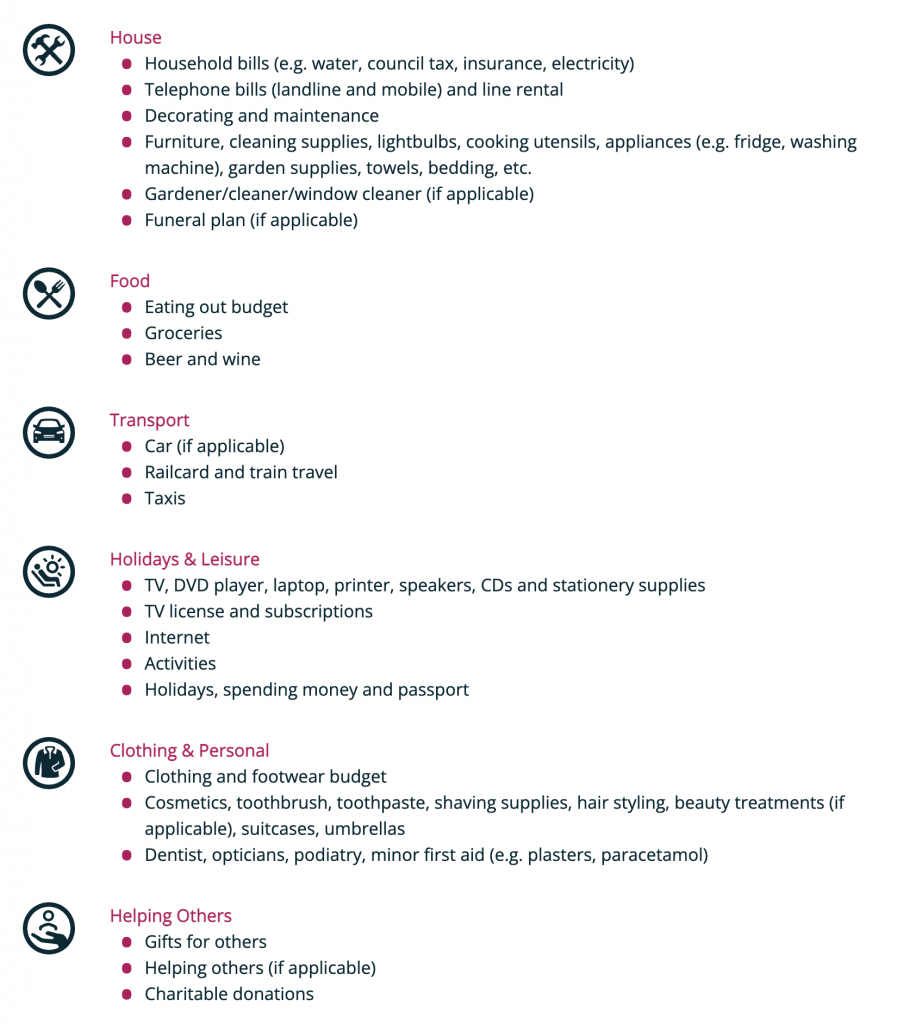
They looked at these different areas:

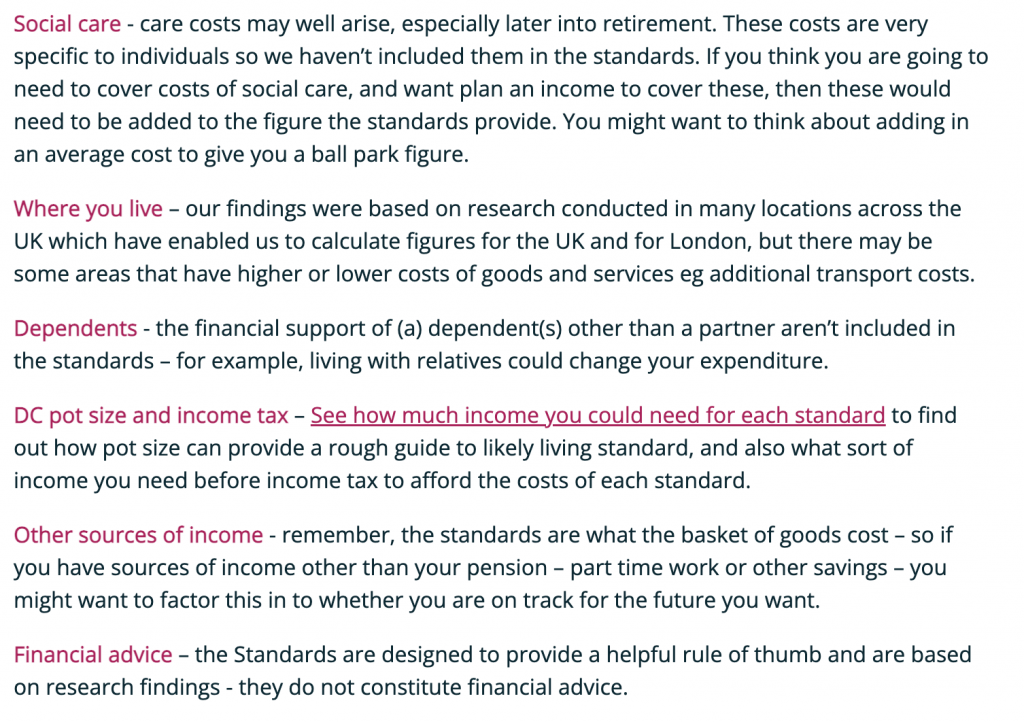
They also take into account different circumstances like living inside of London or living outside of London; and whether you are a single person or a couple.

In addition, the impact of Covid on retirement outcomes was factored in. 

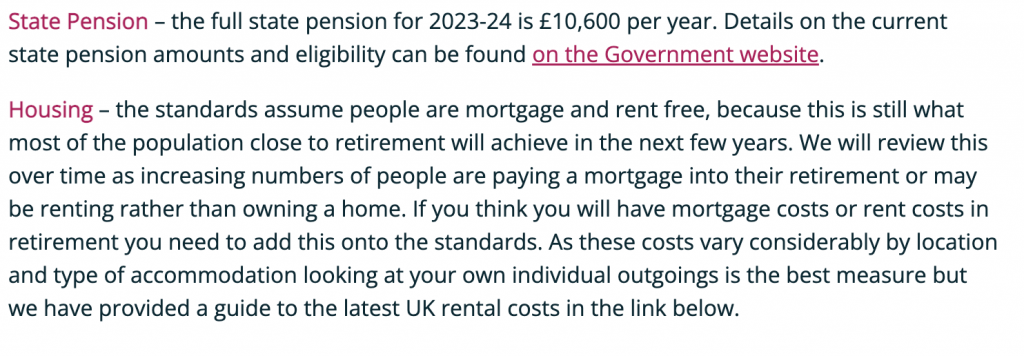
They also made some notable assumptions (pay attention to the housing assumptions):

How Much Money Do I Need To Retire?

Whilst reading the retirement numbers below, think of the different sources that your retirement income could come from:

  • Pension – Defined Benefit or Defined Contribution (taken via Drawdown or Annuity)
  • ISA – Lifetime ISA, Stocks and Shares ISA, Cash ISA, etc.
  • State Pension
  • Property
  • Business 
  • Part-time work, etc.

Here's the big reveal of the UK retirement living standards as of 2023.

How Much Money Do I Need To Retire?
We took this photo on holiday in Zanzibar and it reminded us of how we want retirement to feel.

1. How Much Money Do I Need To Retire For a Minimum Lifestyle?

A minimum lifestyle at retirement is one that covers all your basic needs with some leftovers for fun.

In addition, it's about having what you need in terms of opportunities and choices so that you can participate in society.

The key thing to note with the minimum lifestyle numbers below is that it assumes that you will still have housing costs (mortgage or rent) to pay at retirement.

Single Person

  • A single person outside of London would need an income of £12,800 per year.
  • A single person living in London will need £13,200 per year (as of 2022). 2023 TBC.

Couple In A Relationship

  • A couple outside of London would need an income of £19,900 per year.
  • A couple living in London will need £21,100 per year (as of 2022). 2023 TBC.

Being in a relationship appears to have some advantages from a cost-savings perspective.

2. How Much Money Do I Need To Retire For a Moderate Lifestyle?

A moderate lifestyle at retirement gives you more financial security, flexibility, and options to do what you would like to do.

How Much Money Do I Need To Retire?

Single Person

  • A single person outside of London would need an income of £23,300 per year.
  • A single person living in London will need £28,300 per year.

Couple In A Relationship

  • A couple outside of London would need an income of £34,000 per year.
  • A couple living in London will need £41,100 per year.

These costs factor in more money for things like alcohol, social and cultural participation, etc.

There is also a bigger gap for couples living in London vs outside of London.

3. How Much Money Do I Need To Retire For a Comfortable Lifestyle?

A comfy lifestyle at retirement includes more luxuries and financial freedom.

How Much Money Do I Need To Retire?

Single Person

  • A single person outside of London would need an income of £37,300 per year.
  • A single person living in London will need £40,900 per year.

Couple In A Relationship

  • A couple outside of London would need an income of £54,500 per year.
  • A couple living in London will need £56,500 per year.

The cost of a comfy lifestyle for a couple inside or outside London is almost the same, which came as a surprise to us.

It's worth remembering that there is no rent or mortgage included in these numbers.

This implies that if you do plan to still rent at retirement, or if you're still planning to have a mortgage, then you need to factor those additional costs into your numbers.

How Big Does My Retirement Pot Need To Be?

You might be thinking to yourself, what do the above numbers mean for me?

I want that Comfy or Moderate or Minimum lifestyle 🤔.

  • How does that goal compare to where I'm now in my retirement savings now?
  • What do I need to do next to get to that place where I have that annual income?

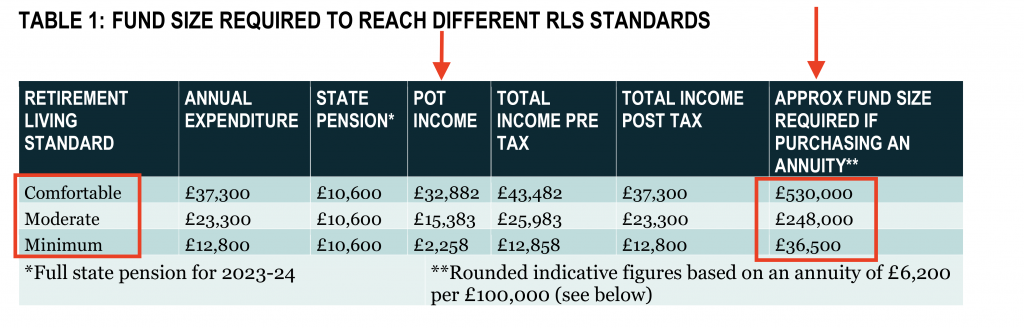
Below are the estimates according to the PLSA for how much of a pension pot you need.

Pension Pot Required For a Single-Person:

How Much Money Do I Need To Retire?

Let me explain the numbers above assuming you want a Comfortable lifestyle (for example) at retirement.

The above table is saying that:

  • A comfortable lifestyle requires an income of £37,300 (before tax).
  • To achieve this income, you need income from 2 sources – State Pension and Personal Pension.
  • Assuming you retire at age 66 and take the full state pension of £10,600 per year, you'd need an additional pre-tax income of £32,882 per year.
  • £10,600 + £32,882 = £43,382 Gross income. Once taxed, you end up with a net income of £37,300 required for a comfortable lifestyle.
  • That additional income of £32,882 needs to come from a Private/Workplace Pension pot.
  • To work backward and estimate the Pension Pot you need to create this income, they suggest using an Annuity formula. i.e. You get £6,200 for every £100,000 in a Pension Pot.
  • In order to estimate the pension pot required, the calculation is £32,882 / £6,200 x £100,000 = £530,000 (in the table above on the RHS).

You can then repeat the same process as above for the Moderate or Minimum lifestyle to see how they got £248,000 and £36,500 respectively.

The most important assumption here is that these numbers assume that you retired at 66 (State Pension age). If you plan to retire early, you'd need an even bigger pot.

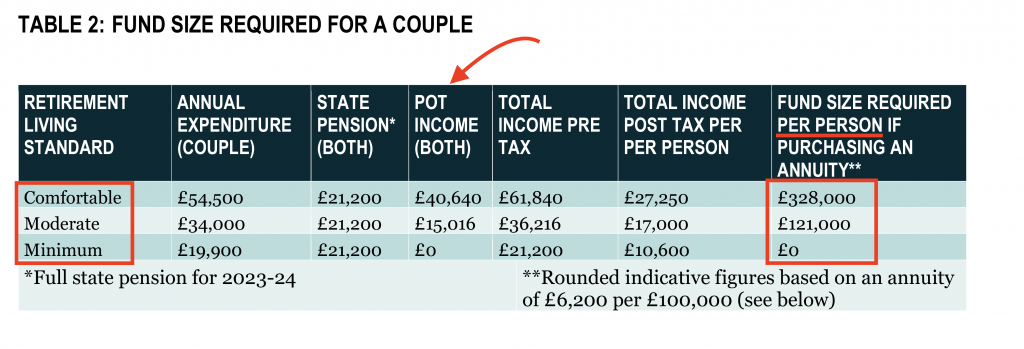
Let's now look at the pension pot size that you need for a couple below.

Pension Pot Required For a Couple:

Note that the numbers on the right-hand side are per person. i.e.

  • Comfortable lifestyle requires a pot of £656,000 (£328,000 x 2)
  • Moderate lifestyle requires a pot of £242,000 (£121,000 x 2)
  • Minimum lifestyle requires a pot of £0 (i.e. the state pension covers it)

Again, there are material advantages to being in a couple situation.

For a Moderate lifestyle, a single person needs a £248,000 pension pot, but a couple needs a total of £242,000.

You also notice this for the Minimum lifestyle where a Couple needs £0 additional funds vs £36,500 required for a Single person after taking the State Pension.

Obviously, not everyone wants to be in a relationship, however, I thought this difference is worth highlighting.

What If I Want To Retire At 55?

Everything I've shared so far can feel overwhelming.

One positive thing we've achieved so far is that you'll hopefully by now know if you need a Minimum, Moderate, or Comfortable lifestyle at retirement.

If you want to personalise this even further for yourself, this is where a Retirement Calculator comes into the picture.

You can search online for a free calculator, however, please pay very close attention to the assumptions made by the calculators.

Alternatively, get our Freedom Acceletor Retirement Calculator and watch a demo on how to use it here:

In addition, consider getting coaching from someone skilled in financial planning or book a Power Session with me.

What About Mini Retirements?

I think the future will be made up of mini-retirements, especially for Millennials and Gen Z.

Most of us want a taste of the retirement lifestyle now and don't want to wait until the age of 55 let alone 67.

For this to happen successfully, there is still an urgent need to save and invest today in order to have a decent level of financial stability.

Plus, given time is the real asset, it's important to let compounding do the heavy lifting, so the earlier you can invest, the better the future that awaits you.

Living for today whilst hoping to have a decent future in older age requires careful life design.

This can be achieved by building part-time work into your retirement plans.

Read: Should Millennials Be Planning For Retirement Beyond Age 65?

How Much Money Do I Need To Retire?
We like the idea of mini-retirements combined with work we love.

What Should I Do Next About My Retirement?

Here are some things to consider doing sooner rather than later.

1) Check your State Pension National Insurance Contributions (NIC).

Click here to check your National Insurance Record.

You typically need 35 years' worth of NIC to be eligible for the full state pension.

However, for some people, it is 30 years, and for others, even more.

Login via the link above to see how many full years you've done. 

This is important because it will determine what State Pension amount you get.

The current full state pension amount is £185.15 per week.

2) Decide On Your Retirement Goals

Here I mean, what income are you aiming for at retirement, and when?

Do you want to retire at 55? or 67? or when?

3) Work Out Your Current Pension Pot

This goes beyond just your pension pot. 

How much do you have in your other retirement savings pots? e.g. Lifetime ISA, Stocks and Shares ISA, etc.

4) Use a Retirement Calculator 

This will help you decide how much you need to be saving and investing monthly today in order to achieve your desired pension pot.

Make a reasonable assumption about what investment returns you can get e.g. 5% is a decent average to aim for.

Feel free to get our Freedom Acceletor Retirement Calculator if you prefer.

5) Start Saving and Investing More To Meet Your Goals

This will likely require a shift in your lifestyle in order to save and invest more.

However, don't get discouraged. Try to look at this as a numbers game and don't get overly emotional about it.

Conclusion

Saving and investing for retirement is complex. 

There are so many moving parts because we all have different retirement goals and lifestyles.

I hope this post has helped to make you more aware of your retirement goals.

If there is one thing to take away, it's the need to do something about this sooner rather than later. 

Don't bury your head in the sand.

It's never too late to begin. Happy retirement planning 😀.

What to read next on How Much Money Do I Need To Retire:

  • Pensions Explained UK: Ultimate Guide For Beginners
  • How to Build a £100K UK Pension Pot in 5 Years
  • Index Funds UK Explained: How To Invest For Beginners

What to watch next on How Much Money Do I Need To Retire:

How do you currently feel about your retirement savings? Are you aiming for a Minimum, Moderate, or Comfortable retirement? Jump in the comments with any questions.


How To Invest To Beat Inflation In 2023

January 11, 2023 by The Humble Penny 3 Comments

How To Invest To Beat Inflation In 2023

Wherever you look around these days, prices are going up all around us.

Whether it's the price of food, energy, child care, travel, rent, you name it.

My barber even went as far as increasing my haircut price from £20 to £30.

I don't know about you guys, but I'm feeling the heat.

The UK inflation rate at the time of writing sits at a high of 10.7% and the Bank of England is aiming to get it down to 2%.

To tackle inflation, the Bank of England has been increasing interest rates with the base rate currently at 3.5%.

They've even said that there are signs that inflation remains persistent, which means more rate rises are expected.

This has been a disaster for most people paying mortgages both for residential and investment purposes.

In short, as the purchasing power of our money decreases due to inflation, we're all getting poorer.

As investors and people building wealth to become financially independent one day, how should we invest our money to beat inflation?

Before going into that, let's first understand what inflation really is.

How to invest to beat inflation

Table of Contents

Toggle
  • What is Inflation?
  • What Drives Inflation?
  • How is Inflation Measured?
  • Why is RPI Greater Than The CPI Inflation Rate?
  • Why Does RPI vs CPI Inflation Matter For Investors?
  • How Does Inflation Keep You Poor?
  • How To Invest To Beat Inflation In 2023
  • 1. Invest In Companies That Raise Prices During Inflation
  • 2. Invest In Businesses With Low Capital Needs
  • 3. Invest In Yourself and Beat Inflation
  • 4. Invest In Property Assets
  • 5. Invest In Gold
  • 6. Index Linked Bonds
  • 7. Negotiate A Higher Salary
  • 8. Limit Your Wants
  • Conclusion

What is Inflation?

Inflation is the measure of how goods and services increase in price over time.

So for example, if you've got high inflation, it means that you can't buy as many goods and services with the money that you currently have.

In practical terms, if your salary is not rising in line with inflation, then it means that your living standard falls as a result.

Low inflation, on the other hand, means that prices are rising slowly and this is usually a good thing for customers.

The Bank of England usually aims to get inflation at a rate of around 2% as they consider this to be a low and stable target.

But at the moment, that rate of inflation is 10.7% as I mentioned earlier.

What Drives Inflation?

So there are two broad groups of things that drive inflation.

  • Goods and services.
  • The money that we use to purchase those goods and services.

So from this, we can look at demand and supply.

On one side of the spectrum you can say the increase in demand for goods and services leads to a rise in prices, therefore driving inflation.

Or we could say that a decline or decrease in his supply of goods and services, leads to higher inflation with prices increasing as a result.

We have all experienced the pandemic and gone through supply restrictions, less food on shelves, for example.

Then came the war and the massive impact that has had on the energy supply.

On top of that, there are many issues related to Brexit among many others.

Let's talk about money and the increase in the supply of money.

The Central Bank's money printing process is known as quantitative easing.

That process has been increasing the supply of money for years, creating more demand, which leads to prices going up.

How is Inflation Measured?

There are two key measures of inflation.

These are both called indexes.

There are the:

  • Consumer Price Index (CPI), and
  • Retail Price Index (RPI).

An index is a list of about 700 items, made up of things such as meat, dairy, bread, etc.

So essentially about 700 items, of which their prices go up and down every single month, creating a change from one month to another.

And that change from one month to another is tracked by the Office for National Statistics (ONS).

Therefore creating the rate of inflation either known as the CPI, which the Bank of England tracks and focuses on.

However, there's another one called the RPI, Retail Price Index, which is currently around 14% vs 10.7% CPI rate.

Let me now explain how these two differ and why they're very important to us.

Why is RPI Greater Than The CPI Inflation Rate?

The retail price index (RPI) is usually higher than the Consumer Price Index (CPI).

The core reason why the RPI is higher than the CPI is because of property costs (e.g. mortgage interest).

The consumer price index does not include property costs whereas the retail price index does include property costs.

Now, what's very interesting about these two rates is that they are attached to different types of things in the economy.

Consumer Price Index Is Linked to Government Benefits

For example, the CPI (i.e. the lower rate of 10.7%) is specifically linked to things such as:

  • State Pension
  • Housing Benefit
  • Income Support
  • Universal Credit
  • Statutory Sick Pay
  • Jobseeker's Allowance
  • Public Section Pensions
  • Statutory Maternity and Paternity Pay
  • Lifetime Allowance for Pensions

And this matters for us as savers and investors.

The powers that be link their spending and expenditure to the lower CPI rate.

i.e. when they have to pay out money for things such as a state pension and benefits, they choose the lower rate of inflation. 

But for the things where they are earning an income i.e. where an income is coming into the economy, they're linked to the higher RPI rate.

Retail Price Index Is Linked to Goods and Services

The retail price index, which at the moment is around 14%, is linked to things such as car tax, which we pay for

  • Car Tax
  • Train tickets
  • Alcohol Duty
  • Tobacco Duty
  • Interest on Student Loans (which a lot of our readers can relate to)
  • Mobile Phone Tariffs

Essentially, the things we are paying for are linked to the higher rate of the RPI.

Whereas the things where we may be getting payments from the powers that be are linked to the lower rate of the CPI.

Now, you might be asking yourself, why does all this matter?

Why should I care about between RPI and CPI? Who cares?

Why Does RPI vs CPI Inflation Matter For Investors?

The reason you should care is that if you want to protect yourself against inflation, and beat inflation, you have to ask yourself, which inflation rate should I be protecting myself against?

Even though the Bank of England aims to reduce the lower CPI rate, which at the moment is 10.7%, we should focus our efforts on that higher RPI rate.

You should make sure that you're taking the practical steps to beat that higher rate of inflation, such that you are not getting poorer every day.

This means that if you are going to your boss and negotiating a salary increase, focus on the RPI rate, where possible.

It's worth mentioning that the government announced recently in November 2020, that they are going to be overhauling the RPI rates.

In fact, what they're doing is that they're introducing a new measure of inflation known as the CPIH, which is made up of the CPI rate plus what they're calling Owner Occupiers Housing Costs.

So they're introducing a measure known as the owner-occupied housing costs with the CPI rate to create the new CPIH rate.

According to my research, this is due to come into force around February 2030.


How Does Inflation Keep You Poor?

Let's talk about how on earth inflation keeps you and me poorer every day.

1. Reduces Purchasing Power

The first way is by reducing the purchasing power of money.

Rising inflation reduces the purchasing power of your currency, whether you've got:

  • Pounds
  • Dollars
  • Euros, etc

You can buy less of what you're normally able to buy with the same amount of money.

E.g. if you went to order a coffee, where you might have been paying for example £2.50 for a coffee, you might now be paying £3.00 or £3.50.

2. Encourages Spending

The second way inflation makes us poor is that it encourages spending.

Let's say prices are going up and people go into a bit of a panic and they start to buy things in advance i.e. things that they might not ordinarily be buying.

People might want to go fill up their freezers with frozen foods because they are buying ahead of time.

We even saw this with the petrol crisis a few months ago.

In the same way, businesses might want to go away and invest in equipment that they might not ordinarily want to invest in just yet because they are trying to beat those prices going up.

3. Increases Cost of Borrowing

The third way inflation keeps us poorer is that it increases the cost of borrowing, through a process known as monetary policy.

Central banks (e.g. Bank of England, Federal Reserve, European Central Bank) try to manage inflation by adjusting interest rates.

So when inflation rises, we'd expect that interest rates might also rise in response.

This then has a negative impact on households and businesses, who have borrowed money (e.g. mortgages, business loans) as a way of getting by.

It's also worth mentioning though that inflation can reduce the cost of borrowing.

As an example, let's say you borrowed £1,000 or $2,000.

And you were paying an interest rate of about 2%.

In this scenario, the real value of your debt is decreasing a lot faster than what you're paying off in total principal and interest payments on that particular debt.

And that scenario, inflation, in a way is working in your favour.

4. Discourages Saving

Next is that it discourages savings.

Interest rates on savings accounts have been low for years although they're now increasing a little with rising base interest rates.

However, it's highly unlikely that interest rates on savings would come anywhere near exceeding the rates of inflation.

So that means that if you leave money in your bank account right now, it means that the value of that money is being eroded, in real terms.

You are getting poorer by leaving that money in your bank account.

5. Slows Down Wealth Creation

Next is that inflation slows down wealth creation and potentially delays retirement.

I mention this because you might invest your money and you might earn the odd 2%, or the odds 2.5%, without paying close enough attention to inflation.

This means your money in real terms is not working for you.

You might find that your goals might be delayed as a result of your money not working as hard for you.

i.e your money is not achieving a return that far exceeds the RPI rate of inflation.

Now, I know it's not very easy for you to earn high returns on investing your money.

But the point remains that we need to aim to invest our money in the right environments.

The level of returns you need to generate to beat inflation is worth pointing out too.

i.e. we need to consider tax depending on whether you are a high-rate taxpayer or a basic-rate taxpayer.

So for you to beat the current RPM rate of 14% of inflation, assuming you're a higher-rate taxpayer, you would need to generate a return of 23.3% on your money.

Why?

The level of returns needed is worth pointing out.

Take the number 14% and divide it by 0.6 (i.e. 60%), the net income you would get if you were paying 40% tax.

That will give you 23.3%.

Now, assuming you apply that same logic to the current CPI rate of 10.7%, as a higher-rate taxpayer, you would need to generate a return of 17.8% to beat inflation.

i.e. 10.7 divided by 0.6.

Again, if we apply that logic to a basic rate taxpayer, respectively, you'd need to generate returns of 17.5% and 13.38%, in order for you to beat inflation.

You work out 13.38% by taking 10.7%, which is the current CPI rate, and divide that by 0.8.

i.e. This is the portion of your net income you expect to get as a basic rate taxpayer who pays 20% tax.

how to invest to beat inflation

How To Invest To Beat Inflation In 2023

We've talked about problems, now let's focus on the positives.

Is it possible to beat inflation?

The mindset here is that as prices go up, we should position ourselves to own the very things that are going up in price.

We want to own productive assets, things that are generating:

  • Income
  • Rents
  • Dividends

Those are the things we want to try and focus our money to be invested in.

We may not beat inflation completely, however, any positive returns we generate helps to maintain our living standards and wealth.

1. Invest In Companies That Raise Prices During Inflation

The first way to beat inflation is to invest your money in companies that raise prices during high inflation.

I'm sure you've gotten letters from companies telling you that are raising their prices.

If a company can raise its price during a period of high inflation without losing its customers to a competitor, that company is in a very good position.

Warren Buffett once said, “the single most important decision in evaluating a business is pricing power”.

You want to try and focus on the likes of blue-chip companies.

i.e. companies that have the capacity to increase their price in a time of a rising inflation rate.

With massive stock market declines in the last 12 months, doing the research now and investing for the long term is a good idea.

Recommended: Learn to Invest and Gain Investing Confidence in Only 12 Days

2. Invest In Businesses With Low Capital Needs

The next thing you can do is invest in good businesses with low capital needs.

During times of high inflation, businesses with low capital needs who are still able to maintain their levels of earnings should perform way better.

Avoid businesses that need to invest more money into their businesses at a higher price as a result of high inflation.

This is another reason on a personal level, why we are big fans of investing in online-based businesses.

Recommended: How Andy Makes £4,596 Per Month Doing What He Loves

3. Invest In Yourself and Beat Inflation

The next way to beat inflation is to invest in yourself to be the best at what you do.

Imagine, before prices increased, that you had educated yourself, and you became a professional or an expert in a particular area.

You did it on old money, on old pounds or old dollars, i.e. before the prices started to increase.

You are then able to adjust your services accordingly, to charge higher prices, generating higher income but with costs based on old pounds or old dollars.

So investing in yourself is essentially one of the most powerful ways to maintain your purchasing power over time.

On a personal level, it was how I was able to double my income 3 times in 10 years.

Recommended: How To Start a Business UK (10-Step Guide)

4. Invest In Property Assets

The beauty of owning property is that a property can increase in value as prices increase.

In addition, the property also generates income (rent), which could also increase in price as these prices increase.

Investing in property is a great way to hedge against inflation.

But do note though, as a buy-to-let investor here in the UK, or elsewhere, if you have a mortgage on that property, with rising inflation we've also seen a rise in interest rates.

This could significantly impact the payments that you might have to make every month on your property investment.

Saying that though, at the time of writing, Halifax (among others) are forecasting at least an 8% fall in UK house prices.

This presents an opportunity for new homeowners and property investors.

That said, I've spoken to property investors in this climate and traditional Buy-To-Lets aren't working anymore.

You'd need an unusual property purchase e.g. a refurb or a House of Multiple Occupancy (HMO), etc, for it to potentially make sense.

Or invest in a popular city with a focus on a capital appreciation strategy.

Overall, it's the leverage that makes property investing worthwhile as it amplifies the returns, however, be careful.

If you don't want the hassle of being involved with physical property units and having a mortgage and things like that…

Another way to get exposure to the property market is to invest in real estate investment trusts, or REITs:


5. Invest In Gold

Gold has historically had this characteristic of being a hedge for inflation.

Fans of gold will tell you that this is what they put their money into.

But interesting though, Warren Buffett is not such a fan of Gold.

He said, “if you own one ounce of gold for an eternity, you will still own one ounce at its end”.

What he's interested in is investing his money in productive assets, assets, such as property and companies in a stock market.

But historically, gold has been known as a hedge against inflation.

Another way of investing in gold is via gold ETFs without having physical ownership of gold and having to think about storage, etc.

6. Index Linked Bonds

These are bonds that provide you with a return (interest payments) that is tied to the inflation rate.

They offer the advantage of being low-risk investments whilst also providing you with a stable income.

Examples include UK Index-linked gilts and US Treasury Inflation Protected Securities (TIPS).

A downside to index-linked funds is that they usually provide you with a lower return compared to traditional bonds and they're not as liquid.

7. Negotiate A Higher Salary

This has caused a lot of debates.

Some politicians have even said we should not ask for pay rises because it creates more inflation.

The mindset a lot of us have at a moment is the mindset of fear and trying to protect our jobs.

If you are confident about the value you bring to your employer, I'd personally ask for a raise.

Remember, focus on the RPI rate, not the CPI rates because RPI is a higher rate of inflation.

Watch the video below to help with a step-by-step process on how to get an above inflation pay rise:


8. Limit Your Wants

The final suggestion is to limit your wants.

This is something that is under everybody's control right now.

Rather than wanting more things (e.g. a lot of us want to travel and have fun), limiting some of those wants is a really good way to combat inflation.

I know this is extremely hard right now with the cost of living crisis, however, paying much closer attention to your non-value-adding costs will help a lot.

I'd suggest checking out our budget for life tool.

If you're new to budgeting or looking for a simple budget tool that's not complicated, this is for you.

Conclusion

A big shift in the way to think of inflation is to remember that each and every one of us has a different personal inflation rate given we all have different lifestyles.

Doing nothing and simply accepting inflation as a given is like buying a guaranteed ticket for a life of poverty.

Pick one or two ideas from the list above and focus on doing the work that's necessary to defeat this silent assassin that's inflation.

Every positive return that you generate from investing your time and money in the right environment makes you richer and better prepared for the future.

What To Read Next On How To Invest To Beat Inflation:

  • Should I Stop Aiming To Achieve Financial Freedom?
  • Should Millennials Be Planning for Retirement Beyond Age 65?
  • How To Prepare For a UK Recession 2023 (ACT NOW)

What To Watch Next On How To Invest To Beat Inflation:

I'd love to hear from you in the comments. Which of the ideas shared will you be exploring as a way of beating inflation? Are there other ideas you'd add to the list? Please comment below.


Financial Joy book: Download ‘Compound Interest Spreadsheet’

January 1, 2023 by The Humble Penny

Please use the form below to instantly download the free Compound Interest spreadsheet that we created for you as a bonus for reading our book, Financial Joy 😀. Enjoy!

Financial Joy book: Monthly Day-To-Day Finances Checklist

January 1, 2023 by The Humble Penny

Please use the form below to instantly download the free Monthly Master Day-To-Day Finances checklist that we created for you as a bonus for reading our book, Financial Joy 😀. Enjoy!

Financial Joy book: Download ‘Financial Joy State’ Spreadsheet

January 1, 2023 by The Humble Penny

Please use the form below to instantly download the free Financial Joy State spreadsheet that we created for you as a bonus for reading our book, Financial Joy 😀. Enjoy!

  • « Go to Previous Page
  • Go to page 1
  • Interim pages omitted …
  • Go to page 8
  • Go to page 9
  • Go to page 10
  • Go to page 11
  • Go to page 12
  • Interim pages omitted …
  • Go to page 49
  • Go to Next Page »

Primary Sidebar

About-the-humble-penny

We are Ken and Mary Okoroafor, founders of The Humble Penny®.

Learning how to take control of our finances, grow our money and develop healthy money habits has transformed our lives since our early days as a young couple with little money having started out as immigrants. It enabled us to become mortgage-free in 7 years and also achieve Financial Independence aged 34!

Today we live purposefully to help others achieve Financial Freedom and ultimately create meaningful lives of Financial Joy.

Follow us

  • mail
  • facebook
  • twitter
  • instagram
  • youtube

Popular Posts

  • BEST SIDE HUSTLE IDEAS UK | 50 Ways to Make Extra 1000 a Month
  • 7 Guaranteed Ways On How To Make An Extra £1000 A Month (2022)
  • 12 Best Income Generating Assets for Passive Income (2022)
  • How To Prepare For a UK Recession 2022 (ACT NOW)
  • BEST VANGUARD FUNDS: ETFs and Index Funds For Financial Independence
  • How To Start An Online Business In 7-DAYS

Create a financial life you love. Subscribe via email:

Menu
  • HOME PAGE
  • About
    • About Us
  • Blog
  • Course
  • Programmes
  • Workshops
  • Free Resources
    • Free Courses
    • Start a Blog Tutorial
    • Best Resources
    • Books We Love
  • PRIVACY POLICY
  • COOKIE DISCLOSURE
  • DISCLAIMER
  • CONDITIONS OF USE
  • Contact Us
Tiktok

To help you remove money stress and achieve financial independence

logo fja

Create a financial life you love.
Subscribe via email:

Menu
  • HOME PAGE
  • About
    • About Us
  • Blog
  • Course
  • Programmes
  • Workshops
  • Free Resources
    • Free Courses
    • Start a Blog Tutorial
    • Best Resources
    • Books We Love
  • PRIVACY POLICY
  • COOKIE DISCLOSURE
  • DISCLAIMER
  • CONDITIONS OF USE
  • Contact Us
Tiktok