
• Skip to main content
  • Skip to primary sidebar
Tiktok
Work With Us
Work With Us
The Humble Penny
Menu
  • Home
  • Shop
  • Books
    • THE WEALTH HABIT
    • Financial Joy
  • Courses
    • One Grand Plus
    • Take Control Bootcamp Planner
    • Make Money Monthly With Affiliate Marketing
    • Budget For Life
    • Super Simple Investing
    • FIRE Superpower
    • Rocket Your Income
    • Value Bundle
  • Coaching
    • 121 Coaching
    • Financial Freedom Coaching
    • Financial Joy Academy (FJA) Membership
    • Architect Programme
    • Financial Joy Academy (FJA) VIP
  • Workshops
  • About
    • About Us
    • Contact
  • Blog
  • Free
    • Free Courses
    • Start a Blog Tutorial
    • Best Resources
    • Books We Love
Order Now
The Humble Penny
  • Home
  • Shop
  • Books
    • THE WEALTH HABIT
    • Financial Joy
  • Courses
    • One Grand Plus
    • Take Control Bootcamp Planner
    • Make Money Monthly With Affiliate Marketing
    • Budget For Life
    • Super Simple Investing
    • FIRE Superpower
    • Rocket Your Income
    • Value Bundle
  • Coaching
    • 121 Coaching
    • Financial Freedom Coaching
    • Financial Joy Academy (FJA) Membership
    • Architect Programme
    • Financial Joy Academy (FJA) VIP
  • Workshops
  • About
    • About Us
    • Contact
  • Blog
  • Free
    • Free Courses
    • Start a Blog Tutorial
    • Best Resources
    • Books We Love
  • Home
  • Shop
  • Books
    • THE WEALTH HABIT
    • Financial Joy
  • Courses
    • One Grand Plus
    • Take Control Bootcamp Planner
    • Make Money Monthly With Affiliate Marketing
    • Budget For Life
    • Super Simple Investing
    • FIRE Superpower
    • Rocket Your Income
    • Value Bundle
  • Coaching
    • 121 Coaching
    • Financial Freedom Coaching
    • Financial Joy Academy (FJA) Membership
    • Architect Programme
    • Financial Joy Academy (FJA) VIP
  • Workshops
  • About
    • About Us
    • Contact
  • Blog
  • Free
    • Free Courses
    • Start a Blog Tutorial
    • Best Resources
    • Books We Love
  • Home
  • Shop
  • Books
    • THE WEALTH HABIT
    • Financial Joy
  • Courses
    • One Grand Plus
    • Take Control Bootcamp Planner
    • Make Money Monthly With Affiliate Marketing
    • Budget For Life
    • Super Simple Investing
    • FIRE Superpower
    • Rocket Your Income
    • Value Bundle
  • Coaching
    • 121 Coaching
    • Financial Freedom Coaching
    • Financial Joy Academy (FJA) Membership
    • Architect Programme
    • Financial Joy Academy (FJA) VIP
  • Workshops
  • About
    • About Us
    • Contact
  • Blog
  • Free
    • Free Courses
    • Start a Blog Tutorial
    • Best Resources
    • Books We Love
Pre-order Now

7 Crucial Millennial Wealth Lessons Passed Down by Baby Boomer Parents

7 Crucial Millennial Wealth Lessons Passed Down by Baby Boomer Parents

April 23, 2024 by The Humble Penny 0 Comments

What have you learned from your baby boomer parents?

The media often play millennials off against baby boomers negatively.

We see this as a lost opportunity as there are so many positive things we can learn from our parent's generation.

Sure, there are things that I'm sure you'd like to unlearn and we have those too.

Although my parents are far from perfect, today I want to share 7 crucial wealth and life lessons I've learned from them 😀.

Without these lessons, we wouldn't have achieved Financial Independence, become bestselling authors and created the many freedoms that we enjoy today and so much more.

They all began with the seeds sown by our parents and we too are passing them on to our children in our own way.

Recommended 📕: Our Sunday Times Bestselling book, Financial Joy

millennials

Table of Contents

Toggle
  • Millennial Wealth Lessons From Baby Boomer Parents
  • 1. “It Is Good To Be Enterprising” 
  • 2. “I Want Us To Buy a House” 
  • 3. “We Should Do Things Together” 
  • 4. “Don't Depend On Just Your Salary” 
  • 5. “In The Multitude of Counsellors, There Is Safety” 
  • 6. “It Is Never Too Late”
  • 7. “Always Put God First”
  • Conclusion

Millennial Wealth Lessons From Baby Boomer Parents

While you read these points, reflect on them and jump in the comments and share what you've learned from your parents.

1. “It Is Good To Be Enterprising” 

When you look up the definition of enterprising in the dictionary, it says:

good at thinking of and doing new and difficult things, especially things that will make money

Growing up, my mum always said, “It is good to be enterprising”.

Looking at my cultural heritage from the Igbo land in Nigeria, I can see why.

My ancestors were traders in pre-colonial times and my parents had to trade yams, fish, etc to survive the civil war.

Being enterprising was not just a way of being, it was a way to thrive.

👉🏽LESSON: Being enterprising (even in your job) gives you the biggest chance of economic success. 

Recommended: 6 Lessons Learned After 6 Years As An Entrepreneur

2. “I Want Us To Buy a House” 

When we emigrated to the UK in 1998, our family of 6 started life in one bedroom.

Then, with some ambition, my parents started renting a council flat from someone else.

But, they didn't want to stop there.

Even with doing 3 manual cash-in-hand jobs, Mum always insisted “I want us to buy a house 🏡”.

She laid the vision for the life that they wanted for our family.

Years later, Mum and Dad would buy their first house in a run-down part of London now served by the Elizabeth Line.

With more hard work and intention, they would build on this to become property investors and lay part of the foundation for their financial independence.

I learned a lot from watching them take leaps of faith to create financial security for our family.

👉🏽LESSON: Overcoming your life and generational challenges to own assets that rise in value with inflation can pay over time.

Recommended: Millennials, Prepare To Become The Richest Generation In History

3. “We Should Do Things Together” 

Western society is very individualistic.

My parents always saw the only way forward as doing things together 🫶🏽.

They'd frequently call long family meetings with many debates. Can you relate? 😅.

Although I didn't appreciate these meetings a lot of the time, they created a family culture of not seeing life as a journey solely on our own.

On the back of years of meetings, we now do many things together including holidays and we even invest in certain things together.

Given the life that Mary and I have created for ourselves today, I know we won't be here without their vision of unity.

👉🏽LESSON: You'll get further with others.

4. “Don't Depend On Just Your Salary” 

When I started my career, my parents would always ask, how’s it going? I’d say, it is going OK.

Their response would often:

Don’t depend on just your salary. You have to do something else.

They were right and could see what was coming.

👉🏽LESSON: Enjoy your job but gradually use your salary to build your table. Think assets.

Recommended: 50 Best Side Hustle Ideas Worth Exploring

5. “In The Multitude of Counsellors, There Is Safety” 

This is about trusting the wisdom of key people as you build wealth 💷

My parents always prioritised relationship capital.

Before making a big decision, they'd seek counsel from friends in business, lawyers, accountants, etc.

This was especially important as we navigated numerous immigration challenges over many years.

The cost of making bad decisions was expensive (especially on tight budgets), so they did everything possible to get it right although not always.

👉🏽LESSON: Prioritising relationship capital will help you navigate challenging situations e.g. work, making investments, starting a biz, etc.

6. “It Is Never Too Late”

A lot of us millennials (and Gen X) feel like it is too late for us in many ways.

If you're in that camp, I've got good news for you, it is not too late for you.

  • My parents took the leap and moved to another country to better their children.
  • They started from nothing in the UK in their mid-40s and with no money or assets.
  • And they did whatever it took, often working 3 jobs in one go.

Today, in their 60s and 70s, they're financial free.

As we share in our debut book, Mum said recently about doing manual jobs like cleaning, washing dishes, stacking shelves, etc:

I did it with joy because it would not last forever.

👉🏽LESSON: Every generation has challenges and unique advantages. Find yours and embrace it without delay. It is never too late for you.

millennials
This is me and mum 🙂

Recommended: Meet My Mum (Conversation about life, wealth, immigration, etc)

7. “Always Put God First”

This message won't be for everyone but it will be for someone.

In a world where it is difficult to talk about your faith, I've grown up with this constant message of putting God first from my parents.

It has kept me humble and is a constant reminder that I'm never alone on this journey of life.

I have an ultimate provider and protector and everything we do is to His glory.

Nothing that exists in our lives today would exist without God's provision and blessing.

Without my parents, I wouldn't have this deep spiritual dimension to my life and journey.

👉🏽LESSON: When you trust and put God first in your life, all things (beyond your imagination) are possible. My life journey tells me this is true.

Conclusion

We should not take the older generation for granted.

Although these lessons are unique to me, there is a lot we can learn from our parents' generation about work, life, values, wealth, well-being, etc.

Rather than envy previous generations, let's learn from them and apply that learning as we navigate the challenges of our generation.

Even if you don't have living parents, make the effort to spend time with people at least 10 years older than you and listen to their life examples, wins and mistakes.

👉🏽What have you learned from your baby boomer parents? 🤔. Comment below.

More to read next about building wealth as millennials, Gen Z and X:

  • 7 Ways To Build Generational Wealth
  • If You Have £5K In The Bank, Do These 5 Things
  • Should Millennials Plan For Retirement Beyond Age 65?

More to watch next about building wealth as millennials, Gen Z and X:
5 Things To Do BEFORE Interest Rates Go Down

March 23, 2024 by The Humble Penny 2 Comments

When will interest rates go down?

This is one of the most searched questions at the moment as different central banks at the moment consider when to pull the trigger to lower interest rates.

If you're currently in the wealth accumulation phase of your life, I believe that this uncertain period before interest rates start to fall presents an opportunity.

Most people will sit waiting and will pin their decisions on the rates falling, however, I believe there are certain things you should consider taking advantage of now before the interest rates fall.

Table of Contents

Toggle
  • When Will Interest Rates Go Down?
  • 5 Things To Do Before Interest Rates Go Down
  • 1. Buy Property 🏡
  • 2. Pay Off Expensive Debts 💷
  • 3. Invest in Stocks 📈
  • 4. Fixed Rate Saving 💰
  • 5. Assess Your Mortgage 📝
  • Conclusion

When Will Interest Rates Go Down?

Truth is, no one knows.

In the most recent round of votes by the Monetary Policy Committee (MPC) at the Bank of England, the MPC voted by a majority of 8–1 to maintain Bank Rate at 5.25% on the 21st March 2024.

CPI Inflation, which is a major determinant of when interest rates might go down, currently sits at 3.4%, below the expected 4%.

The BoE said that:

CPI inflation is projected to fall to slightly below the 2% target in 2024 Q2

However, their biggest concern is that they don't want inflation to remain persistently above the 2% level, so they have been “restrictive” for some time by keeping the base rate at 5.25%.

Interest rates will inevitably fall eventually and the decision makers are hinting at sooner rather than later.

We expect that the earliest it will happen will be in the second half of 2024.

Here are 5 things to do before interest rates go down to help you stay ahead on your wealth-building journey 😀

Recommended: Our bestselling book 📕, Financial Joy, is a 10-week plan to help you Banish Debt, Grow Your Money and Unlock Financial Freedom.

interest rates

5 Things To Do Before Interest Rates Go Down

These tips are not one-size-fits-all as different people have different goals and are at different stages of their money journey.

Please take from it what you can and make decisions for the long term based on what goals you’re trying to achieve for yourself.

1. Buy Property 🏡

Assuming you can afford to, waiting for interest rates to fall before you get on the property ladder is not the best time.

If you’re buying as a first-time buyer or as an investor it’s best to do so ideally well before the rates fall as you can drive a much better bargain.

For example, the people who bought in the second half of 2023 would have made the smartest moves because there was maximum chaos then.

Although interest rates were quite high, it remained a buyers' market and sellers were slashing prices in the tens of thousands to sell.

Yes, they would have borrowed at a higher rate of interest temporarily, but the amount they borrow, which compounds over time, would have been a lot less.

Plus, they stand to benefit more from property price rises in the future because they bought when prices fell.

It's not too late as interest rates have not yet started falling as at the time of writing this post.

👉🏾 Lower interest rates lead to higher demand as people start to make a move, which will drive up property prices over time.

2. Pay Off Expensive Debts 💷

Falling interest rates usually translate to lower borrowing costs, which is good for business because it drives us economic activity and boost GDP.

However, on a personal level, if you have high-interest debt, such as credit card debt or variable-rate loans, consider paying them down to save on interest expenses.

The same goes for mortgages if your rate of interest is high.

Making mortgage overpayments in this scenario also makes sense as it gives you a guaranteed return and reduces the capital element of your debt, thereby improve Loan-To-Value ahead of a remortgage.

Please make sure that you have 3 to 6 months of an emergency fund before you consider overpaying a mortgage.

Recommended: The Real Cost of 35-year Mortgages

3. Invest in Stocks 📈

As interest rates fall, the relative attractiveness of stocks compared to fixed-income investments may increase.

Investors seeking higher returns may shift their focus towards stocks, leading to increased demand for stocks and a rise in stock prices.

👉🏾 This anticipation of rates falling is partly why the S&P 500 index is currently at an all-time high.

interest rates

4. Fixed Rate Saving 💰

If you have the opportunity to lock in fixed-rate investments before interest rates fall, it may be advantageous.

Look for high-yield savings accounts or other alternative options that offer competitive rates.

According to Money Facts, the best 1-year fixed rate is currently 5.26% (this will change over time).

👉🏾 Ultimately, the goal is to get a return that exceeds inflation.

5. Assess Your Mortgage 📝

Start speaking with a broker now and assessing different rates if you’re coming up for a remortgage.

According to Money Facts, the best 2-year fixed rate is 4.69% and the 5-year fixed rate is 4.24%.

It will make sense to choose a 2 year fixed given the expected changes to interest rates.

However, what you choose will depend on your circumstances as some may prefer the security of a 5-year fixed after considering the fees and hassle of the remortgage process.

👉🏾 Ideally, aim to get a mortgage product without any overpayment caps. They’re available from high street banks (and others) via brokers.

Conclusion

Whether interest rates are falling or not, there is always an opportunity to grow or build your wealth.

Please make the decisions that work best for your current personal circumstances and long-term goals.

🟢 To help you build sustainable wealth in a tried and tested way for the future, order our debut bestselling book 📕, Financial Joy: a 10-week Plan to Help You Banish Debt, Grow Your Money and Unlock Financial Freedom


What to read next above the interest rates and the economy and cost of living:

  • 15 Ways To Improve Your Credit Score
  • I Wish I Knew This Before Getting a Mortgage
  • 5 Signs You're Living Above Your Means

What to watch next above the interest rates and the economy and cost of living:

👉🏾 Have you been waiting for interest rates to fall before making some big decisions? Comment ⬇️

Millennials: Prepare to become ‘Richest generation in history’

March 7, 2024 by The Humble Penny 0 Comments

Wealth transfer: Millennials, prepare to become ‘Richest generation in history'

Millennials are on course to become the ‘richest generation in history’ according to the Guardian due to a wealth transfer from the Baby Boomers over the next 20 years.

With so much wealth in property, pensions, ISAs, etc, there will inevitably be a wealth transfer to Millennials (Gen Z and even X) 😀.

How should you and your family prepare such that you don't give away that generational wealth in taxes?

I believe you need to parent your parents, respectfully. i.e. Get involved in the admin required for this wealth transition over time.

But you need to do it for them not you (even though you may benefit one day).

This is a sensitive topic culturally.

Plus, not everyone has a living parent or any wealth that could be inherited.

I'm sharing this to get us thinking as not every family has done estate planning.

To do this properly, someone in your family (maybe you?) needs to take responsibility for it.

On top of that, you'd need to approach this sensitively and confidentially and keep all your siblings looped in by communicating.

👉🏽 We cover Estate Planning extensively in Week 10 of our bestselling book, Financial Joy a 10-week Plan to Help you Banish Debt, Grow Your Money and Unlock Financial Freedom.

wealth transfer

Table of Contents

Toggle
  • How To Prepare For The Generational Wealth Transfer
  • 1. What do you own? And where in the world is it?
  • 2. What do you owe? And to whom?
  • 3. What are your wishes for your assets? 
  • 4. Do you have Life Insurance?
  • 5. Do you have any other insurance products? 
  • 6. Do you have a Lasting Power of Attorney (LPA)?
  • 7. Have you made any form of inheritance tax planning?
  • 8. Do I have your permission to contact relevant professionals to offer our family some advice?
  • Conclusion

How To Prepare For The Generational Wealth Transfer

Having been through this difficult but important process with our parents, here are 8 important questions to ask your parents 📝:

1. What do you own? And where in the world is it?

Document the following:

  • Asset type & value
  • Title docs
  • Address
  • Access details

2. What do you owe? And to whom?

Document as above.

You need this information so that you can work out your parents' overall net worth.

Plus, it will help you easily know who to contact and what priority of debts to focus on paying off if you ever need to do so.

3. What are your wishes for your assets? 

If they have a will, where is it stored?

If not, talk about it sensitively and keep minutes.

The key is to get this conversation going. 

Frustratingly, for a lot of people, culturally, this conversation is a taboo even though it shouldn't be.

We especially see this in our Nigerian and African culture where some parents think you're wishing them to die if you talk about writing a will.

It shouldn't be when there is a life-threatening situation that we take this seriously. 

We need to be smarter and real about this.

4. Do you have Life Insurance?

Document the following:

  • Provider name
  • Cover amount
  • Policy number
  • Access details

5. Do you have any other insurance products? 

Here I'm talking about things like pre-paid funeral plans.

We need to move beyond GoFundMe's when someone passes away 🙏🏽.

I'm reminded of a story my mentor told me about an Indian funeral that he went to.

Everyone was celebrating and that's because the parents of the children got their act together and prepared for the inevitable.

In fact, the two children in their 30s and 40s were able to retire early because their parents had positioned them to inherit their wealth properly.

An alternative to pre-paid funeral plans is for siblings to save into a joint account monthly.

Even £20 – £50 a month saved between siblings will go very far.

Last year, I sadly had to organise a funeral for a family member and it cost around £15,000.

I learned so much from this experience of trying to negotiate with so many people in the family to get this money organised. 

Such costs will only get more expensive over time and the last thing you and your family want to do is face the stress of no money whilst dealing with the emotional turmoil of losing a loved one.

6. Do you have a Lasting Power of Attorney (LPA)?

Here I'm talking about an LPA for ‘Health and Welfare' or ‘Property and Financial Affairs'.

If they don’t have this in place, click here to start on the government website.

This takes months so don't delay!

7. Have you made any form of inheritance tax planning?

i.e. gifted assets to anyone?

The 7-year rule, for example, is important for reducing inheritance tax liability.

There are also other forms of inheritance tax and gifting rules that you may need to be aware of.

With careful planning, your parents could reduce or completely remove any future potential inheritance liability.

8. Do I have your permission to contact relevant professionals to offer our family some advice?

Seek out resources to help your family get organised.

You may need tailored financial advice

Read week 10 of our book where we've summarised and arranged everything for you practically with action steps.

Conclusion

These conversations can feel uncomfortable BUT talking about it and preparing for the inevitable will give your parents (and you) a lot of peace of mind and preserve family wealth.

A huge part of building and keeping wealth is doing admin.

There is always a cost to delay with these topics, so taking small steps to get things in order for the future will pay off.

Even if you did one thing on this list, it is progress.

One big point to consider is that there will be a future of higher care costs for some of our parents, so it will be interesting to see how this plays out.

Either way, please act now not later.

Read more about the generational wealth transfer to millennials:

  • Order our debut book, Financial Joy
  • Guardian article about the wealth transfer
  • 5 Signs You'll Become Wealthy 10 Years From Now

Watch this video about the generational wealth transfer to millennials:

Have any of these topics come up in your family conversations yet? Comment below and share 🙂

10 Budget-Friendly Best Places To Retire In The World

February 27, 2024 by The Humble Penny 12 Comments

10 best places to retire in the world on a budget.

Would you like to retire one day to a warmer climate during the winter months?

Today, we have a special topic that resonates with many of us – finding the ideal place to retire comfortably on a budget one day.

Whether you're from the UK, the US or anywhere else in the world, this post is for you.

We'll be exploring 10 amazing locations, considering factors such as:

  • cost of living,
  • weather,
  • healthcare,
  • housing,
  • safety, and
  • overall quality of life.

This is after we asked our audience in a poll what most important to them if they retired outside the UK:

We’ll be counting down from Number 10 to Number 1, so make sure you read on and don't miss number 1 on the list as it really surprised us.

Need to plan for a comfortable retirement? 😀

👉🏽Read our bestselling book, Financial Joy, a 10-week plan to help you banish debt, grow your money and unlock Financial Freedom.

best places in the world to retire

Table of Contents

Toggle
  • 10 Best Places To Retire In The World
  • Location 10: Algarve, Portugal
  • Location 9: Accra, Ghana
  • Location 8: Chiang Mai, Thailand
  • Location 7: Medellin, Colombia
  • Location 6: St George’s, Grenada
  • Location 5: Kigali, Rwanda
  • Location 4: Penang, Malaysia
  • Location 3: San José, Costa Rica
  • Location 2: Valletta, Malta
  • Location 1: Valencia, Spain
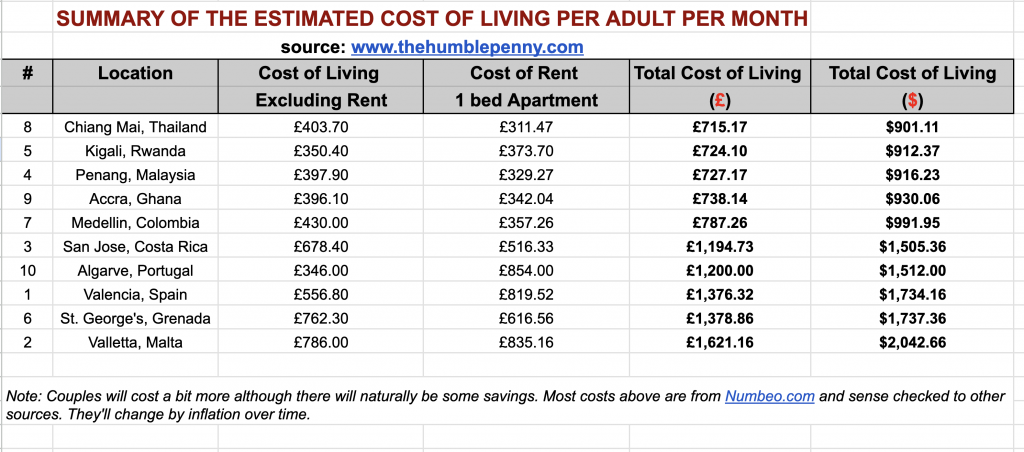
  • Cost of Living Summary For The Best Places To Retire In The World
  • Conclusion

10 Best Places To Retire In The World

To get this topic going, jump into the comments right now and tell us, where in the world you would like to retire.

Here are some assumptions we made for this post:

For cost of living numbers, we’ll use London as a base and for all our locations, we’ll work out the cost of living relative to London.

We will assume that when you are retired, for easy access to various amenities, you will be living without children in a 1-bedroom apartment inside the Centre for all locations we’ll look at to keep things reasonable.

Here is the estimated cost of living in London at the moment according to Numbeo.

These numbers will change in the future due to inflation.

  • A single person's estimated monthly costs are £1,086.7 ($1,369.24) without rent.
  • An apartment (1 bedroom) in City Centre costs £2,210.64 ($2,785.41) per month
  • This brings the estimated total cost to £3,297.34 ($4,154.65)

For a couple, you’ll have a bit more in terms of costs but not too much more as there will be many savings due to shared costs.

Here are the top 10 best places to retire in the world:

Location 10: Algarve, Portugal

The Algarve is a great place to retire with more than 300 days of sunshine.

It has beautiful beaches and a laid-back culture that makes it a popular place to move to.

The cost of living in the Algarve is also affordable, particularly when it comes to food and drink.

Portimão and Faro are the two largest cities on the Algarve.

Faro is the prettier of the two with more to offer Tourists.

best places in the world to retire

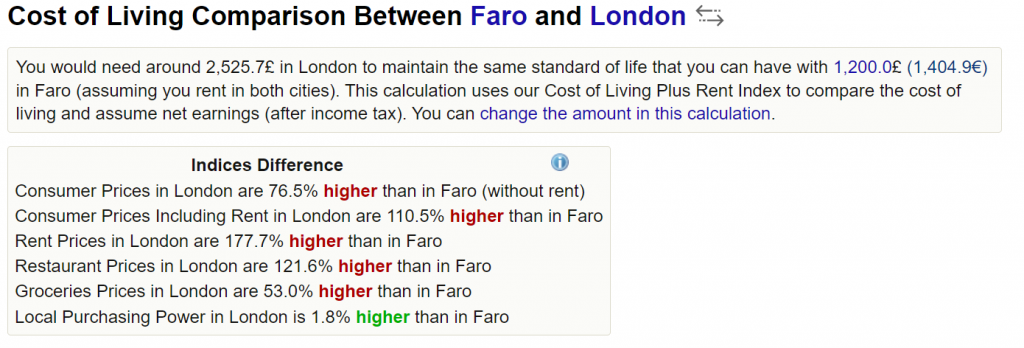
In terms of cost of living:

  • An apartment (1 bedroom) in City Centre on average would cost around £854 ($1076) but it could be higher or lower.
  • Overall, it is possible to live in the Algarve for between £900 ($1,134) – £1,200 ($1,512) per month for a single person.
  • It will be a bit more for a couple.

Here is how the cost of living in the Algarve compares to London:

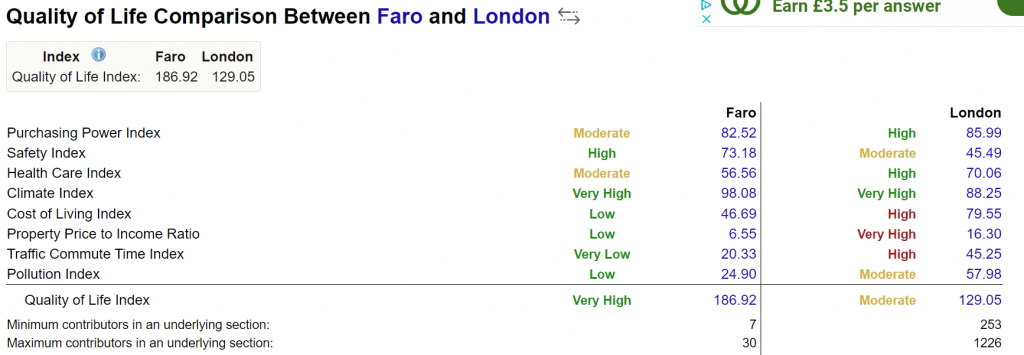
In terms of Quality of Life (higher is better) here is the ideal for all locations:

  • Purchasing Power Index (higher is better)
  • Pollution Index (lower is better)
  • House Price to Income Ratio (lower is better)
  • Cost of Living Index (lower is better)
  • Safety Index (higher is better)
  • Health Care Index (higher is better)
  • Traffic Commute Time Index (lower is better)
  • Climate Index (higher is better)

Now, here is the Quality of Life Index for Algarve compared to London:

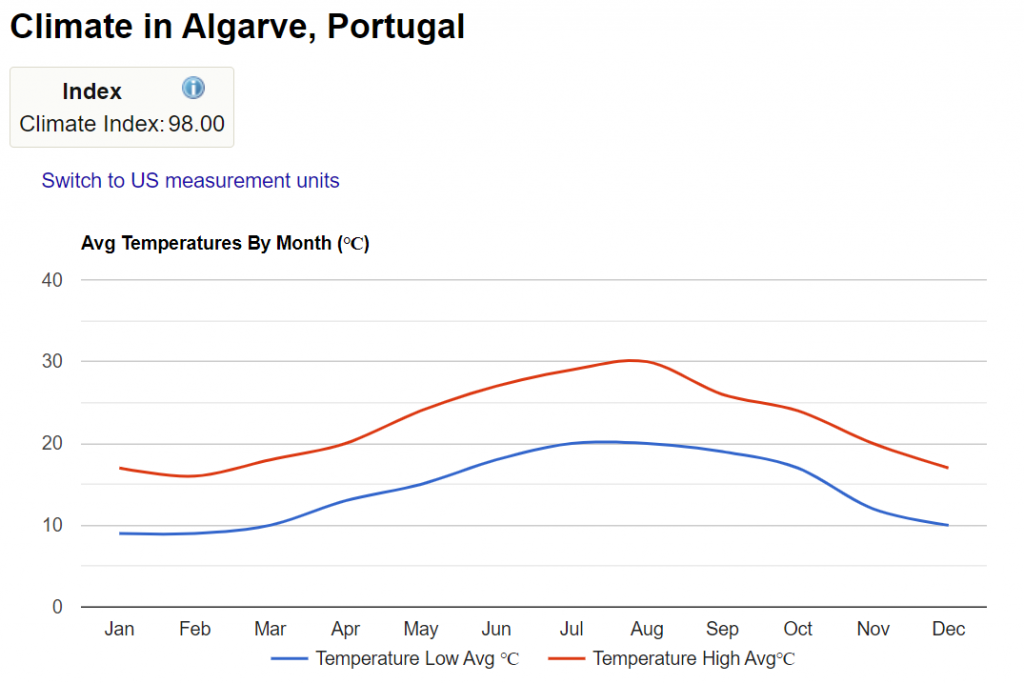
Here is what the weather looks like throughout the year:


What we think of Algarve, Portugal:

  • We loved it when we visited and the people were nice.
  • The weather is decent in those important Winter months and the beaches are stunning.
  • Overall, we can see ourselves living here.


Location 9: Accra, Ghana

Accra, Ghana, offers retirees a vibrant cultural experience, affordability, and a tropical climate.

With a rich history and diverse traditions, the city's low cost of living and developing infrastructure provide a comfortable retirement.

The multicultural environment, English language, and stunning landscapes make Accra an increasingly popular choice for a fulfilling retirement in West Africa.

Here is what the cost of living looks like in Accra, Ghana:

  • A single person's estimated monthly costs are £396.1 ($499) without rent.
  • An apartment (1 bedroom) in City Centre is £342.04 per month
  • The total cost of living in Accra for a single person is £738.14 ($930) per month. It will be a bit more for a couple.

Here is how the cost of living in Accra compares to London:

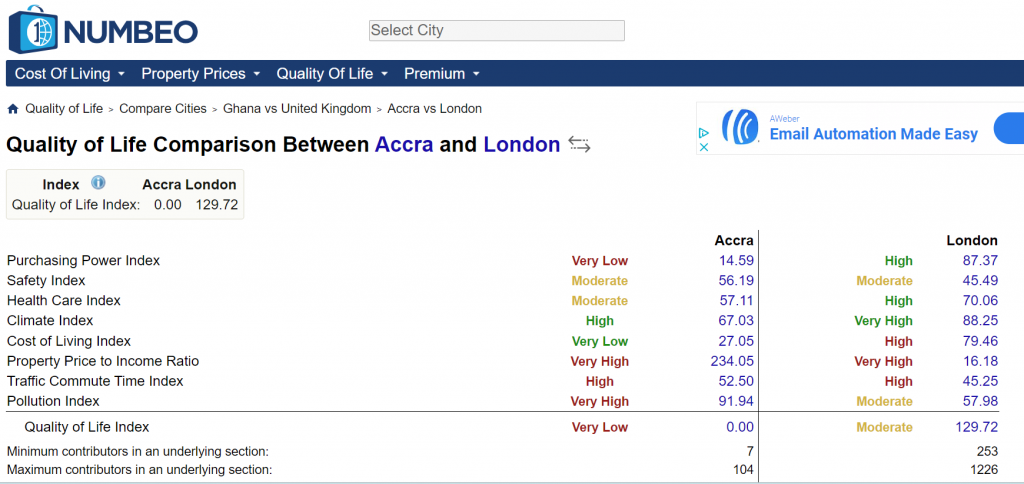
Now, here is the Quality of Life index for Ghana


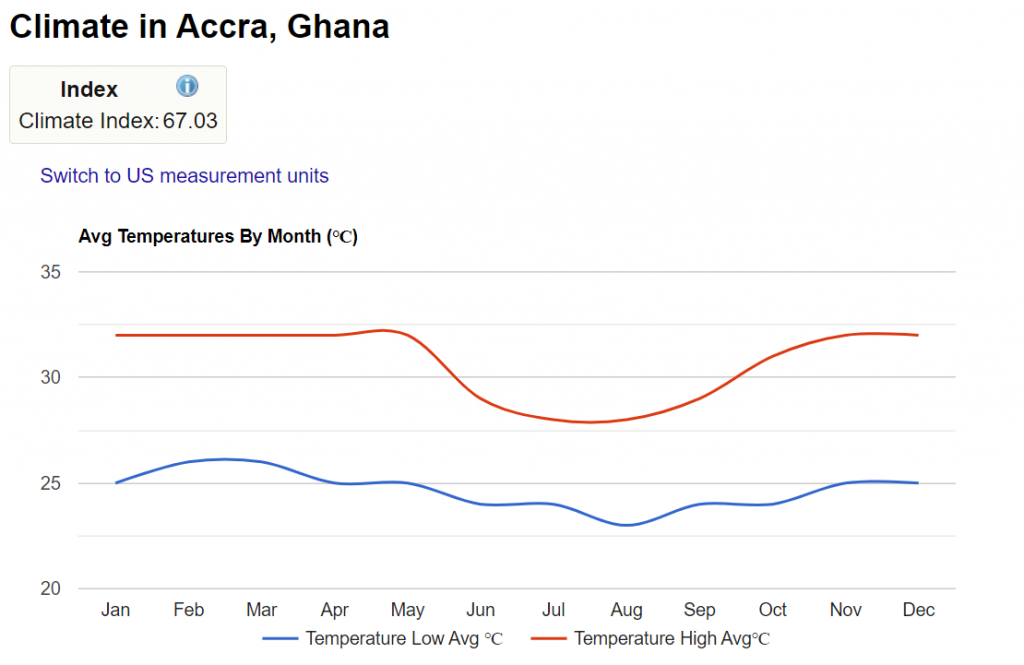
Here is what the weather looks like throughout the year in Accra, Ghana:


What we think of Accra, Ghana:

  • Having been to Accra, Ghana ourselves, the key observation is that the safety, climate, culture and people are the biggest attractions.
  • It is cheaper but getting more expensive as it gains global attention.
  • The point on pollution above is important though because this points to potential future health issues. However, this pollution is not everywhere.


Location 8: Chiang Mai, Thailand

Chiang Mai, Thailand, stands out as an alluring retirement destination with its rich cultural tapestry, affordability, and pleasant climate.

Retirees can immerse themselves in Thai traditions, benefit from a low cost of living, and enjoy the city's vibrant expatriate community.

The combination of cultural charm, economic advantages, and a welcoming atmosphere makes Chiang Mai an increasingly popular choice for a fulfilling retirement in Southeast Asia.

Here is the summary of the cost of living in Chiang Mai, Thailand:

  • A single person's estimated monthly costs are £403.7 ($508.67) without rent.
  • An apartment (1 bedroom) in City Centre is £311.47 ($392.45) per month
  • The total cost of living in Chiang Mai for a single person is £715 ($901) per month. It will be a bit more for a couple.


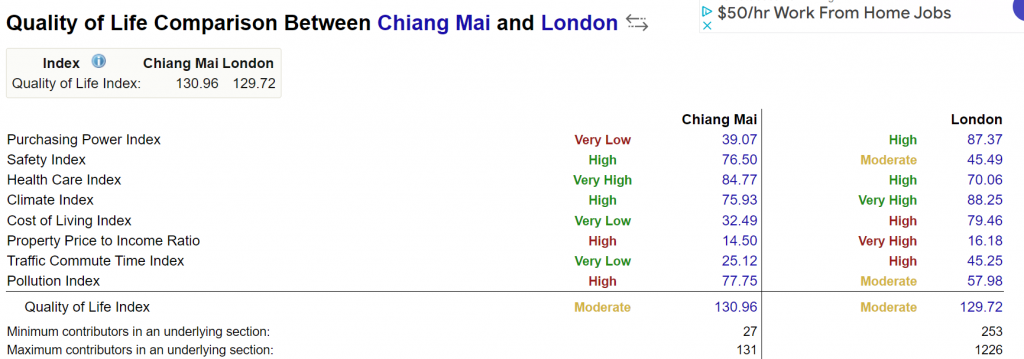
Here is the Quality of Life Index for Chiang Mai vs London:


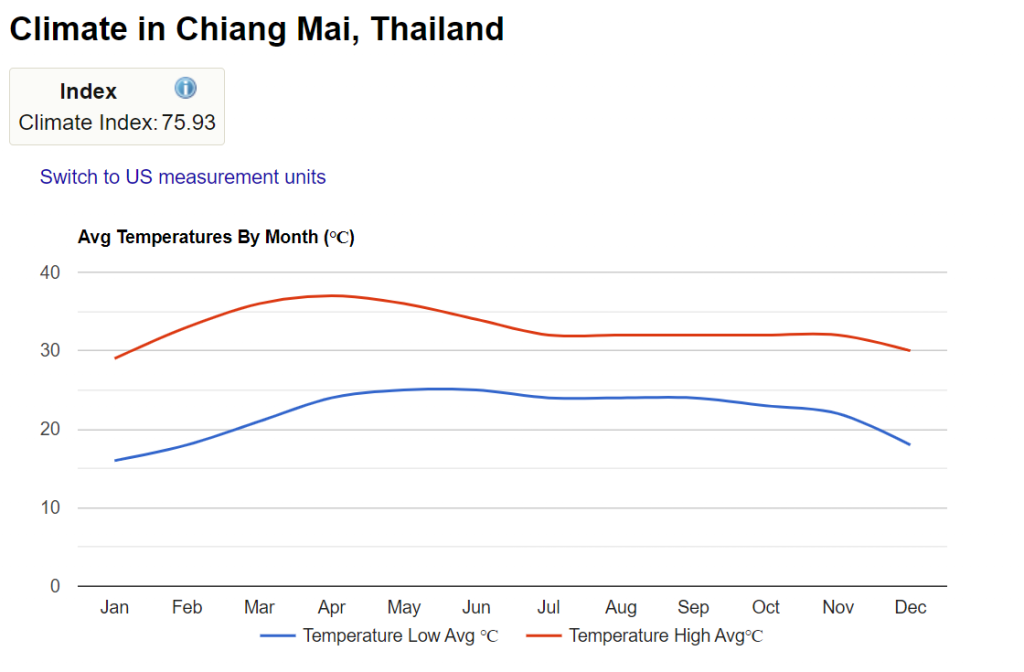
Also, here is what the weather looks like throughout the year:

What we think of Chiang Mai, Thailand:

  • Our family members have visited and enjoyed it.
  • It seems pretty out of this world from what we're used to already.
  • I think you'd need to be pretty open-minded to move and live here as there will be a huge cultural difference.


Location 7: Medellin, Colombia

Medellin, Colombia, stands as a dynamic and alluring retirement destination, celebrated for its pleasant climate, innovative urban transformation, and warm hospitality.

Nestled in a picturesque valley surrounded by lush mountains, Medellin offers retirees a comfortable and temperate environment.

The city's commitment to sustainability and social development is evident through its efficient metro system, cable cars, and vibrant public spaces.

Retirees can explore the cultural richness in the city's museums, enjoy lively street art, and savour the Colombian coffee culture.

With its resilient spirit and a burgeoning expatriate community, Medellin provides a unique and culturally vibrant setting for a fulfilling retirement experience in South America.

best places in the world to retire


Here is the cost of living in Medellin, Colombia:

  • A single person's estimated monthly costs are £430.0 ($542) without rent.
  • An apartment (1 bedroom) in City Centre costs £357.26 ($450)
  • This brings the total cost of living for a single person to £787.26 ($992). It will be a bit more for a couple.

Now, here is how the cost of living in Medellin compares to London:


Let's look at what the weather in Medellin looks like:


What we think of Medellin, Colombia:

  • We spent 10 days in Bogota, Colombia and it was very safe and friendly and we were received well.
  • It's likely to be the same as Medellin – very sunny, mountainous and cheap.
  • Overall, although it is far from the UK, the cheap cost of living, food, weather and culture make it an attractive option although far from perfect.
  • Oh, don't worry about the Medellin Cartel either. It was disbanded in the 90s.


Location 6: St George’s, Grenada

St. George's, Grenada, is an enchanting retirement destination boasting a blend of Caribbean charm, affordability, and a tropical climate.

Retirees can embrace the island's rich culture, benefit from a relatively low cost of living, and enjoy the stunning coastal landscapes.

With its welcoming community and relaxed atmosphere, St. George's offers an appealing option for a serene and fulfilling retirement in the Caribbean.

In terms of cost of living:

  • A single person's estimated monthly costs are £762.3 ($960) without rent.
  • An apartment (1 bedroom) in City Centre will cost around £616.56 ($777) per month
  • This brings the total cost of living for a single person to £1,378.86 ($1,737). It will be a bit more for a couple.

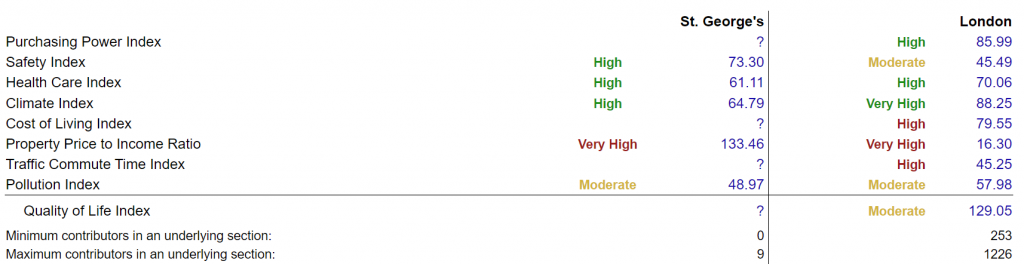
In terms of quality of life in St Georges, Grenada compared to London:

It is clear that the only metric that's holding Grenada back relative to London is the property price to income ratio.

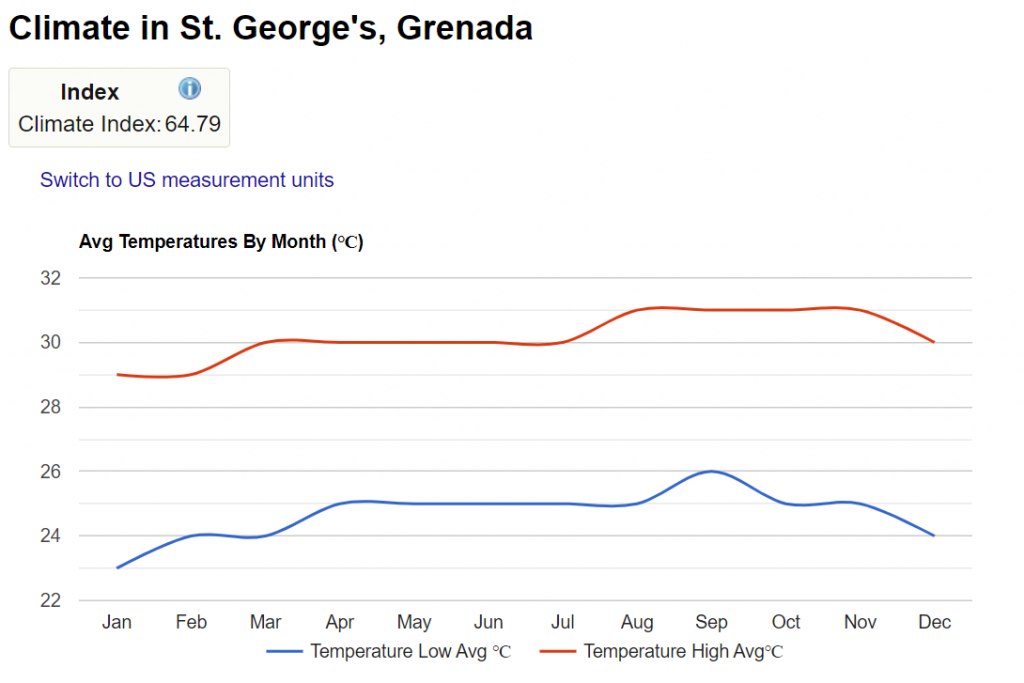
Here is what the weather looks like:


What we think of St Georges, Grenada:

  • We visited in February 2014 and absolutely loved it. It's a hidden gem.
  • Grenada is not as touristy as the other Caribbean islands. 
  • It is calmer, the people are friendly, but the cost of living is higher than a lot of other destinations we've looked at.


Location 5: Kigali, Rwanda

Kigali, Rwanda, emerges as a compelling retirement destination, characterised by its remarkable economic growth, political stability, and captivating landscapes.

Nestled in the heart of East Africa, Kigali boasts a temperate climate, making it an inviting setting for retirees.

The city's clean and organised urban design, vibrant markets, and friendly locals contribute to a welcoming atmosphere.

Retirees can engage in Rwanda's rich cultural heritage, explore the lush hills surrounding the city, and appreciate the nation's commitment to environmental sustainability.

With affordable living costs, a focus on security, and a unique blend of traditional and modern influences, Kigali offers a distinctive and promising retirement experience in the heart of Africa.

best places in the world to retire


In terms of cost of living:

  • A single person's estimated monthly costs are £350.4 ($441.5) without rent.
  • An apartment (1 bedroom) in City Centre costs around £373.70 ($471) per month on average.
  • This brings the total cost of living for a single person to £724.1 ($912.4) per month. It will be a bit more for a couple.

Here is how the cost of living in Kigali, Rwanda compares to London:


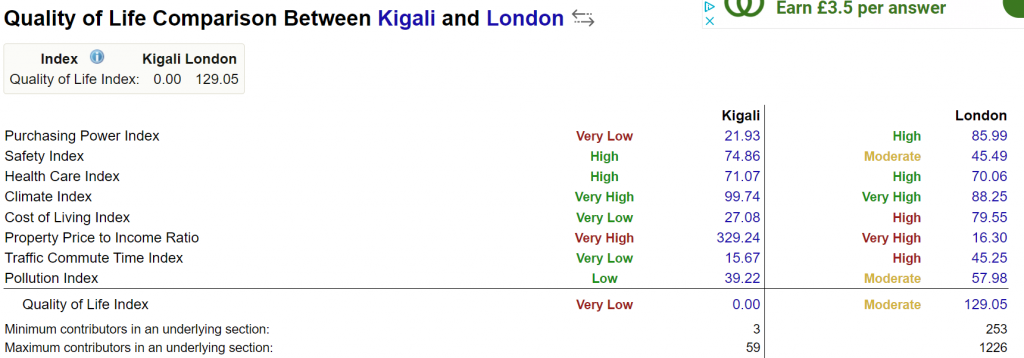
Now, here is the Quality of Life Index for Kigali – please look at the categories individually (not the total for this one):

Although the property price-to-income ratio is exceptionally high locally, your £ or $ may give you an advantage.

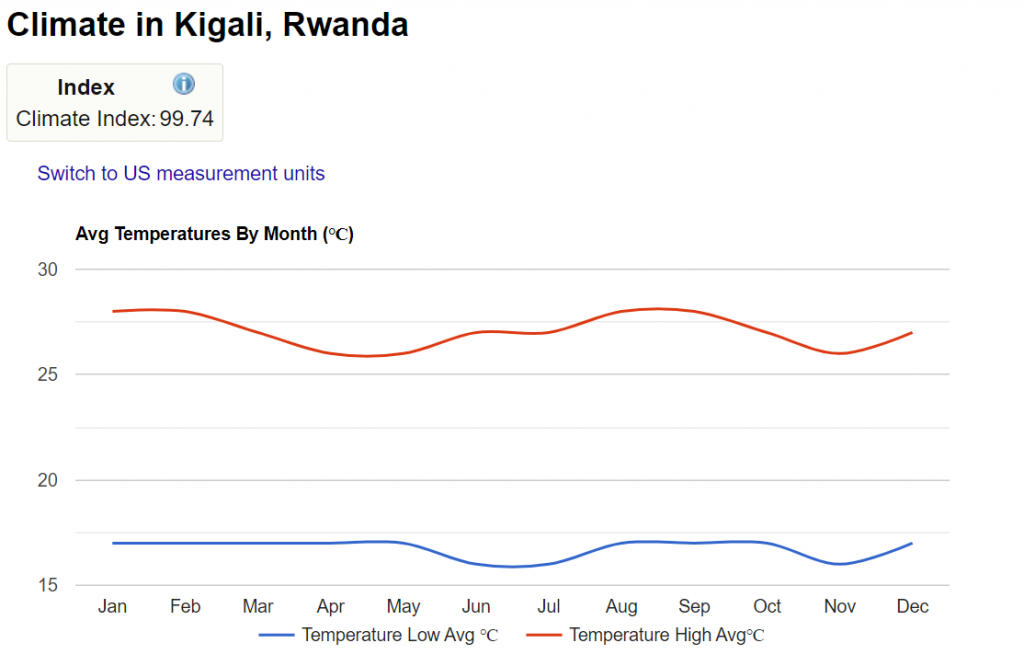
Here is what the weather looks like:


What we think of Kigali, Rwanda:

  • When I think of Rwanda, I think of Hotel Rwanda and the UK's not-so-desirable immigration policy.
  • However, Rwanda is an African nation to be proud of. One of order and inspiring progress.
  • Our research shows that Kigali is very safe, clean, welcoming, warm and affordable. It is a big contender for us.

best places to retire in the world


Location 4: Penang, Malaysia

Penang, Malaysia, emerges as an enticing retirement haven, boasting a harmonious fusion of diverse cultures, affordability, and a tropical setting.

Renowned for its UNESCO-listed George Town, retirees can explore the city's vibrant street art and savour a culinary tapestry reflecting Malay, Chinese, and Indian influences.

The city's strategic location in the Strait of Malacca, coupled with its historical charm, provides retirees with a unique blend of old-world charm and modern amenities, making Penang a culturally rich and captivating choice for a fulfilling retirement in Southeast Asia.


In terms of cost of living:

  • A single person's estimated monthly costs are £397.9 (£501.35) without rent.
  • An apartment (1 bedroom) in City Centre will cost around £329.27 ($414.88) per month
  • This brings the total cost of living for a single person to £727.17 ($916.23) per month. It will be a bit more for a couple.


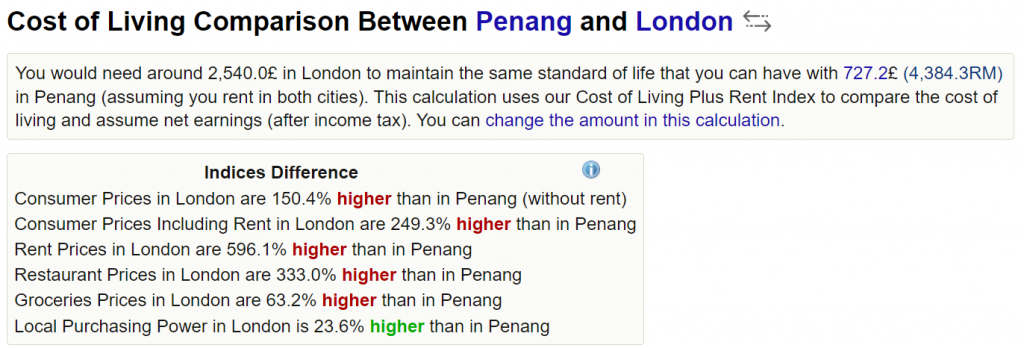
Here is how the cost of living in Penang compares to London:


Here is the quality of life summary and comparison to London:

It's amazing to see how much more quality of life Penang offers compared to London.

Here is what the weather looks like:

Here is what we think of Penang, Malaysia:

  • We've been to Kuala Lumpur, Malaysia, and the initial treatment we received as people with Nigerian heritage by the taxi driver was not too warm.
  • However, this does not mean that Penang is not friendly. Have you been?
  • Overall, Penang appears to offer a much better quality of life than London, however, we'd say you should check the local attitudes to people from other ethnicities.


Location 3: San José, Costa Rica

San José, Costa Rica, emerges as an enticing retirement destination, celebrated for its harmonious blend of tropical beauty, a laid-back Pura Vida lifestyle, and a stable economic environment.

Nestled in the heart of Central America, San José offers retirees diverse climates, from the sun-kissed beaches of the Pacific and Caribbean coasts to the temperate highlands.

The country's commitment to conservation is evident in its lush rainforests, national parks, and abundant biodiversity.

Retirees can immerse themselves in Costa Rica's welcoming culture, enjoy a wealth of outdoor activities, and access a reputable healthcare system.

With moderate living costs, diverse housing options, and a reputation for safety, San José provides a unique and appealing setting for a fulfilling retirement experience in the midst of nature's wonders.

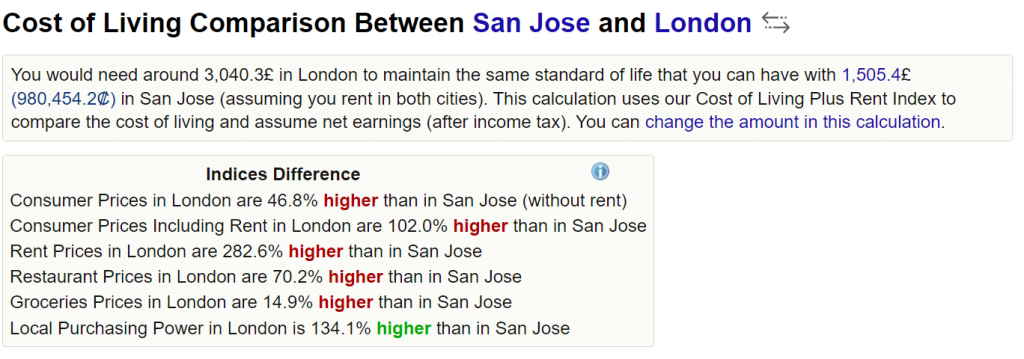
Here's what the cost of living looks like in San José:

  • A single person's estimated monthly costs are £678.4 ($855) without rent.
  • An apartment (1 bedroom) in City Centre costs around £516.33 ($651) per month
  • This brings the total cost of living for a single person to £1,505.36 ($1897) per month. It will be a bit more for a couple.


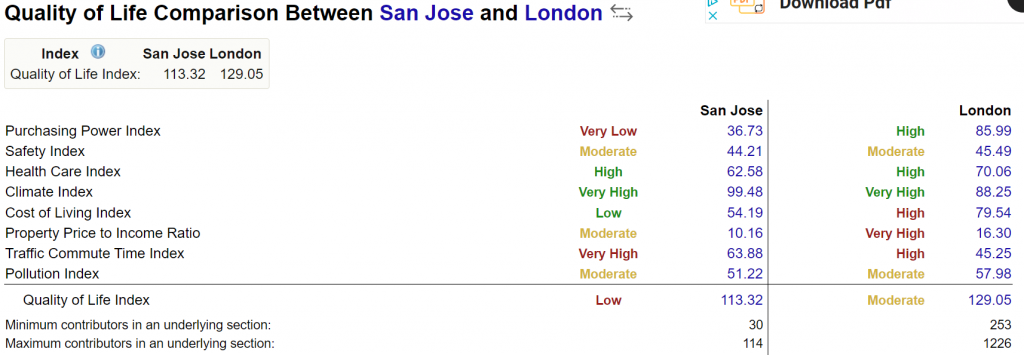
The Quality of Life Index for San Jose (Hose) compared to London:


Here is what we think of San José, Costa Rica:

  • It seems like a dream location but the traffic commute seems to be reducing the overall quality of life score.
  • Interestingly, the pollution score is lower than in London, however, the overall cost of living is much higher relative to other locations.
  • The biggest attraction for us is the laid-back Pura Vida lifestyle and the tropical beauty.


Location 2: Valletta, Malta

Valletta, Malta, beckons retirees with its historic charm, Mediterranean allure, and a unique blend of cultures.

As a UNESCO World Heritage site, the city showcases Baroque architecture, charming streets, and a rich tapestry of history.

Retirees can savour the island's diverse cuisine, explore ancient temples, and enjoy the mild Mediterranean climate.

Valletta's compact size fosters a sense of community, while its residency programs offer expatriates ease of integration.

With English widely spoken and a welcoming atmosphere, Valletta provides retirees a distinctively cultural and picturesque haven for a fulfilling retirement in the heart of the Mediterranean.

Here is what the cost of living looks like in Valetta, Malta:

  • A single person's estimated monthly costs are £786.0 ($990) without rent.
  • An apartment (1 bedroom) in City Centre costs around £835.16 ($1,052) a month
  • This brings the total cost of living for a single person to £1,621.16 ($2,043) per month. It will be a bit more for a couple.

Now, here is the Quality of Life Index for Valletta:


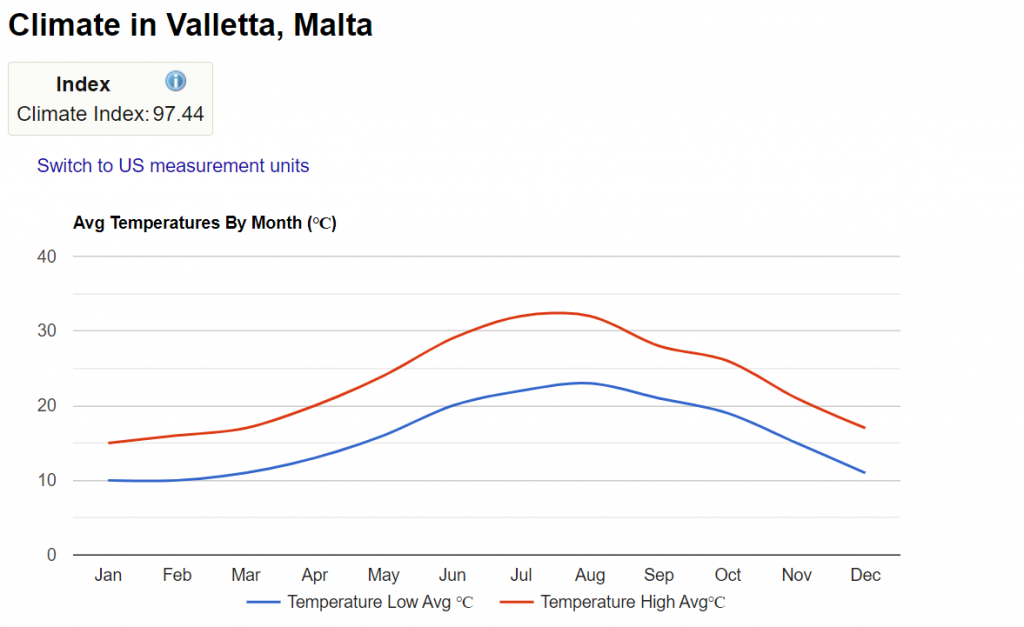
And the weather:

Here is what we think of Valetta, Malta:

  • This location will have less geopolitical risk and future risk of wars and unrest.
  • The weather is great, however, it is not amazing during the cold winter months of December to April.
  • The Mediterranean culture is a big attraction. However, you'd need to seriously consider the visa issues post Brexit for this location and others in Europe.


Location 1: Valencia, Spain

Valencia, Spain, emerges as a captivating retirement destination, blending historic elegance, a vibrant cultural scene, and a Mediterranean climate.

The city boasts stunning architecture, including the futuristic City of Arts and Sciences, complemented by a plethora of museums and festivals.

Retirees can indulge in Valencia's renowned gastronomy, highlighted by paella and fresh seafood.

With its moderate cost of living, beautiful beaches, and well-connected public transportation, Valencia offers a laid-back yet dynamic lifestyle.

The city's welcoming locals and diverse expatriate community make it an appealing choice for retirees seeking a harmonious blend of culture, history, and coastal charm in Spain.

Here is what the cost of living looks like in Valencia:

  • A single person's estimated monthly costs are £556.8 ($701.57) without rent.
  • An apartment (1 bedroom) in City Centre cost around £819.52 ($1,032.59) per month on average
  • This brings the total cost of living for a single person to £1,376.32 ($1,734) per month. It will be a bit more for a couple.


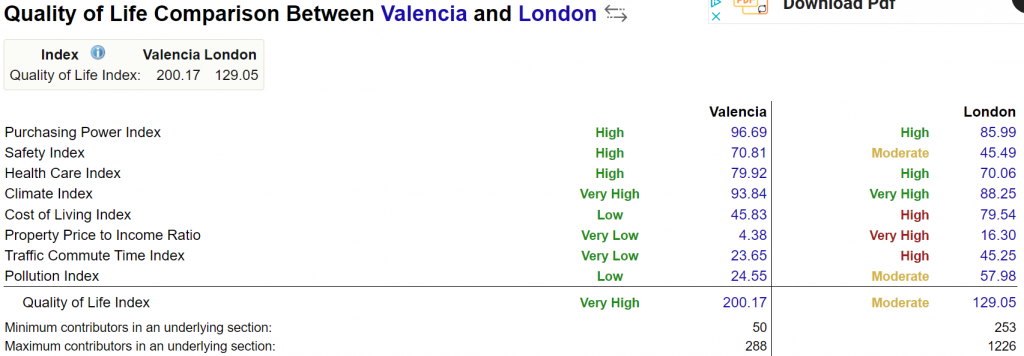
This next bit was a shock! The quality of life metrics for Valencia, Spain are unbelievable!

This score of 200.17 towers over London's score of 129.05!

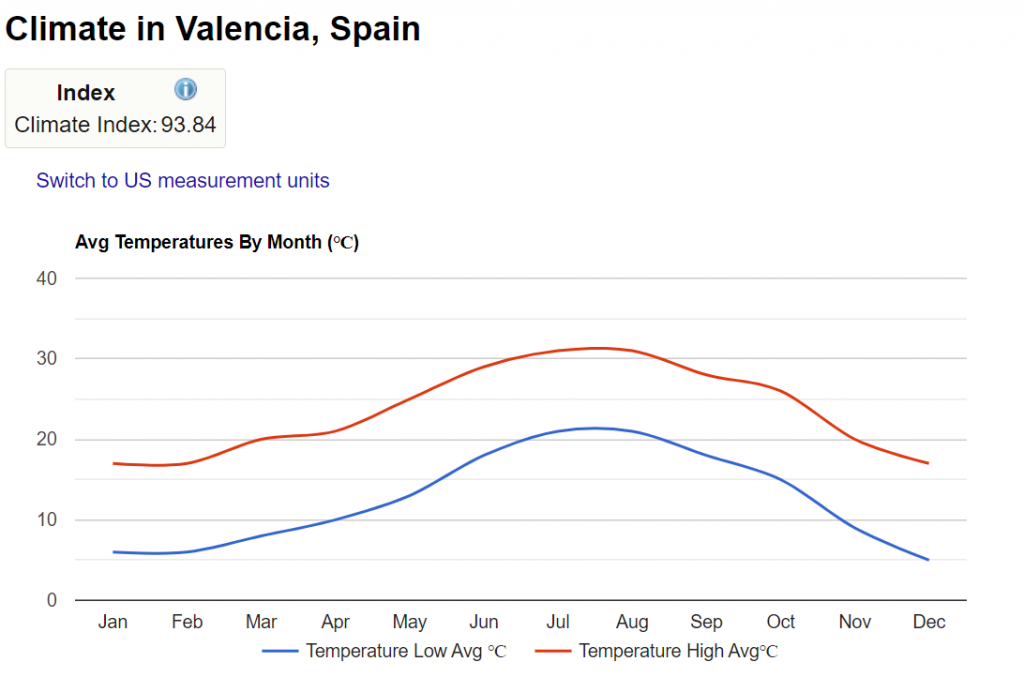
The weather also does not disappoint:

Here is what we think of Valencia, Spain:

  • Valencia has one of the highest quality of life scores in the world for a reason.
  • Mediterranean climate, lower cost of living, proximity to the UK (with cheap flights), safety and quality healthcare to name a few.
  • The only issue we see is the potential visa issues with Brexit.
  • Plus, although English is spoken by some, you'd have to learn Spanish to really fit in.

Cost of Living Summary For The Best Places To Retire In The World

Conclusion

Did Valencia surprise you?

Doing this research has certainly opened our eyes as this is a topic we've pondered for years as life in the UK seems to get worse overall.

We really enjoyed doing a deep dive into these locations and feel confident that even at modest budgets, one can have a comfortable retirement around the world.

There are also so many other locations that could have made the list, so we'd happily explore a part 2 if you tell us in the comments.

Where in the world do you think you’ll love to retire? Which of the 10 locations most resonated with you and why? Comment below and let us know 🙂

Creating that option to retire comfortably starts with building some wealth.

👉🏽Read our bestselling book, Financial Joy, a 10-week plan to help you banish debt, grow your money and unlock Financial Freedom.

Here is what to read next about the best places to retire in the world:

  • 40 Years Old and NOTHING Saved For Retirement? Do This!
  • 5 Signs You'll Become Wealthy 10 Years From Now
  • How Much Money Do I Need To Retire Comfortably?

Here is what to watch next about the best places to retire in the world:

Want a Recurring Income Stream Outside 9 to 5? Do This!

February 10, 2024 by The Humble Penny 0 Comments

Want a Recurring Income Stream Outside 9 to 5? Do This!

We asked 22,000 people on our Instagram what they'd do with an extra £500 to £1,000 a month.

We were flooded with responses and the most common answers were:

  • Invest
  • Pay debts
  • Overpay mortgage
  • Save for a house
  • Start a business

Then we asked, “if we showed you exactly what you need to do to create an extra £500 to £1,000 a month, are you prepared to put in the work?”

Only a fraction of the number of people who replied initially said yes.

We worked with a number of people recently to create their membership businesses that now pays them recurring monthly income.

Having interviewed them, today we want to share 5 actions they took that set them aside from others who at best only dream.

Learn more and book a call here if you want us to help you too.

Table of Contents

Toggle
  • How To Create a Recurring Income Stream Outside 9 to 5
  • 1. Trust Someone Else To Help You Do It
  • 2. Work Hard Over a Fixed Period of Time
  • 3. Use Existing Skills and Follow a Tried and Tested Path
  • 4. Have An Effective Launch Strategy
  • 5. See This As Your Only Option
  • Conclusion

How To Create a Recurring Income Stream Outside 9 to 5

Here are the 5 things they did to make it a reality creating a recurring income stream a reality:

1. Trust Someone Else To Help You Do It

One of the things that stood out when we interviewed Kayus of ‘The In Demand Speaker' was that he recognised that he's a smart guy.

However, his smartness aside, he was standing in his own way when it came to starting a side hustle that made him a recurring income stream.

The same applied to others we've worked with.

There is a trend we've noticed, which is that, even when we tell people how they can earn that extra £1,000 a month or month, for some, their scarcity mindset holds them back.

For example, here are 50 Best Side Hustle Ideas For Extra Income

In order to actually take that leap and create that extra income, it is better to trust someone else who has the results to prove it to coach you.

This way, you are pulled out of your comfort zone and held accountable weekly, which is what you need to create that income.

Watch this interview of my chat with Kayus Fernander:

2. Work Hard Over a Fixed Period of Time

If you don't have a hard deadline over which you want to start a side hustle or business for recurring income, it just won't happen.

You'll always kick the can down the road, which is what Parkinson's Law says:

Work expands to fill the space that is available to it.

One thing that set Kayus, Felicia, Andy, Pippa, etc apart is that they forced themselves to take action over a defined period.

In this case, it was over 14 weeks. That was it!

No matter what was going on in life, they made creating this side hustle a priority.

If you do the same, coupled with being kept accountable by someone who knows what they're doing, you'll achieve success.

Tied to this, it is also important to understand that:

There is always a cost to delay.

This applies to so many different aspects of life.

Things progressively get more costly and opportunities are lost the more you delay.

  • If you want to invest, start today.
  • If you want to start a business, start today.
  • If you want to get on the property ladder, seek ways to start today.

Basically, start whatever you've dreamed of starting today and give yourself a hard deadline.

If you don't know what to do, ask for help and invest in your success with a focus on the Return On Investment (ROI).

See what you're spending on your learning or growth as an investment and not an expense. This requires a shift in mindset.

3. Use Existing Skills and Follow a Tried and Tested Path

If you think about the different types of ways you can make some extra money, there are too many paths.

Then you throw in the fact that most side hustles or business paths won't provide you with a sustainable income.

You might make money one month and for the next few months, you might not.

This is why it is easier to not only start with your existing skills but if you pair them with a sustainable business model (e.g. memberships), you can create steady income.

For example:

Pippa is a Business Analyst (BA) and she teaches others via her membership business to become BAs or earn more as BAs.

Andy is an Angel Investor and he teaches others to become Angel Investors with small amounts of money.

Kayus is a Finance professional and public speaker and he helps others through his membership business to become in-demand speakers.

Felicia is a branding specialist and she helps women in the beauty business to level up their businesses and branding.

You can watch the interviews of Pippa, Andy, Kayus and Felicia here.

Can you see the trend here? Having the existing skills was a core foundation.

However, they paired this with a sustainable model, following a tried and tested plan because they'd seen others get results the same way.

4. Have An Effective Launch Strategy

You can start a business or side hustle but if you don't have an effective launch plan that uses certain mental triggers, it will not work out.

You need an approach to build awareness, interest, anticipation, urgency and scarcity.

Without a combination of these, it is highly unlikely that you might make any money.

However, with careful planning, you can build these elements into your offering, leading to a successful launch that keeps making money.

All the people we've worked with who launched their membership businesses and started making money executed a clear launch strategy.

Most were online-focused launch strategies, something we teach as part of the Architect Programme, and in-person event-led launch strategies.

5. See This As Your Only Option

When you feel like you have other options in life, it is harder to be forced to get outside your comfort zone to get the results you want.

For example, if you know that you'll always have enough money from your job to cover your expenses, you might not have the urgency to start a side hustle with a recurring income stream.

The one thing that unites the people we know who have started their side hustles successfully is that they'd got to a point of no return.

They were:

  • fed up with their jobs
  • desperately in need of another source of income
  • searching for something more fulfilling and impactful, etc.

In short, they were tired of BS'ing themselves and had to see these side hustles as a possible way out of the 9 to 5 grind.

Conclusion

Creating a steady recurring income outside of your day job is not easy, but it is possible.

Dreaming about it alone will not get you there. You need to be prepared to do something different and not see yourself as the only source of solutions.

Beyond these, you need to act today. The years of saying you're gonna do something needs to be a thing of the past. 

Reflect on the five points I've shared today and accept that creating a recurring income stream is possible for you.

This belief is half the battle won.

Next, decide on who you need to learn from to make creating this source of income a reality. Then take the step and reach out to them to get moving.

Whatever you do, don't just read this and do nothing. No progress happens without taking that first step.

What to read next about creating a recurring income stream:

  • Book a call to discuss your membership idea
  • How Andy's Side Hustle Makes £4,596 Per Month
  • Turn Your Knowledge To Multiple Streams of Income

What to watch next about creating a recurring income stream:

What other questions do you have about creating a steady recurring income stream outside of your 9 to 5? Comment below

Debt Solutions: How to Become Debt Free

January 26, 2024 by The Humble Penny 0 Comments

Debt Solutions: How to Become Debt Free

This is bonus content for the readers of our debut book, Financial Joy.

In our book, we covered our tried and tested 10 steps of The Debtonator® Method to help you become debt-free.

These 10 steps helped us to become mortgage-free in 7 years and 100% debt-free.

What if your debt situation feels completely out of control and beyond the point of no return?

This is where exploring the available debt solutions from reputable debt advisers and charities comes in.

Table of Contents

Toggle
  • What are Debt Solutions?
  • Debt Solutions: Pros and Cons
  • What Else Should You Consider Before Choosing a Debt Solution?
  • 1. Seek Professional Advice
  • 2. Understand the Impact on Credit Rating
  • 3. Review Costs and Fees
  • 4. Commitment to Repayment
  • Conclusion

What are Debt Solutions?

A debt solution offers you a way to take control of your debts.

There are a lot of companies out there promising debt solutions to help you become debt free.

Sadly, a number of these are scammers so make sure that you only speak with reputable companies.

Debt charities that help with such debt solutions include StepChange.org, Capuk.org or CitizensAdvice.org.uk.

When you get in touch with these organisations, debt solutions available to you include:

  • Debt Management Plans,
  • Debt Consolidations,
  • Debt Relief Orders, and
  • Individual Voluntary Arrangements (IVAs).

The type of solution that you might get help with depends on the type of debt that you’re in and how bad your situation is.

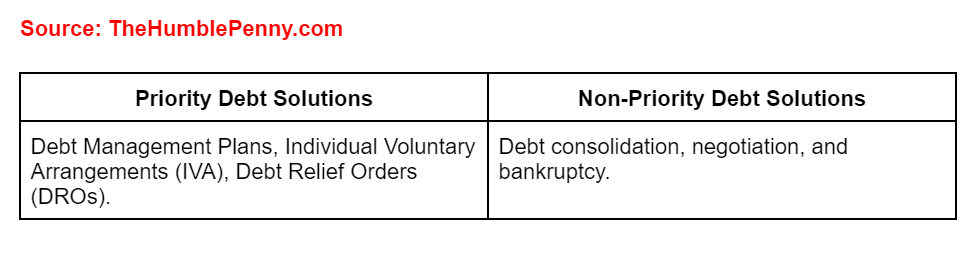
Here is a summary of debt solutions by priority vs non-priority debt:

debt solutions

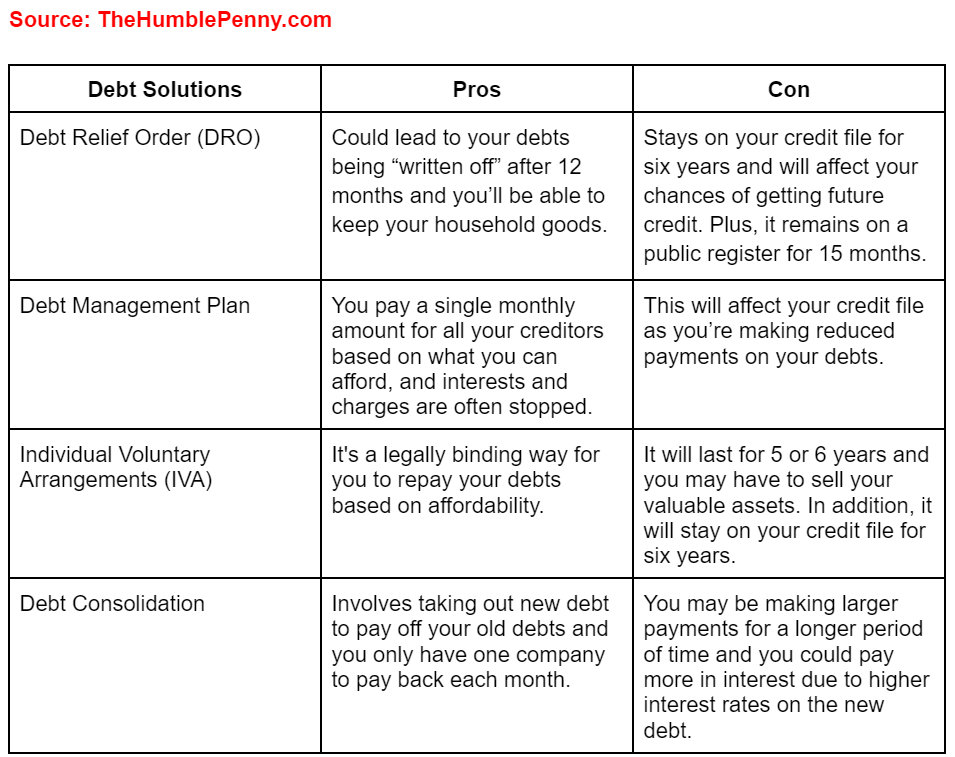
Each of these solutions has its pros and cons, which you need to consider very strongly before proceeding with any of them, if at all.

Here is a spotlight on some of these to be aware of:

Debt Solutions: Pros and Cons

debt solutions

What Else Should You Consider Before Choosing a Debt Solution?

Here are practical things to do before going ahead with a debt solution:

1. Seek Professional Advice

Consult with a reputable debt advice organisation or financial advisor to explore the best solution for your specific circumstances.

They can help you understand the implications and guide you through the process.

2. Understand the Impact on Credit Rating

Most debt solutions will have an impact on your credit rating.

Consider the long-term effects on your ability to obtain credit and whether this aligns with your financial goals.

3. Review Costs and Fees

Some debt solutions may involve fees or costs.

Understand the financial implications and ensure that the overall cost is justified by the benefits.

4. Commitment to Repayment

Assess your ability to commit to the terms of the chosen debt solution.

Failure to stick to the agreed-upon terms could lead to further financial difficulties.

Conclusion

Ultimately, the worthiness of a debt solution depends on your unique circumstances and the specific details of the solution.

Seeking professional advice is crucial to making informed decisions about managing your debt.

Remember, you're never alone when it comes to debt.

So many people have been there and also currently experiencing the same things as you.

The worst thing you can do is bury your head in the sand. 

Small action steps like opening up your debt letters and even talking about your debt will help you manage the emotions related to debt and take action.

What to read next about becoming debt-free:

  • Our debut book, Financial Joy
  • The Real Cost of 35-Year Mortgages
  • 15 Ways To Improve Your Credit Score To 999

  • « Go to Previous Page
  • Go to page 1
  • Interim pages omitted …
  • Go to page 4
  • Go to page 5
  • Go to page 6
  • Go to page 7
  • Go to page 8
  • Interim pages omitted …
  • Go to page 49
  • Go to Next Page »

Primary Sidebar

About-the-humble-penny

We are Ken and Mary Okoroafor, founders of The Humble Penny®.

Learning how to take control of our finances, grow our money and develop healthy money habits has transformed our lives since our early days as a young couple with little money having started out as immigrants. It enabled us to become mortgage-free in 7 years and also achieve Financial Independence aged 34!

Today we live purposefully to help others achieve Financial Freedom and ultimately create meaningful lives of Financial Joy.

Follow us

  • mail
  • facebook
  • twitter
  • instagram
  • youtube

Popular Posts

  • BEST SIDE HUSTLE IDEAS UK | 50 Ways to Make Extra 1000 a Month
  • 7 Guaranteed Ways On How To Make An Extra £1000 A Month (2022)
  • 12 Best Income Generating Assets for Passive Income (2022)
  • How To Prepare For a UK Recession 2022 (ACT NOW)
  • BEST VANGUARD FUNDS: ETFs and Index Funds For Financial Independence
  • How To Start An Online Business In 7-DAYS

Create a financial life you love. Subscribe via email:

Menu
  • HOME PAGE
  • About
    • About Us
  • Blog
  • Course
  • Programmes
  • Workshops
  • Free Resources
    • Free Courses
    • Start a Blog Tutorial
    • Best Resources
    • Books We Love
  • PRIVACY POLICY
  • COOKIE DISCLOSURE
  • DISCLAIMER
  • CONDITIONS OF USE
  • Contact Us
Tiktok

To help you remove money stress and achieve financial independence

logo fja

Create a financial life you love.
Subscribe via email:

Menu
  • HOME PAGE
  • About
    • About Us
  • Blog
  • Course
  • Programmes
  • Workshops
  • Free Resources
    • Free Courses
    • Start a Blog Tutorial
    • Best Resources
    • Books We Love
  • PRIVACY POLICY
  • COOKIE DISCLOSURE
  • DISCLAIMER
  • CONDITIONS OF USE
  • Contact Us
Tiktok