
• Skip to main content
  • Skip to primary sidebar
Tiktok
Work With Us
Work With Us
The Humble Penny
Menu
  • Home
  • Shop
  • Books
    • THE WEALTH HABIT
    • Financial Joy
  • Courses
    • One Grand Plus
    • Take Control Bootcamp Planner
    • Make Money Monthly With Affiliate Marketing
    • Budget For Life
    • Super Simple Investing
    • FIRE Superpower
    • Rocket Your Income
    • Value Bundle
  • Coaching
    • 121 Coaching
    • Financial Freedom Coaching
    • Financial Joy Academy (FJA) Membership
    • Architect Programme
    • Financial Joy Academy (FJA) VIP
  • Workshops
  • About
    • About Us
    • Contact
  • Blog
  • Free
    • Free Courses
    • Start a Blog Tutorial
    • Best Resources
    • Books We Love
Order Now
The Humble Penny
  • Home
  • Shop
  • Books
    • THE WEALTH HABIT
    • Financial Joy
  • Courses
    • One Grand Plus
    • Take Control Bootcamp Planner
    • Make Money Monthly With Affiliate Marketing
    • Budget For Life
    • Super Simple Investing
    • FIRE Superpower
    • Rocket Your Income
    • Value Bundle
  • Coaching
    • 121 Coaching
    • Financial Freedom Coaching
    • Financial Joy Academy (FJA) Membership
    • Architect Programme
    • Financial Joy Academy (FJA) VIP
  • Workshops
  • About
    • About Us
    • Contact
  • Blog
  • Free
    • Free Courses
    • Start a Blog Tutorial
    • Best Resources
    • Books We Love
  • Home
  • Shop
  • Books
    • THE WEALTH HABIT
    • Financial Joy
  • Courses
    • One Grand Plus
    • Take Control Bootcamp Planner
    • Make Money Monthly With Affiliate Marketing
    • Budget For Life
    • Super Simple Investing
    • FIRE Superpower
    • Rocket Your Income
    • Value Bundle
  • Coaching
    • 121 Coaching
    • Financial Freedom Coaching
    • Financial Joy Academy (FJA) Membership
    • Architect Programme
    • Financial Joy Academy (FJA) VIP
  • Workshops
  • About
    • About Us
    • Contact
  • Blog
  • Free
    • Free Courses
    • Start a Blog Tutorial
    • Best Resources
    • Books We Love
  • Home
  • Shop
  • Books
    • THE WEALTH HABIT
    • Financial Joy
  • Courses
    • One Grand Plus
    • Take Control Bootcamp Planner
    • Make Money Monthly With Affiliate Marketing
    • Budget For Life
    • Super Simple Investing
    • FIRE Superpower
    • Rocket Your Income
    • Value Bundle
  • Coaching
    • 121 Coaching
    • Financial Freedom Coaching
    • Financial Joy Academy (FJA) Membership
    • Architect Programme
    • Financial Joy Academy (FJA) VIP
  • Workshops
  • About
    • About Us
    • Contact
  • Blog
  • Free
    • Free Courses
    • Start a Blog Tutorial
    • Best Resources
    • Books We Love
Pre-order Now

Leaving The UK? Here’s What Happens to Your Assets and Investments

Leaving The UK? Here’s What Happens to Your Assets and Investments

February 8, 2025 by The Humble Penny 2 Comments

Thinking about leaving the UK? 🤔

This appears to be a growing trend as more people are considering leaving for various reasons such as higher taxes in the UK, declining living standards or even better weather. 

We've seen people in and around our lives move to UAE (Dubai and Abu Dhabi), Bermuda, Ghana, Kenya, Canada, USA, Portugal, etc. 

We have personally seen a mix of Doctors (e.g. to Canada), entrepreneurs (e.g. to Dubai), investors with assets, and others with other careers including those without many assets to their names.

The Doctor (GP) friend who's leaving for Bermuda said he is leaving because his income would be 250% higher and he'd pay no income tax. Plus less hassle.

Have people you know relocated or planning to? Comment below and share.

Whether planning a few months abroad each year or a permanent move, have you considered what will happen to your ISA, pension, property, investments—and even your crypto and gold?

We’ll cover all this and more in today’s post by looking at two scenarios:

  • Scenario 1: Part-year residency (living abroad for 3–6 months, but returning to the UK for the rest of the year)
  • Scenario 2: Permanent departure from the UK.

Then, we’ll bring this to life with real-life case studies of two people 😀.

One with part-year residency between the UK and Spain, and a second scenario of someone moving permanently to Dubai.

Don’t miss the bonus at the end of the post where we’ll share a 10-step checklist of things you should start doing now if you plan to leave the UK in the near future.

If all this sounds good, please take a moment to share this post with family and friends.

My name is Ken Okoroafor and I’m a Chartered Accountant, a Financial Coach and Business Coach and a former CFO.

The other half contributor is my wife, Mary, a Creative Entrepreneur and former E-business Analyst.

Together, we’re founders of The Humble Penny and Financial Joy Academy.

We are the Sunday Times Bestselling Authors of Financial Joy, a 10-week Plan to help you Banish Debt, Grow Your Money and Unlock Financial Freedom.

Please see this post as a starting point in your research.

Always check the local tax rules and consult with a tax professional when dealing with cross-border financial matters.

Leaving the UK
Our dream would be hybrid living between the UK and another warm location. This is Jamaica, for example.

Table of Contents

Toggle
  • Part 1: What Happens to Your UK Assets and Investments 
  • Scenario 1: Part-Year Residency (For example, Living 3–6 Months Abroad, Remainder in the UK)
  • Scenario 2: Permanent Departure (Non-Resident)
  • ISAs (Individual Savings Accounts)
  • UK Pensions
  • General Investing Accounts
  • Cryptocurrency (e.g. Bitcoin)
  • Gold and Precious Metals
  • Property Ownership
  • Part 2: Relatable Case Studies
  • Case Study 1: Sarah who has Part-Year Residency
  • Case Study 2: James – Permanent Departure to Dubai
  • Our Personal Take on Leaving The UK
  • 10-Step Leaving The UK Checklist 🗒
  • Conclusion

Part 1: What Happens to Your UK Assets and Investments 

We’ll talk about this in the context of 2 scenarios:

Scenario 1: Part-Year Residency (For example, Living 3–6 Months Abroad, Remainder in the UK)

This is the most likely scenario for a lot of people who want to live in the UK in the Spring and Summer months, but live somewhere warmer during the Winter and Autumn months.

Tax Residency Status:

  • Under the UK’s Statutory Residence Test, if you spend more than 183 days in the UK in a tax year, you remain a UK tax resident.
  • Split residency means you may need to file taxes in both countries.

For example, if you spend more than 183 days in the UK but also spend significant time in Another Country (say, 120 days or more) and that country has a similar rule, you could meet the residency criteria in both places.

Scenario 2: Permanent Departure (Non-Resident)

Tax Residency Status:

  • Once you permanently leave, you become a UK non-resident.
  • Non-residents are taxed only on UK-sourced income (with some exceptions).

Given both of these scenarios, Let’s now talk about your tax-advantaged accounts and what happens to them when you leave the UK:     

ISAs (Individual Savings Accounts)

Here is What Happens:

Existing ISAs remain tax-free in the UK if you’ve not sold your investments and taken the money with you. 

What about Contributions to the ISA?:

This is only permitted if you’re a UK resident (or eligible Crown employee).

Here are some Considerations Abroad:

If you leave the UK, some countries do not recognise the tax-free status of the ISA.

Income or gains might be taxable locally.

For example, in the United States, Australia, Canada, Germany, and France, the special tax treatment afforded to ISAs in the UK is not recognised.

Consequently, any income or gains could be subject to local taxation. 

In jurisdictions with little or no personal income tax—such as the United Arab Emirates—even if the ISA tax exemption isn’t formally recognised, the overall tax environment might still result in little to no tax on your ISA earnings.

UK Pensions

So What Happens?

Your pension continues to grow tax-free.

When you withdraw, tax rules differ if you’re a resident vs. non-resident.

Typically, up to 25% can be taken as a tax-free lump sum.

Options Abroad:

Cnsider transferring to a QROPS (Qualifying Recognised Overseas Pension Scheme) if leaving permanently—but be aware of transfer fees and tax implications. 

QROPS (Qualifying Recognised Overseas Pension Scheme) is an overseas pension scheme that meets specific requirements set by HM Revenue & Customs (HMRC) in the UK.

It allows individuals who have accumulated UK pension savings to transfer their pension funds to an overseas scheme when they leave the UK permanently.

Double Tax Treaties are worth mentioning:

These may prevent double taxation on your pension income.

Let’s now talk about non-tax-advantaged accounts.

General Investing Accounts

What Happens when you leave the UK?

Gains, dividends, and interest are taxed under standard UK rules.

What’s the Residency Impact?

If you’re deemed a UK tax resident (even part of the year), you’ll likely be taxed on worldwide gains.

As a non-resident, you’re generally taxed only on UK-sourced income.

 Let’s talk about Alternative Investments

Cryptocurrency (e.g. Bitcoin)

What Happens to this?

In the UK, realised gains are subject to Capital Gains Tax (CGT).

Residency Impact?

UK non-residents may not face UK CGT on crypto trades—unless the gains are considered UK-sourced.

However, the new country of residence may tax crypto transactions as part of worldwide income.

Gold and Precious Metals

What Happens?

This is treated similarly to other capital assets; subject to CGT upon sale, for example, gold bars.

Note that there is no tax on UK legal tender coins, such as Britannias and Sovereigns.

Residency Impact?

UK non-residents may only be taxed on UK-sourced gains.

Always check local tax laws, as some jurisdictions tax worldwide capital gains.

Property Ownership

First, Your Principal Private Residence (PPR) i.e. where you live as home. 

What Happens:
If the property has been your principal private residence, you may be eligible for PPR relief, which can exempt you from CGT on the sale.

Considerations for Those Leaving the UK:

  • If you move abroad and the property ceases to be your main home (for example, if you convert it to a rental property), you might lose some or all of the PPR relief.
  • The timing of your move and sale is crucial; selling while it’s still your principal private residence may allow you to claim full relief, whereas a later sale could result in CGT liabilities.

Additionally, if your new country also taxes capital gains, double taxation treaties may help mitigate the impact, so consult a tax professional to understand how these rules apply in your situation.

What about Rental Income?

  • Rental income from your UK property is subject to UK tax.
  • Non-resident landlords must comply with HMRC’s Non-Resident Landlord Scheme.

What about Capital Gains on Sale of Property?

If you sell a UK property as a non-resident, you’re liable for UK Capital Gains Tax (CGT) on any gains made.

Rental income or gains from selling your property may be taxable both in the UK and in your new country of residence.

Double taxation treaties between the UK and your destination can help prevent paying tax twice on the same income or gains.

Record Keeping is important.

Keep detailed records of days spent in each country and income from all sources.

Let’s now make this real in

Part 2: Relatable Case Studies

Here are some case studies to make this real.

Case Study 1: Sarah who has Part-Year Residency

Profile:

Sarah is 35, an Online Business Manager, and due to flexibilities with her remote work, she spends 9 months of the year in the UK to be closer to family and 3 months in Spain.

Her Assets are:

  • Stocks and Shares ISA: £22k
  • Pensions: £30k
  • General Investing Account: £5k 
  • Rental property in the UK: £50k equity
  • Bitcoin: £1k
  • Physical gold stored in a secure facility in the UK

Here is what might happen to those assets:

1) First, let’s talk about Tax Residency:

Because Sarah spends more than 183 days in the UK, she remains a UK tax resident.

2) ISAs & Pensions:

Her ISA continues to grow tax-free and so does her pension, although she'll pay UK tax on 75% of her pension on withdrawal.

She is less likely to be considered a Spanish tax resident under Spanish law as she only stays there for 3 months.

3) General Investing Account:

Gains are reported on her UK tax return.

4) Crypto & Gold:

UK CGT applies when she sells and realises gains. Nothing to report in Spain.

5) Property

Rental income is fully integrated into her UK tax filings.

Lesson from partly leaving the UK:

Sarah needs to coordinate tax filings in the UK and understand both UK and Spanish tax rules to make sure her “center of vital interests” is not seen to be in Spain. 

Case Study 2: James – Permanent Departure to Dubai

Profile:

James is an Entrepreneur aged 45, married and has 1 young child.

He and his wife are fed up with UK life and have chosen to move permanently to Dubai.

Assets:

  • Stocks and Shares ISA:£20k
  • General Investing Account:£10k
  • UK Pension:£100k
  • UK Rental Property: Equity Valued at approximately £200k
  • Online Business: Generating six figures a year, with an estimated valuation of around £300k
  • Crypto & Gold Portfolio: Valued at roughly £20k

Tax Residency:

Upon relocating to Dubai, James becomes a non-resident for UK tax purposes. Generally, he will only be liable for UK taxes on UK-sourced income.

ISAs

His Stocks and Shares ISA remains in the UK and continues to grow tax-free, although he can no longer contribute since contributions are limited to UK residents.

UK Pensions

James can either keep his pension in the UK or consider transferring it to a QROPS designed for UAE residents.

Withdrawals will generally be taxed in the UK, but thanks to the favourable tax environment in Dubai—and the provisions of the double taxation agreement between the UK and the UAE—he may avoid being taxed twice.

General Investing Account

Only income from UK-sourced investments (such as interest from UK bank accounts) remains subject to UK tax.

In Dubai, where there is no personal income tax, worldwide investment gains are typically not taxed locally.

Crypto & Gold Portfolio

Any gains from his cryptocurrencies and gold remain subject to UK Capital Gains Tax (CGT) on UK-sourced transactions.

Dubai generally does not tax these gains, but James must ensure he meets all UK reporting requirements.

UK Rental Property

Rental income from his UK property continues to be taxed under UK law, and any sale of the property will incur UK CGT.

If the property had ever been his principal private residence, he might have had access to reliefs, but once converted to an investment property, such relief may no longer apply.

Online Business

If James’s online business is registered in the UK or generates UK-sourced income, its profits will continue to be subject to UK taxation.

However, if he restructures the business or shifts its management to Dubai, he could benefit from Dubai’s favourable tax environment.

The precise tax treatment will depend on the legal structure of the business and the extent to which its income is considered UK-sourced.

Professional advice is essential to navigate these issues and optimize his overall tax position.

Lesson from leaving the UK:
By moving to Dubai, James takes advantage of a favourable local tax regime—especially for personal income and investment gains.

However, he must still navigate the complexities of UK taxation on assets such as his ISA, pension, rental property, and potentially even his online business if it remains UK-registered or generates UK-sourced income.

Detailed planning and professional advice are crucial for managing these cross-border tax rules and making the most of double taxation agreements.

Leaving the UK

Our Personal Take on Leaving The UK

Life in the UK has been great for me and my family and I will always be a British Citizen and continue to contribute in multiple ways.

I continue to love many things about the UK, however, it's also clear that things are tougher and overall quality of life is declining. 

People are struggling, the cost of living and taxes continue to rise, and overall morale is low. 

If one can, it's certainly a good idea to think globally and explore opportunities that serve them better around the world.

However, it's a very individual choice.

As for me and my family, we continue to live and enjoy life in the UK. 

I can't see us just leaving completely for many reasons. 

We've fought to move here, live here and made a life here.

Plus, we have ageing parents in the UK and we'll always need to be around them.

That said, the cold weather here is crushing and our ideal is to live partly in the UK and partly somewhere warmer for a few months in a year.

Where that is remains a mystery.

What matters most to us is having the freedom and finances to move around the world, which is both a blessing and priviledge.

For now, we plan to travel to different locations to see what living partly in other places could look like.

👉🏽 What do you plan to do? Relocate or stay? Comment and share 😀

Ok, here is the bonus I promised…

10-Step Leaving The UK Checklist 🗒

Before you pack your bags and set off on your new sunny adventure, there are several critical steps you should take at least 12 months before leaving the UK.

Here's a comprehensive checklist to ensure a smooth transition.

  1. Review Your Tax Residency Status
    • Familiarise yourself with the UK’s Statutory Residence Test.
    • Understand how your planned move affects your tax obligations both in the UK and your destination country.
  2. Consult a Tax Advisor/Financial Planner
    • Schedule a meeting with an advisor experienced in cross-border finances.
    • Discuss the impact on your pensions, ISAs, general investments, and any alternative assets like crypto or gold.
  3. Research Double Taxation Treaties
    • Identify which treaties exist between the UK and your new country.
    • Learn how these treaties can help you avoid being taxed twice on the same income.
  4. Notify HMRC of Your Plans
    • Prepare to file form P85 once you leave, and inquire about any tax refunds or obligations.
    • Start gathering the documentation you’ll need for a smooth exit from the UK tax system.
  5. Assess Your Asset Strategy
    • Decide whether to keep, transfer, or liquidate your UK assets.
    • Look into options like transferring your pension to a Qualifying Recognised Overseas Pension Scheme (QROPS) if you plan on a permanent move.
  6. Contact Your Bank and Financial Institutions
    • Ask about international banking services and how your accounts will be managed after you leave.
    • Explore the possibility of setting up an international bank account.
  7. Update Your Wills and Estate Plans
    • Ensure your legal documents reflect your new international status.
    • Review beneficiary designations and estate planning to align with your future residency.
  8. Plan for Healthcare and Insurance
    • Research healthcare systems and insurance requirements in your destination country.
    • Check if you need to adjust your current coverage or obtain additional international insurance.
  9. Secure All Essential Documentation
    • Organise your passports, visas, birth certificates, and other important records.
    • Make digital and physical copies for safekeeping.
  10. Arrange Logistics and Notify Relevant Parties
    • Create a moving timeline covering everything from shipping your belongings to finalising travel details.
    • Inform employers, landlords, utility companies, and other relevant parties about your departure.

Conclusion

In conclusion, it’s a case of more money, more problems.

The fewer the assets and commitments you have in the UK, the easier it is to leave the UK and move abroad if that’s what you want to do. 

Different countries have different rules, so it’s important to thoroughly do your research and seek advice specific to your personal circumstances and goals.

Please share this post with others if you find it very useful 😀.

Are you planning on leaving the UK in the next 3 to 5 years? What questions do you have on the back of reading this post?

More to resources on leaving the UK:

  • Book 121 Financial Coaching
  • 10 Warm Budget-Friendly Places to Retire Globally
  • How Much Do You Need To Retire Comfortably?
  • No Savings At 40+? Retire In 10 Years Investing £500 a Month

Here is what to watch next about leaving the UK:
No Savings at 40+? RETIRE in 10 Years INVESTING £500 Monthly (Tax-Free!)

January 29, 2025 by The Humble Penny 0 Comments

RETIRE in 10 Years by INVESTING £500 Monthly (Tax-Free!)

Do you currently feel like time is running out for you? 🤔

You know you have to retire sometime in the future but at this very moment, you have little or nothing saved for that retirement.

You keep hearing of people talking about investing and letting that money compound for 20 years or 30 years but you know deep down that you don't have that long.

At best you've got 10 years.

If that resonates with you, then this post is exactly for you.

Table of Contents

Toggle
  • No Savings at 40+? RETIRE in 10 Years INVESTING £500 Monthly (Tax-Free!)
  • The Reality of Limited Time
  • Investing £500 Monthly: Starting with Zero Saving
  • Investing £500 Monthly Plus 3% Annual Growth: Starting with Zero Saving
  • Investing £850 Monthly: Starting with Zero Saving
  • Investing £850 Monthly Plus 3% Annual Growth: Starting with Zero Saving
  • Considering a Starting Balance of £20,000
  • Investing £500 Monthly: Starting with £20,000 Saving
  • Investing £850 Monthly: Starting with £20,000 Saving
  • Realistic Expectations for Retirement Savings
  • Factors Influencing Retirement Expectations
  • Maximising Your ISA and Pension Contributions
  • Strategies for Maximising Contributions
  • Choosing Your Retirement Location
  • Popular Retirement Locations
  • Conclusion: Retire In 10 Years

No Savings at 40+? RETIRE in 10 Years INVESTING £500 Monthly (Tax-Free!)

I recently wrote about how to generate £2,000 per month in passive income tax free and I did a bunch of scenarios about when people might want to receive that level of passive income.

i.e. 30, 20 and 10 years from today.

This was to appeal to different people because we have different age groups who read our blog.

However, I went to have my haircut and the barber said to me:

Do you know what, Ken? I read that post and I felt really down. I feel like I'm running out of time 😔.

He said, imagine this scenario.

Assume you are 45 years old and doing a job because you have to do it and pay your bills.

You barely even spend time in a house you're paying a mortgage for because you're always working.

On top of that, you've got two children and every month you have a choice to make with the little bit of money left over e.g. £500 or at best £850 with a push.

You could either use it to enjoy your life or use that bit of money you have left over to invest for a future retirement bearing in mind that you have little to nothing at the moment.

What would you do, Ken, in my scenario?

I don't have 20 or 30 years. I want to be done by 55, 10 years from now.

I want to start enjoying my life while I've still got it.”

The Reality of Limited Time

I'm making this video to not only speak to my barber but to speak to you if you are in this situation where you have little to nothing saved for retirement in your ISAs or their pensions.

This dilemma really hit me when my barber explained this because this is something that people are really struggling with.

Post-pandemic, most people don't want to work for that much longer in the future.

In a recent poll at Financial Joy Academy, I asked, what age is your absolute final point to stop working?

Not a single person said they want to retire beyond the age of 60.

Most said between 50 and 55 at the latest ideally. 

I'll make a few assumptions to tackle this dilemma while keeping it relatable to more people:

  • Scenario 1: You're starting with zero savings, although unlikely.
  • Scenario 2: You have around £20,000 in retirement savings.
  • For each, I'll assume you have £500 or £850 a month available to invest. 
  • I'll also assume you're in your 40s and want to retire in 10 years.
  • You either own a home with a mortgage or you're renting.
  • Finally, I'll assume an average of 8% real return on investment from investing in the S&P 500 or a low-cost global index fund or ETF.

👉🏽If this sounds good, please take a moment to share this post with a friend or family member.

Recommended: If You Have £5,000 In The Bank, Do These 5 Things

Investing £500 Monthly: Starting with Zero Saving

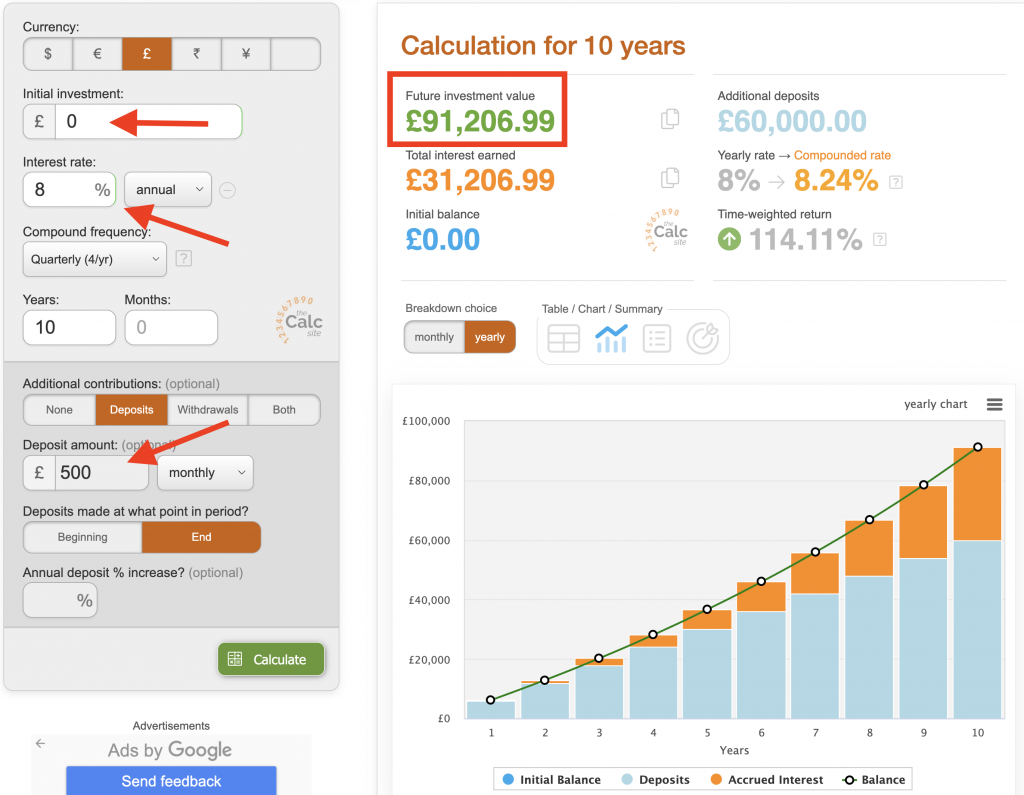
If you choose to invest £500 a month, starting from nothing, you can expect significant growth over ten years.

Assuming an average return of 8% per year, your portfolio could potentially reach around £91,206.99.

This figure is not trivial; it's a substantial amount that can provide a foundation for your retirement, depending on where you choose to retire around the world.

Investing £500 Monthly Plus 3% Annual Growth: Starting with Zero Saving

Now, consider increasing your monthly investment by 3% each year.

This adjustment acknowledges the potential for salary increases or lifestyle changes that allow for more substantial contributions over time.

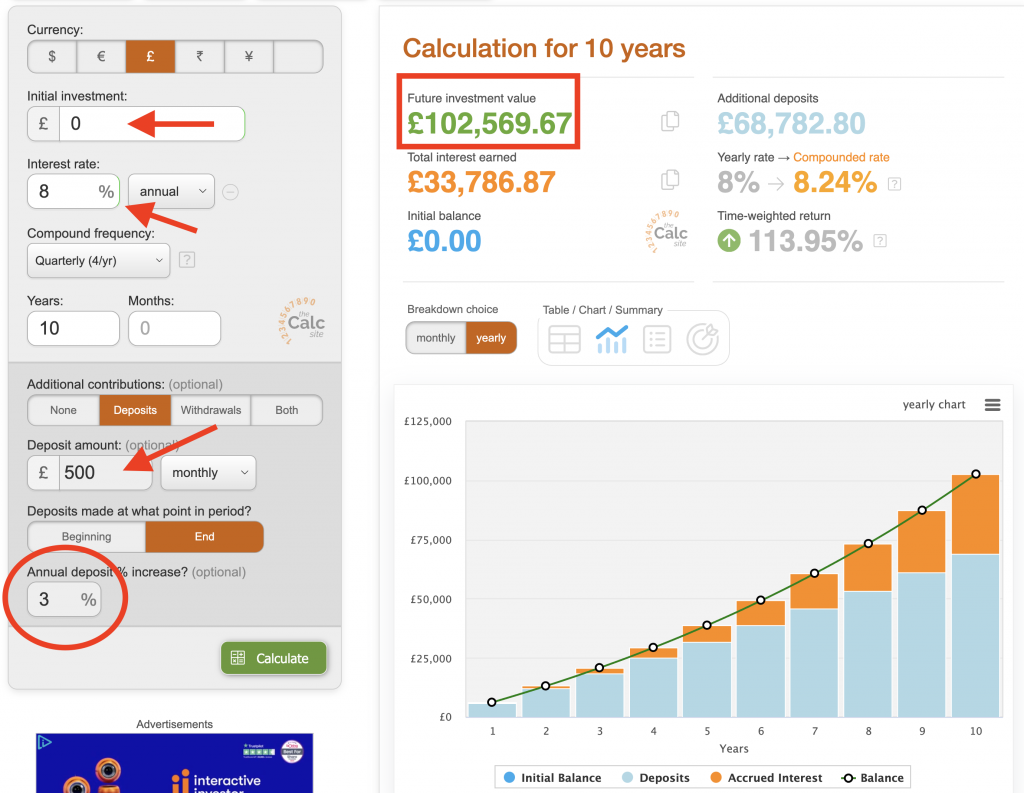
At this rate, after ten years, your portfolio could grow to approximately £102,569.

Last year, the S&P 500 returned around 25%. 

If you had £102,569 invested, a 25% return is around £25,642 additionally. 

Of course, The S&P 500 does not have this unusual return every year.

Some years are high and some low, but expect a long-term average of around 8%.

Investing £850 Monthly: Starting with Zero Saving

Next, let's examine the scenario where you invest £850 each month, starting again from zero.

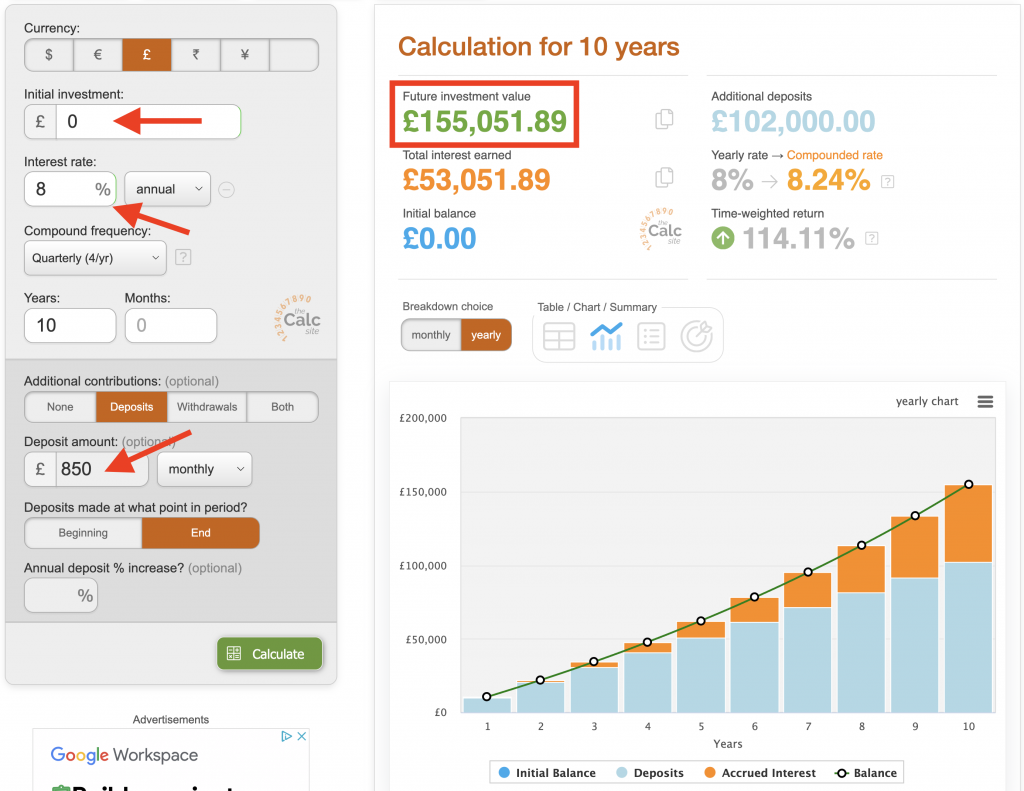
Under the same 8% annual return assumption, your investment could grow to an impressive £155,051 over the same ten-year period.

This scenario highlights the power of increased contributions and the impact they can have on your financial security.

Investing £850 Monthly Plus 3% Annual Growth: Starting with Zero Saving

If you decide to increase your monthly contribution of £850 by 3% each year, the growth potential becomes even more significant.

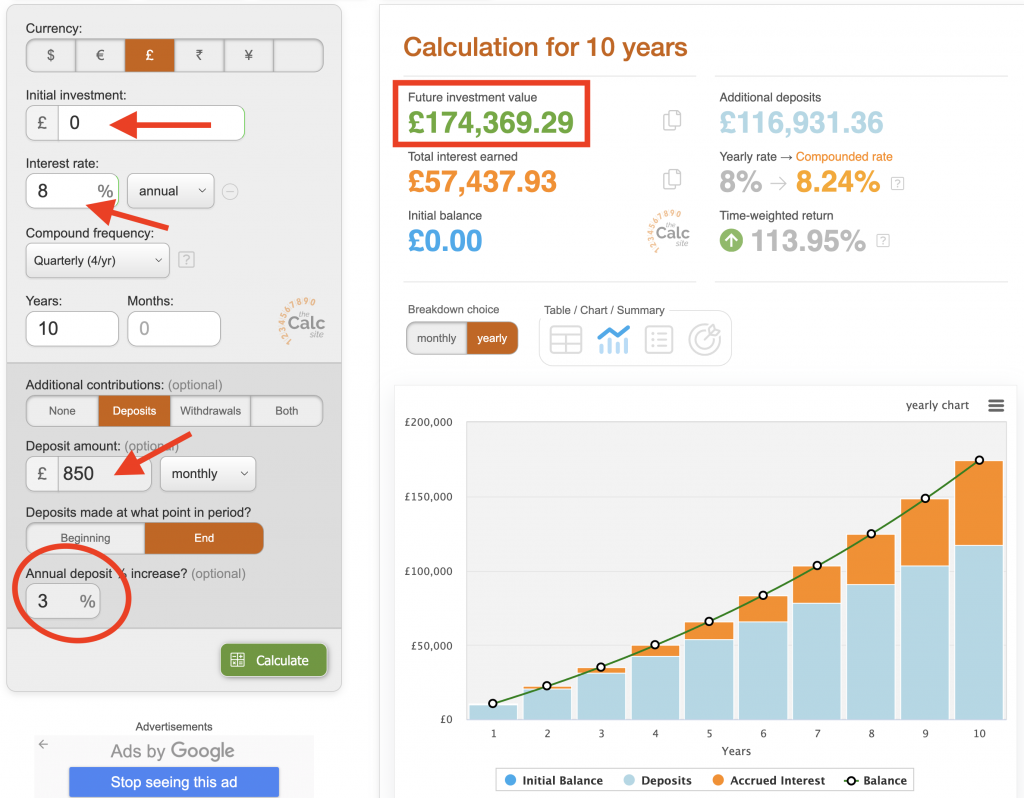
In this case, your portfolio could reach around £174,369 after ten years.

This strategy not only takes advantage of compound growth but also aligns with the principle of gradually increasing your investment as your financial situation improves.

It's worth noting here that the average UK pension pot in retirement is around £166,000. 

So with this scenario, you're doing pretty well, again, depending on where you choose to retire around the world. 

More on this below.

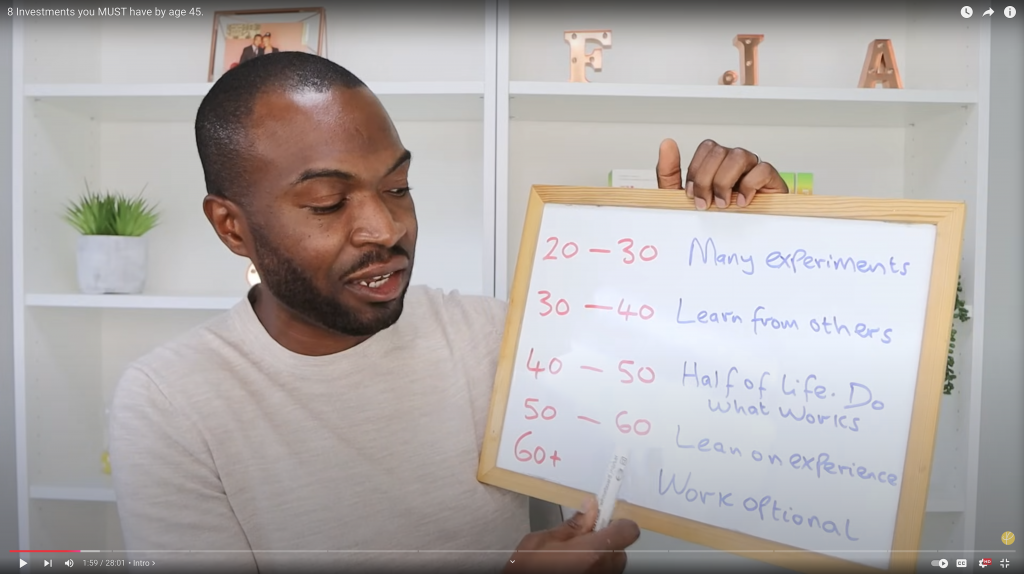
Recommended: 8 Investments You MUST Have By Age 45

These scenarios illustrate the importance of starting early and staying consistent with your investments.

Even modest contributions can accumulate to a substantial amount over time, especially when combined with the benefits of compound interest.

Remember, the journey to a secure retirement is not solely about the amount you invest but also about the decisions you make along the way.

By defining your investment scenarios and committing to a plan, you set yourself on a path toward financial security.

Considering a Starting Balance of £20,000

Starting your retirement planning with a balance of £20,000 can significantly alter your financial trajectory.

This initial amount provides a solid foundation from which to grow your investments over the next ten years.

I know not everyone has £20,000 in their ISA.

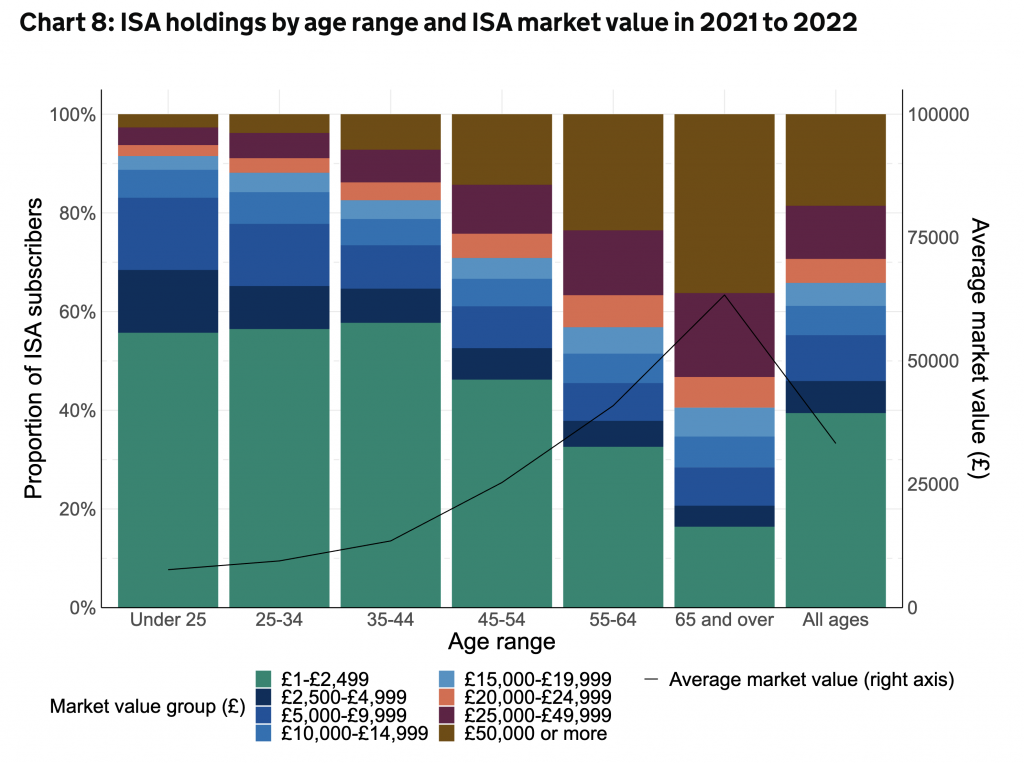
Here is what the research says about the average market value of ISA accounts in the UK by age:

retire in 10 years

The average across all ages is just over £30,000.

Let’s assume that you start with a lower amount of a £20,000 ISA pot (which I'm aware not everyone has).

By incorporating this starting balance into your investment strategy, you can leverage the power of compound interest more effectively.

Recommended: Index Funds Explain: How To Start Investing

Investing £500 Monthly: Starting with £20,000 Saving

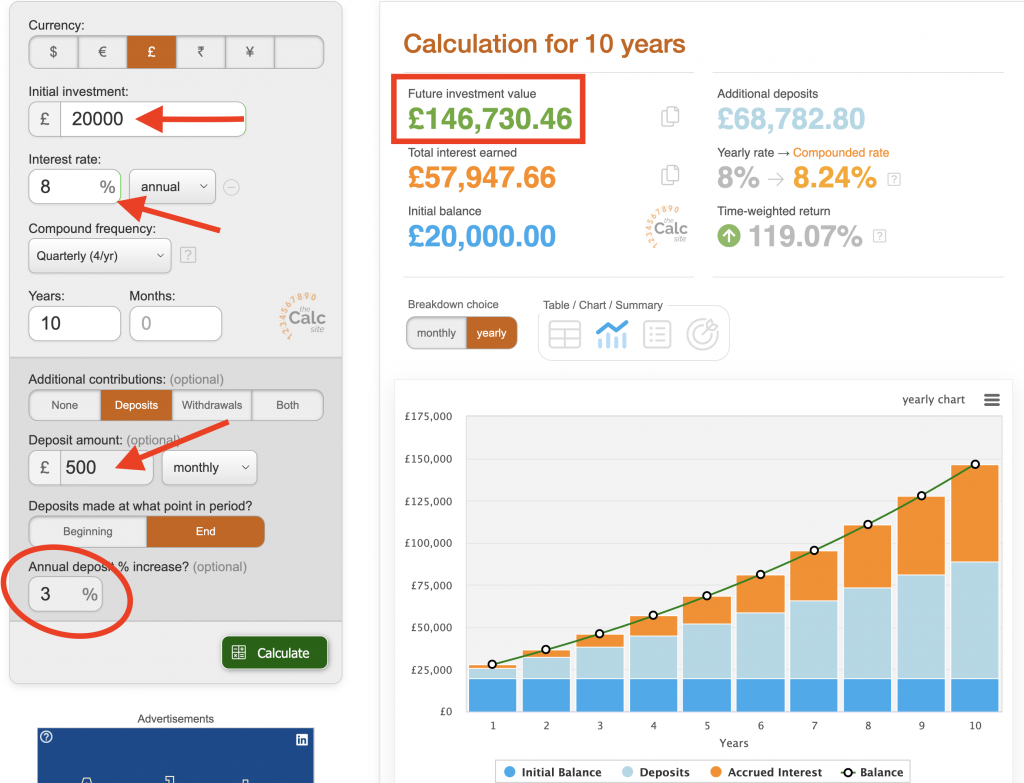
For instance, if you invest £500 a month with this starting balance, your total portfolio could reach approximately £146,730 after ten years, assuming an 8% annual return.

Note below that we've also assumed that the amount you invest rises by 3% annually.

retire in 10 years


Investing £850 Monthly: Starting with £20,000 Saving

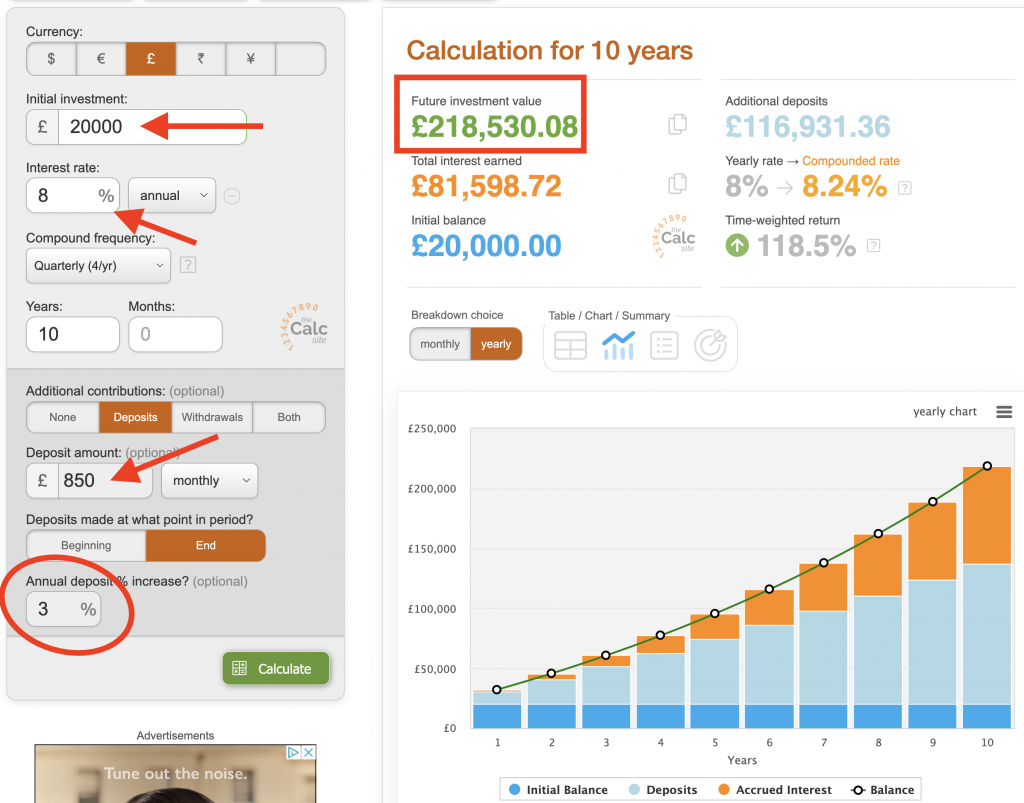
Alternatively, if you choose to invest £850 monthly under the same conditions, your portfolio could grow to approximately £218,530 after ten years.

This scenario emphasizes the significant impact of higher contributions on your retirement savings.

The difference in outcomes between investing £500 and £850 is substantial, highlighting the importance of maximizing your contributions wherever possible.

retire in 10 years

Realistic Expectations for Retirement Savings

When planning for retirement, it's essential to set realistic expectations.

The figures mentioned earlier illustrate that while significant savings can be achieved in ten years, it will not guarantee a luxurious lifestyle.

Depending on your retirement goals and lifestyle choices, the amount saved may need to be adjusted.

Understanding the average retirement savings in the UK can provide context.

As mentioned, the average pension pot is around £166,000.

This figure serves as a benchmark, helping you gauge your progress and set achievable goals based on your circumstances.

Factors Influencing Retirement Expectations

  • Cost of Living: Consider where you plan to retire and the associated living costs.
  • Housing: Renting is harder in retirement in the UK, so consider cheaper locations. Alternatively, aim to downsize or move to a cheaper location if you're a homeowner. This will free up equity.
  • Healthcare Needs: Factor in potential healthcare expenses as you age.
  • Desired Lifestyle: Reflect on the lifestyle you wish to maintain during retirement.

Maximising Your ISA and Pension Contributions

Utilising tax-efficient accounts like ISAs and pensions can enhance your retirement savings.

In the UK, you can invest up to £20,000 annually in an ISA, which allows for tax-free growth. Plus, you can access your money at any time.

Additionally, contributing to a pension can provide tax relief, making it an attractive option for many savers.

For every £80 you contribute to your pension as a basic rate taxpayer, the government adds an extra £20, effectively boosting your investment.

Higher-rate and additional rate taxpayers benefit even more, receiving additional tax relief on their contributions.

These incentives can significantly increase your retirement savings over time.

However, remember, you cannot access your pension until the age of 55 or 57 (from 2028).

Strategies for Maximising Contributions

  • Automate Your Savings: Set up automatic transfers to your Stocks and Shares ISA each month.
  • Increase Contributions Gradually: Aim to increase your contributions by a small percentage each year.
  • Take Advantage of Employer Contributions: If your employer offers a pension scheme, ensure you contribute enough to benefit from any matching contributions.

Choosing Your Retirement Location

The location where you choose to retire can have a significant impact on your financial situation.

Retiring in an area with a lower cost of living can stretch your savings further, allowing for a more comfortable lifestyle.

Researching potential retirement locations can provide valuable insights into the best options for your budget and lifestyle preferences.

Read this blog post about 10 budget-friendly places to retire in the world.

Consider factors such as housing costs, healthcare availability, and local amenities when evaluating potential retirement locations.

Countries with lower living costs, such as those in Southeast Asia or parts of Eastern Europe, Africa, etc, may offer attractive alternatives for retirees looking to maximise their savings.

Popular Retirement Locations

  • Portugal: Known for its mild climate and affordable living.
  • Spain: Offers a vibrant culture and lower costs compared to the UK.
  • Thailand: Popular among expats for its affordability and quality of life.
  • Ghana: offers retirees a vibrant cultural experience, affordability, and a tropical climate.
  • etc

Note that Brexit has made things a lot harder for a lot of European destinations. So countries in Asia, Africa, South America, etc, might take priority.

Conclusion: Retire In 10 Years

Achieving a decent retirement in 10 years is possible, even with limited savings.

The key lies in taking proactive steps now, making informed investment decisions, and setting realistic expectations.

You may also need to make difficult choices, e.g. downsizing to free up equity and moving to a lower-cost location.

If you choose to retire in the UK, it will be a lot harder to make any of the above numbers work, although not impossible, depending on your circumstances.

However, my suggestion is to consider strongly the possibility of retiring outside the UK where the cost of living (including housing) is a lot lower.

In addition, you may need to maintain some part-time work to supplement your income and give yourself a sense of purpose when you retire.

Whether you start with £20,000 or nothing at all, your actions today can significantly impact your future.

As you embark on this journey, remember to stay focused, be disciplined, and regularly review your progress to stay on track.

Overall, stay encouraged and don't give up!

Thank you for reading today's post.

Below are some additional resources to help you with your goal to retire in 10 years:

  • Book 121 Financial Coaching with me 
  • Read the Financial Joy book
  • Join Financial Joy Academy

What are your thoughts about today's post? 😀. Do you feel more encouraged having read this? Feel free to ask a question below ⬇️

Here is a video version to help you with your goal to retire in 10 years:


And as always, in all things, be thankful and seek joy. Take care and bye for now.

Invest THIS In an ISA to Earn £2,000 Monthly Passive Income (Tax-Free!)

January 21, 2025 by The Humble Penny 2 Comments

Would you like to know how to earn £2,000 in tax-free monthly passive income—and keep up with inflation so your money never loses value?

Stick around, because we’ll not only show you how to do it by investing with an ISA (i.e. Individual Savings Account) but we’ll also share two bonus ways to hit that same goal! 

Today, we’re sharing how you can use an ISA to create £2,000 in monthly passive income while factoring in inflation—because, let’s be honest, £2,000 today will not be worth the same in 20 years.

As you read, remember, that it's not too late for you to start.

Let’s jump right in! 😀

Invest THIS In an ISA to Earn £2,000 Monthly Passive Income (Tax-Free!)

Table of Contents

Toggle
  • Invest THIS In an ISA to Earn £2,000 Monthly Passive Income (Tax-Free!)
  • Part 1: Why £2,000 Tax-Free is Life-Changing 
  • Part 2: How Much To Invest To Make £2,000 Monthly Passive Income
  • Part 3: Inflation and the ISA Strategy
  • Part 4: Other Options For Investing Your Money
  • Part 5: Two Bonus Ways to Earn £2,000/Month
  • Part 6: What Else Can You Invest In?
  • Conclusion

Invest THIS In an ISA to Earn £2,000 Monthly Passive Income (Tax-Free!)

Let’s start with why £2,000/month is such a powerful number. 

Part 1: Why £2,000 Tax-Free is Life-Changing 

For most people, this amount could cover major expenses like rent, a mortgage, or even a significant chunk of their family budget.

And here’s the best part – when it’s tax-free inside an ISA, you keep every single penny. No income tax, no capital gains tax. It’s all yours!

Part 2: How Much To Invest To Make £2,000 Monthly Passive Income

Here’s the strategy. 

  • Step 1: First you need to choose a sensible dividend yield 

i.e. what return your portfolio needs to generate in order to create £2,000 per month passive income. 

Then we need to work backwards to arrive at a number.

A sensible dividend yield to assume is 3.5%, although you can get much higher.

  • Step 2: Gradually build your portfolio with growth-focused stocks and funds.

To figure out how much you need to build your portfolio up to, take the monthly amount you want to earn e.g. £2,000 per month, then annualise it by multiplying by 12 

i.e. £2,000 x 12 = £24,000. 

Then, take that number and divide it by the 3.5% mentioned earlier i.e. £24,000/0.035 which gives you £685,000.

Why £685,000? 

That's because, at a 3.5% yield, this portfolio would generate £24,000 annually, or £2,000/month tax-free.

Now, I know what you’re thinking…

‘Guys, £685,000?! That’s a huge number!’ 

But here’s the secret and this is where step 3 comes in: 

  • Step 3: Start small and stay consistent.

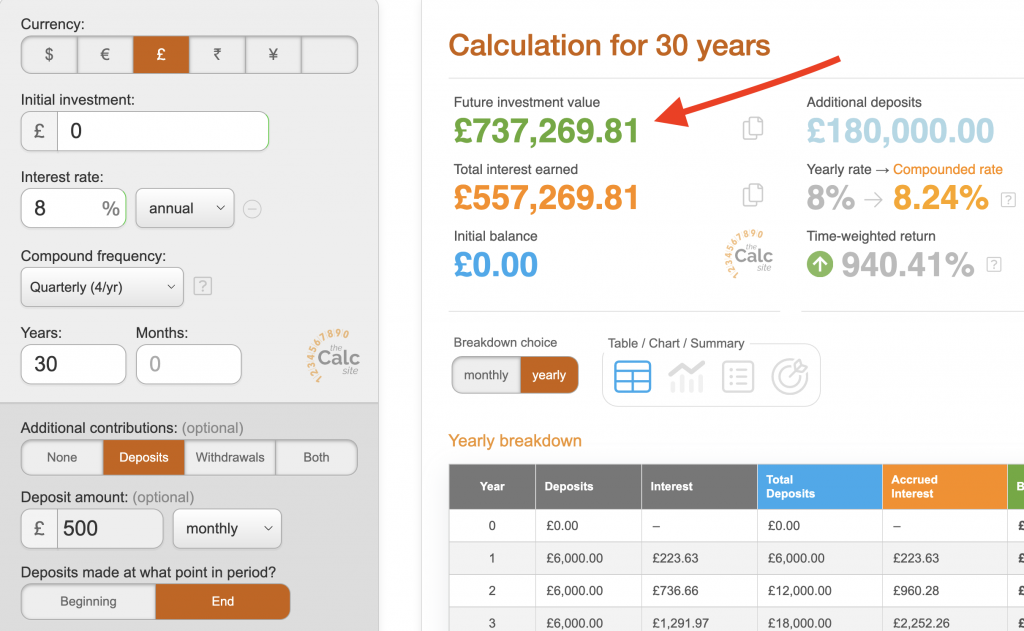
If you invest £500/month in say, the S&P 500 for simplicity, and earn an average return of 8% annually (after fees), you could reach £685,000 in about 30 years. 

See below for an illustration. 

Of course, if you invest more money each month, you’ll reach that goal a lot quicker than 30 years. 

Invest THIS In an ISA to Earn £2,000 Monthly Passive Income (Tax-Free!)

Recommended: Read week 7 of Financial Joy to master all aspects of investing.

Our approach is to focus on investing in growth-focused index fund or ETF to max out returns.

Then, when you’ve reached that portfolio goal, you could switch to funds or stocks (e.g. UK dividend aristocrats) that mainly pay a dividend if dividend passive income is the priority. 

Alternatively, stay invested in high-growth index funds and ETFs and the 3.5% becomes an annual Safe Withdrawal Rate from your portfolio.

There is the big topic of inflation to factor in. 

But before talking about that, if you are finding this post helpful, please take a moment to share it with someone who will find it useful.  

Part 3: Inflation and the ISA Strategy

First, let’s talk about inflation. The silent wealth killer. 

Historically, inflation averages around 2-3% annually. 

If we assume an average of 3%, it means prices double roughly every 24 years (using the rule of 72), it’s 72 divided by 3, which gives us 24 years.

Although to be frank, true inflation is higher than 3% as we're sure you know, but let's stick with 3% for now.

So if you want £2,000/month in passive income from dividends in today’s terms, the question is, when do you want it? 

Obviously now would be amazing, but that would be unrealistic for most people as you’d first need to build up an investment portfolio. 

To begin, we’ll assume 3 times periods of 10 years from now, 20 years from now and 30 years from now.

The problem as highlighted is that the purchasing power of £2,000 today won’t be the same in the future…

so we’ll need to work backwards to see how much we need to earn in dividend passive income in 10, 20 and 30 years from now, in order to maintain the same purchasing power as we have today.

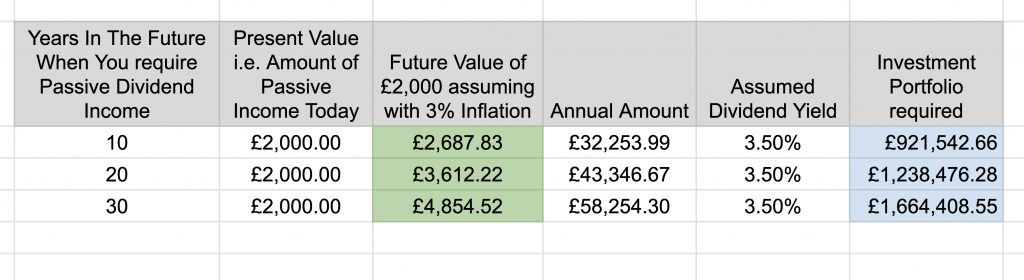
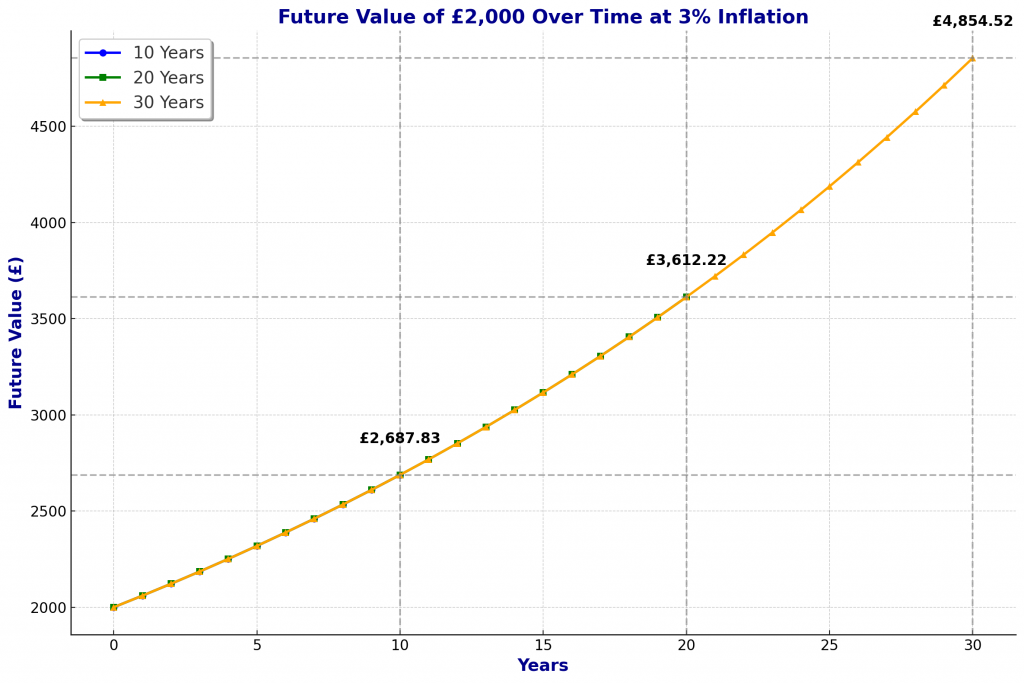
Here is the example with £2,000 today and what the future value of that amount is.

£2,000 x (1 + 0.03)^10 = £2,687.83

This is what’s called a Future Value calculation.

It is saying that to maintain the purchasing value of £2,000 a month (today) in 10 years, your investments need to make you £2,687.83 per month in income.

This amount in 1 year is £32,253.99

Then, we divide that annual number by the assumed dividend yield of 3.5% (or 0.035):

£32,253,99 divided by 0.035 = £921,542.66.

Below is a summary table that repeats this process for 20 years and 30 years from now:

Invest THIS In an ISA to Earn £2,000 Monthly Passive Income (Tax-Free!)

Below is a graph of what £2,000 today will be equivalent to in 10, 20, and 30 years from today.

These are large investment portfolio numbers but remember, you have potentially 10, 20 and 30 years ahead of you for that portfolio to be built up! 

In addition, if we adjust our contributions to increase with inflation, it makes a huge difference in terms of achieving those numbers! 

This is where it gets exciting and we can gamify this process. 

To begin, we need to make an assumption about how much you might have in your ISA pot now.  

We took a look at the average market value of ISAs in the UK.

Keep an eye on the line charting up and then down.

Invest THIS In an ISA to Earn £2,000 Monthly Passive Income (Tax-Free!)


The average across all ages is just over £30,000.

Let’s assume that you start with a lower amount of a £20,000 ISA pot (which by itself is a lot for many people).

Here is what you need to be investing today to achieve the passive income goals.

  • Scenario 1: Receiving Passive Income In 30 Years

First, Let’s start with if you want £2,000 per month dividend passive income 30 years from now. 

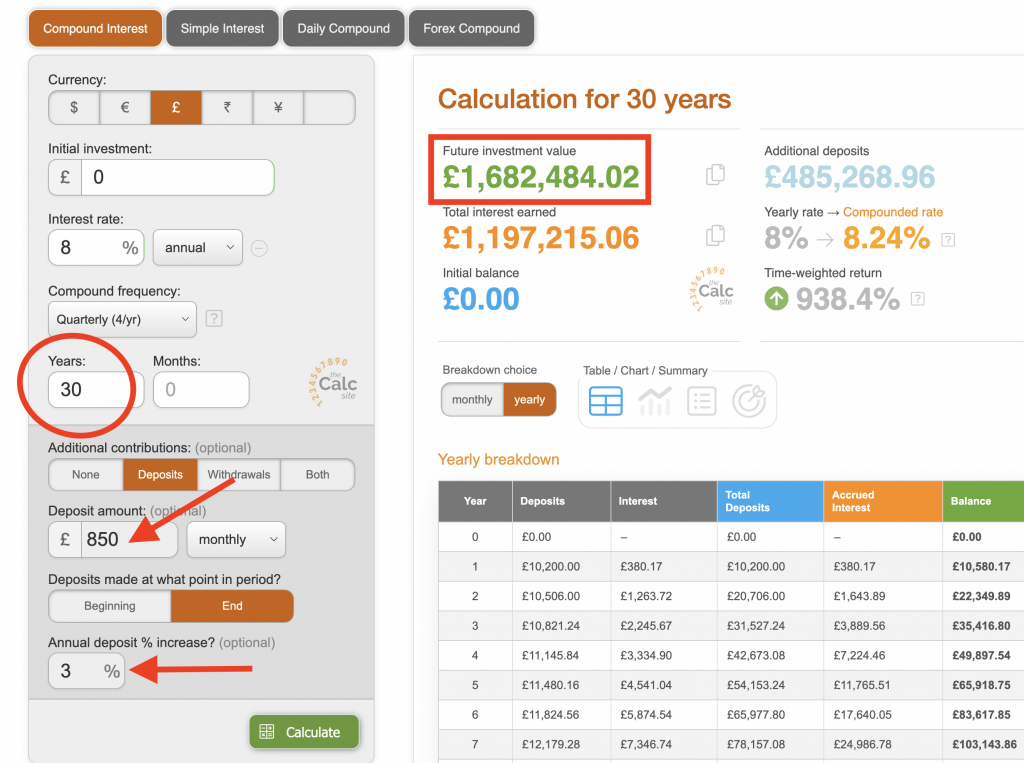
We previously worked out that this is equivalent to earning £4,854.52 per month and as a result, you’d need a portfolio of £1,664,408. 

Using Compound Interest Calculator, we worked out that if you invest £850 a month in an index fund (e.g. S&P 500) generating an average interest rate of 8% per year (after fees), you’d generate a future portfolio value of £1,682,484, which exceeds the amount required of £1,664,408. 

Notice that in these scenarios, we are assuming that your annual deposit is also increasing by the inflation rate of 3%.

  • Scenario 2: Receiving Passive Income In 20 Years

Let’s start looking at the the same for 20 years from now. 

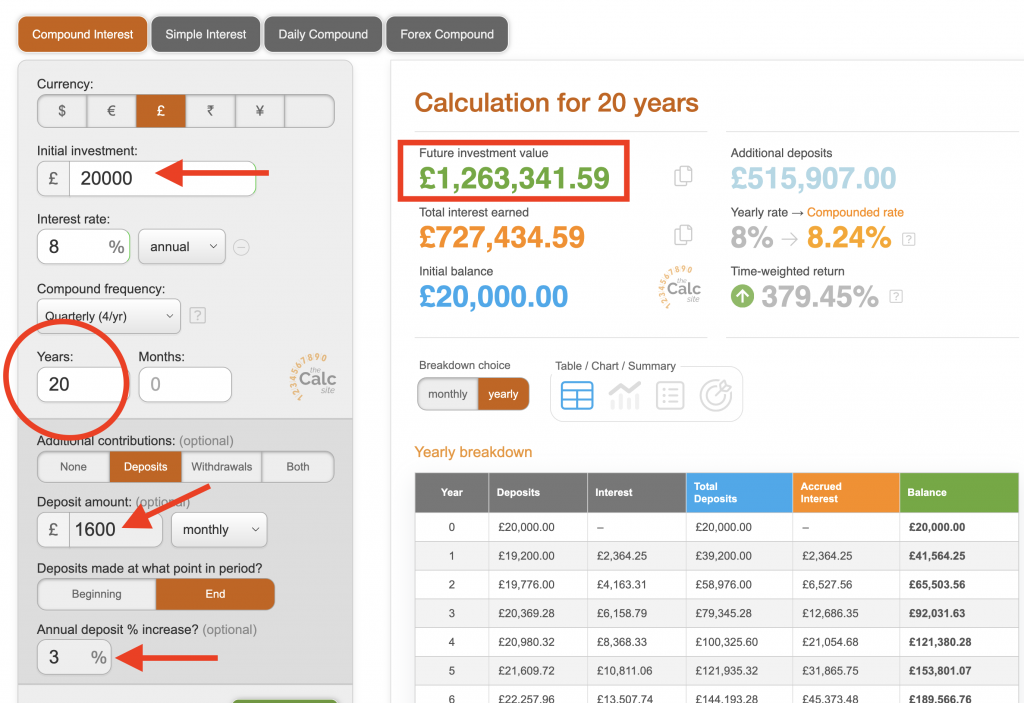
With the 20-year scenario, £2,000 a month in passive income today is equivalent to needing to earn £3,612.22 in order to maintain the same purchasing power. 

We previously worked out that as a result, you’d need to aim for an investment portfolio of £1,238,476.

Again, using a compound interest calculator, we worked out that you’d need to start investing £1,600 per month today and increasing that by 3% annually to reach £1,263,341.59 in 20 years, which exceeds what you’d need to create the passive income you need.

  • Scenario 3: Receiving Passive Income In 10 Years

The final scenario is 10 years from now. 

To make the equivalent of £2,000 per month in passive income today in 10 years, you’d need to receive £2,687.83 in passive income due to inflation. 

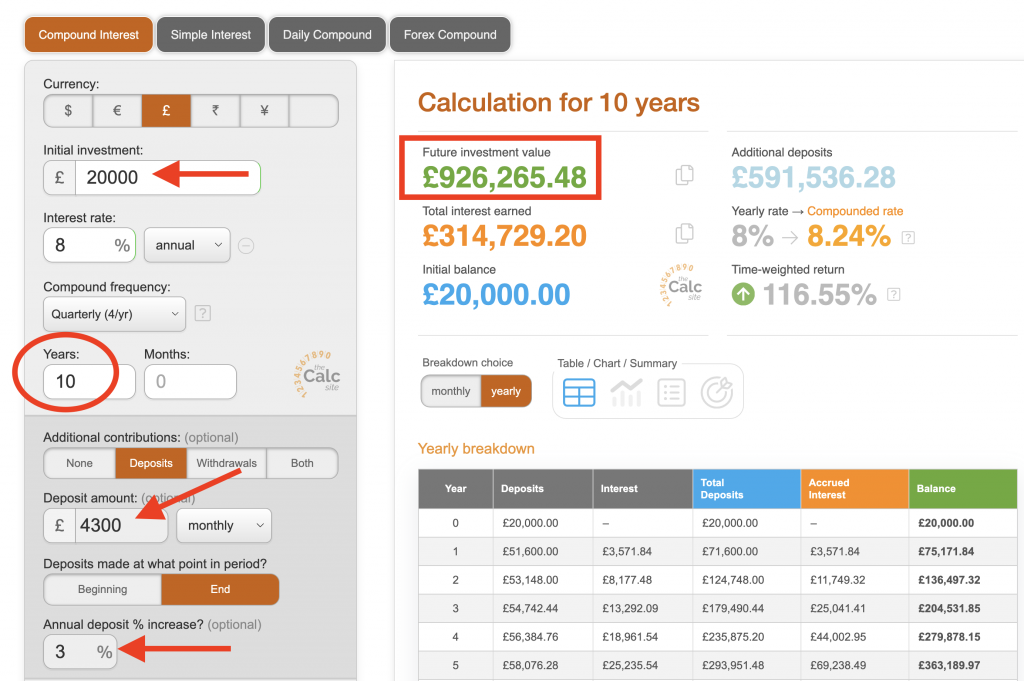
However, given that 10 years is much closer than 20 or 30 years, you’d need it invest a lot more money now to arrive at the portfolio you need of £921,542.66. 

This is by far the hardest of the scenarios and will be unachievable by most people, although more likely to be achievable by a couple who are high earners and who invest aggressively. 

The compound interest calculator shows that you’d need to invest around £4,300 a month and rising by 3% inflation annual to arrive at a portfolio of £926,265.48, which exceeds the target amount we mentioned earlier.

But note that this scenario cannot fully be achieved in an ISA even for a couple as the current allowance is £20,000 a year or £40,000 a year for a couple.

You'd get close if you combined a Stocks and Shares ISA with a Lifetime ISA, making it possible to invest £42,000 a year (£3,500/month) for a couple.

See other account options below.

Phew! 😅

That is a lot to process, but this perspective of factoring inflation into your future plans hopefully has given you a lot of insight. 

£2,000 a month is a fantastic first milestone to aim for. 

We’d say, start there, and adjust your contributions as your income grows.

Part 4: Other Options For Investing Your Money

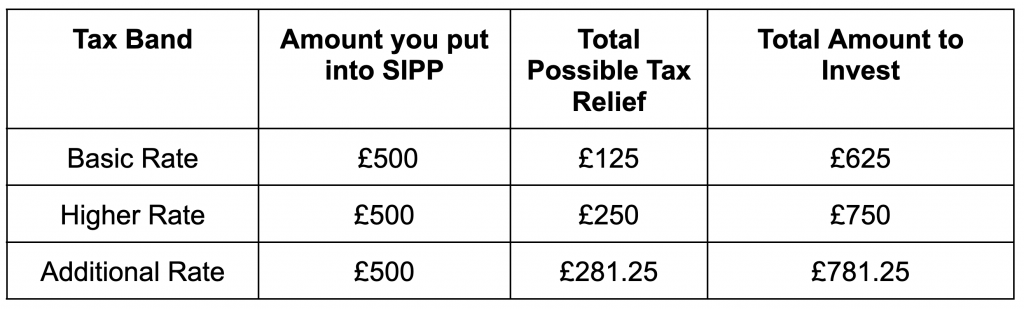
Option 1: You could invest the money via a Self Invested Personal Pension (SIPP), to get tax relief and give the amount you invest a boost.

  • Basic Rate Tax Payer: For every £80 you put in, you get a £20 rebate from the government as tax relief.
  • Higher Rate Tax Payer: For every £80 you put in, you get a £40 rebate from the government as tax relief. £20 of that from doing a self-assessment.
  • Additional Rate Tax Payer: For every £80 you put in, you get a £45 rebate from the government as tax relief. £25 of that from doing a self-assessment.

Here is an Example with £500 a month invested and what that could look like with tax relief added.

These higher amounts can then be invested to achieve your investment goals a lot quicker 😀.

However, note that with a SIPP, you have to factor in future taxes. 

As things stand, only 25% of your pension is tax-free, the remaining 75% will be taxable depending on what future tax band you are on. 

In addition, you won’t have access to this money until the age of 57 (from 2028) and future tax rules could also change (including the age of accessing your pension), making access to your pension potentially harder. 

But don’t let this scare you. 

We personally give the ISA priority for this ease of access and tax-free status, but we also invest in our pension for the tax benefits, too.

Option 2: You can also invest money via a General Investing Account (GIA), however, this has no tax benefits as gains become taxable when you sell and dividends become taxable, too, above any tax-free amounts. 

You’d only really consider this account when you’ve exceeded your Annual ISA allowance, currently £20,000 a year per person.

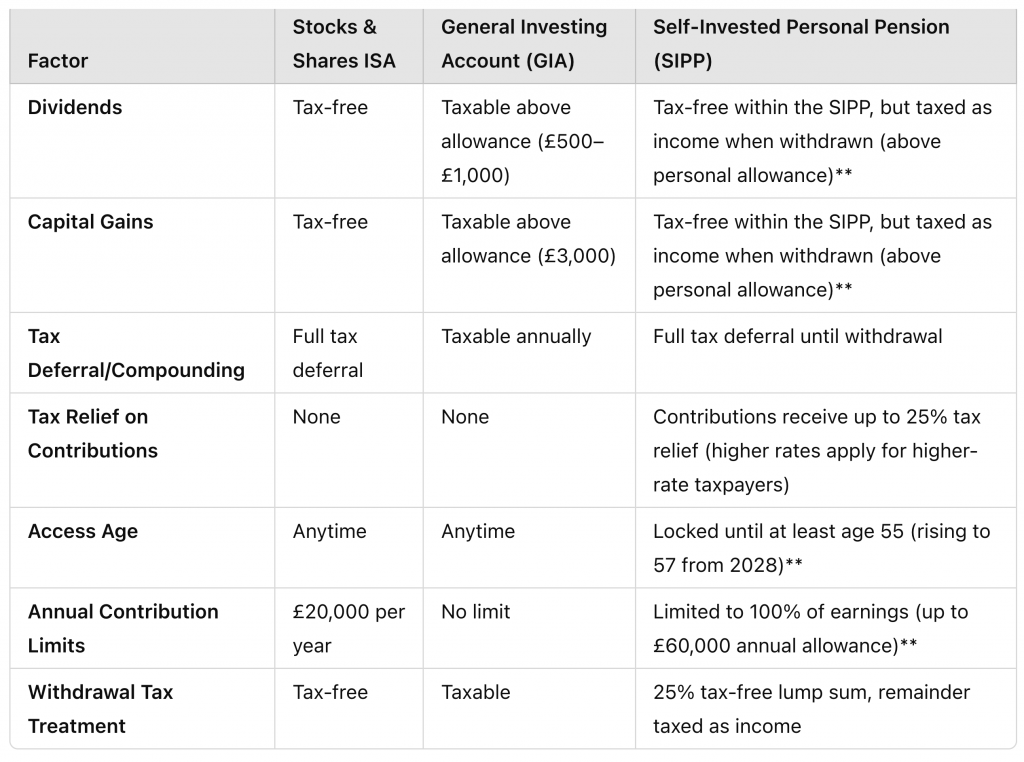
Below is a detailed comparison table between a Stocks and Shares ISA, General Investing Account and a SIPP. 

Note that details are expected to change in the future.

Part 5: Two Bonus Ways to Earn £2,000/Month

While the ISA strategy is great for some, it’s not the only way to create £2,000 in monthly passive income, especially if you don’t have time on your side.

Here are three more ideas to diversify your income streams:

1. Property Investing (After Tax):

Rental income from property investing can be a great way to generate passive income but it is a business by itself and requires a lot of work and capital investment, therefore is NOT passive and is not for everyone. 

However, if you can find the right deal with the right strategy, it can help you build up capital to then invest in the stock market. 

You can either explore UK or international property opportunities. 

Strategies include Flipping, Commercial Property, HMO, AinBnB, Rent To Rent, etc. Learn to implement these strategies via week 9 of Financial Joy where we have real life case studies.

Property investing is harder in the UK due to regulation and tax changes such as extra stamp duty on second homes.

2. Real Estate Investment Trusts – REITs (Tax-Free with ISA):

You can use your ISA to invest in Real Estate Investment Trusts (REITs). 

These often provide 4-6% annual returns and are less hands-on than traditional property investing, however, keep an eye on fees. 

We’ve made a detailed video about it that we’ll link to below:

Part 6: What Else Can You Invest In?

Here are some additional ideas to explore.

1. Start an Online Business With AI

There are also other things you can do, for example, creating various types of online businesses. 

With the accessibility we all have to AI, it has never been easier to start and grow an online business even if you don’t want to show your face.

Examples include: Anonymous AI-Created Niche Blogs, Faceless YouTube channels, AI-Curated Newsletter or Paid Subscriptions, etc

The difficulty is knowing where to start and getting ongoing guidance from people who’ve done it, and staying accountable 😀.

If you’d like our help whilst learning from us, our classes and getting kept accountable by us, join our membership community.

2. Invest In Alternative Asset Like Bitcoin

This one comes with a huge risk warning – You can lose all your money, but you can also gain a lot. 

Your capital is at risk always. 

My suggestion here is to consider investing up to 1% of your investable assets after doing your research. 

Risk management is important, especially with all the crypto memes coins out there.

Please don’t treat this as financial advice. Do what works for you.

If you make money from something like this, that can be reinvested after capital gains tax into an income-producing asset for passive income.

Conclusion

Chances are you feel behind and your investment portfolio is nowhere near what you'd like it to be.

We fully understand especially as we've seen our parents start later in life from scratch (in their mid 40s), which had knock on effects on us too as immigrants.

The key with any of these strategies is to start as early as you can (i.e. today), take some measured risks and reinvest your earnings early on to grow your income faster.

Don't let the negativity of your current situation hold you back or make you think it's too late for you. It's not!

Whether it’s through ISAs via the stock market, property, or other strategies, creating £2,000 in passive income is achievable with the right plan—and now you know how to account for inflation too.

Building wealth through investing is like planting a tree. 

Each monthly contribution is a seed. 

At first, it may not seem like much, but with patience, time, and consistency, those small seeds grow into a strong, flourishing tree that provides shade and fruit for a lifetime. 

So, keep planting those seeds, one month at a time.

More resources about making monthly passive income: 

  • Join Financial Joy Academy
  • If You Have £5,000 in the Bank, DO THESE 5 Things
  • 85 Easy Ways To Make Extra Money

Is investing for passive income in the future something you're working towards? Which of the strategies above will you prioritise? Comment ⬇️ and share your thoughts or ask questions.

Thanks for reading, and as always—In all things, be thankful and seek joy

Watch this next for more about monthly passive income: 

Pay Off Mortgage or Invest? The Smarter Move, Explained with Maths

November 25, 2024 by The Humble Penny 12 Comments

Pay Off Mortgage or Invest? The Smarter Move, Explained with Maths

If you had an extra £500 or $500 a month, would you throw it at your mortgage to be debt-free sooner? 🤔

Or would you invest it in the stock market and let compound interest do its magic? 

This is one of the most debated personal finance dilemmas, and the answer isn’t as simple as you might think.

Both options have strong arguments, but some unusual and compelling reasons go beyond just crunching numbers.

Let’s dive into the financial and emotional aspects of both choices, with practical examples, research-backed insights, and strategies to help you decide.

For context, in our 30s, we chose to pay off our mortgage in 7 years rather than 25 years, and we did it whilst also investing in the stock market.

We have zero regrets and see it as one of our best financial decisions 😀.

Today, a bigger portion of our income, aside from being spent on enjoyment, goes towards investing in the stock market to further boost our freedom pot.

👉🏽Read our Instant Sunday Times Bestseller, Financial Joy and our new book, The Wealth Habit (a mindset and habit system to make wealth building effortless, inevitable and sustainable for life)

pay off mortgage or invest
Pay Off Mortgage Early or Invest? We've been debating the pros and cons of both.

Table of Contents

Toggle
  • Why Paying Off Your Mortgage Early Can Be a Game-Changer
  • Why Investing in the Stock Market Could Be the Better Bet
  • Unusual and Compelling Reasons for Each Option
  • Reasons to Pay Off Your Mortgage Early
  • Reasons to Invest in the Stock Market
  • Non-Financial Considerations
  • 1. Personality and Risk Tolerance
  • 2. Life Goals
  • 3. Family and Dependents
  • 4. Job Loss or Income Reduction
  • 5. Serious Illness or Disability
  • 6. General Financial Emergencies
  • Combining the Best of Both Worlds
  • Practical Tips for Making Your Decision
  • Conclusion

Why Paying Off Your Mortgage Early Can Be a Game-Changer

1. Guaranteed Returns
When you pay down your mortgage, you effectively earn a “return” equal to your mortgage interest rate.

For example, if your interest rate is 5%, every extra pound or dollar you pay saves you 5% annually in interest.

That’s a guaranteed return—something the stock market can never promise.

Take a £200,000 mortgage at 5% interest over 25 years.

Paying an extra £500 a month could save you over £73,000 in interest and cut your mortgage term by 11.1 years.

Imagine the peace of mind knowing you’re debt-free years ahead of schedule!

2. The Emotional Power of Debt Freedom
Psychologically, owning your home outright is freeing.

A 2018 study from Harvard Business School found that people experience higher levels of happiness when they reduce debt compared to when they accumulate wealth.

Debt can be stressful—even if it’s “good debt” like a mortgage.

Eliminating it gives you financial security and flexibility.

3. Recession-Proof Your Finances
Mortgage-free living means one less major bill to worry about if times get tough.

Whether it’s a job loss, a recession, or an unexpected expense, having a paid-off home can significantly reduce financial stress.

4. Simplify Your Retirement
If you aim to retire early or live off a smaller income in retirement, not having a mortgage payment simplifies your budgeting.

Without this monthly expense, your income requirements drop dramatically, making financial independence or optional early retirement more achievable.

This was one of the biggest appeals for us, especially having seen our parents retire and they still had the mortgage to pay.

Why Investing in the Stock Market Could Be the Better Bet

Here are some reasons why investing in the stock market might be a better option mathematically.

1. Stock Market vs Mortgage Pay Off In Numbers
The stock market has historically delivered average annual returns of around 7-10% after inflation.

Over the long term, this beats the typical UK or US mortgage interest rate, although interest rates remain fairly high, with the UK base rate currently 4.75%.

Let’s use an example:

Mortgage Details:

  • Loan Amount: £200,000
  • Interest Rate: 5% (fixed)
  • Standard Term: 25 years
  • Monthly Payment (without overpayment): £1,169.18
  • Total Interest Over Term: ~£150,753

Mortgage Overpayment Scenario:

  • By overpaying £500/month, the monthly payment becomes £1,669.18.
  • The mortgage is paid off in 13 years and 11 months (167 months) instead of 25 years, wiping off 11 years and 1 month off the term.
  • Total Interest Paid: ~£77,641
  • Interest Saved: £150,753 − £77,641 = £73,112

Investment Scenario (Same Term: 13 years and 11 months)

  • Investing £500/month in an index fund with an 8% annual return (compounded monthly) for 13 years and 11 months (167 months):
  • Using the compound interest formula, the investment grows to approximately £153,511 (including the total invested of £83,500).

Comparison Over 13 Years and 11 Months

  • Mortgage Overpayment Savings:
    • Total Interest Saved: £73,112
    • The mortgage is fully paid off, offering peace of mind and closer to financial freedom but with inaccessible capital.
  • Stock Market Investment Growth:
    • Total Value: £153,511 (including the total invested of £83,500).
    • Potentially higher returns though with market volatility risks and capital is accessible.

Key Insights

  • With a 5% mortgage rate, the difference between the two options narrows, but the stock market investment still generates more wealth (£153,511 vs. £73,112 in interest savings)

In this scenario, the stock market is expected to generate over double the amount saved in interest on a mortgage.

  • This is still the case even after accounting for taxes and inflation.
  • However, remember that the stock market return is not guaranteed, whereas, the mortgage return is 100% guaranteed.
  • Plus, future stock market returns may not be as generous as they've been for the last 15 to 20 years.
  • You also have to consider whether your stock market investments are made inside or outside an ISA for tax purposes.

2. Diversify Your Wealth
Your home is an asset, but it’s not liquid.

By investing in the stock market, you’re diversifying your portfolio and building a safety net you can tap into when needed.

This approach reduces the risk of being “house rich but cash poor.”

3. Keep Up with Inflation
Mortgage payments remain relatively fixed (excluding variable rates), but investments can grow to outpace inflation.

This means the purchasing power of your wealth increases over time.

4. Leverage Low-Interest Debt
If your mortgage rate is low (e.g., 2-3%), it might make sense to keep the debt and invest your extra money at a higher return.

This is known as “good debt leverage” and is a strategy used by many wealthy individuals.

Unusual and Compelling Reasons for Each Option

Reasons to Pay Off Your Mortgage Early

1. Freedom to Pursue Unconventional Dreams
Being mortgage-free can open doors to life changes like taking a career break, starting a business, or working fewer hours.

It’s a lifestyle choice as much as a financial one.

This is one of the biggest reasons why we chose to pay off our mortgage. 

I wanted to leave my super stressful career as a CFO and explore something more creative and suited to my lifestyle as a dad.

In addition, the 9 to 5 grind was literally destroying my overall quality of life, marriage and well-being.

Without paying off the mortgage (backed by other investments), I won't have easily taken the leap to run The Humble Penny full-time.

2. Sleep Factor
There’s a psychological comfort in knowing you truly own your home.

No market crash or job loss can take it away from you.

This peace of mind or mental freedom can be worth more than financial returns.

3. Legacy Building
Paying off your mortgage can free up your estate for future generations.

A paid-off home provides a tangible, stable asset to pass down to your children or loved ones.

Reasons to Invest in the Stock Market

1. Hedge Against Rising Rates
If inflation rises, your mortgage interest rate could increase (if it’s variable).

By investing, you build a buffer that grows with inflation, protecting your future purchasing power.

2. Flexibility for Opportunities
Investments can be sold or used as collateral for other ventures, like buying a rental property or funding a child’s education.

This flexibility doesn’t exist with home equity unless you refinance.

3. Opportunity Cost of Time
The earlier you start investing, the more time you have to take advantage of compound growth.

Delaying investments to focus on your mortgage could mean missing out on years of market growth.

pay off mortgage or invest
Becoming mortgage-free (backed by stock market investments) has meant we're free to enjoy our lives sooner rather than later.

Non-Financial Considerations

Here are some important non-financial considerations to think about:

1. Personality and Risk Tolerance

If you’re risk-averse, paying off your mortgage might feel safer.

If you’re comfortable with market fluctuations, investing could align better with your goals.

2. Life Goals

Are you aiming for early retirement, a change of career or do you value a debt-free life more?

Your personal priorities will shape your decision.

3. Family and Dependents

If you have a family, the security of a paid-off home might outweigh potential investment gains.

Conversely, if you’re younger or single, you might prioritise growth over safety.

4. Job Loss or Income Reduction

  • Mortgage Overpayment Scenario:

If you lose your job or face reduced income, having an overpaid mortgage offers no liquidity.

The extra money you put into the mortgage cannot easily be accessed without selling or refinancing the property, which may be challenging during a financial emergency.

However, once the mortgage is fully paid off, your monthly outgoings reduce significantly, offering a safety net.

  • Stock Market Investing Scenario:

Investments in the stock market are more liquid. In an emergency, you can sell shares to cover expenses.

On the downside, if the job loss coincides with a market downturn, you might have to sell investments at a loss, reducing their effectiveness as a safety net.

Key Takeaway:
Investing provides liquidity and flexibility, while overpaying your mortgage offers eventual financial security but no short-term accessibility.

5. Serious Illness or Disability

  • Mortgage Overpayment Scenario:

A serious illness can limit your ability to work, and an unpaid mortgage could become a financial strain.

There is evidence suggesting that illness rates have increased post-COVID, particularly due to conditions like Long COVID and rising mental health issues.

Furthermore, disability benefit claims in the UK have surged post-pandemic, with a significant rise in claims related to mental health conditions.

However, if you’ve already paid off the mortgage, your financial burden is significantly reduced.

If you’re still in the process of paying off the mortgage early, the overpayments might leave you with less cash to cover medical expenses.

  • Stock Market Investing Scenario:

Investments can act as a financial cushion, offering liquidity for unexpected medical costs.

However, reliance on the stock market during illness adds uncertainty, as the value of your portfolio might fluctuate when you need it most.

Plus, illness limits your earning power, limits your disposable income and ability to invest more funds.

Key Takeaway:
A paid-off mortgage eliminates the risk of repossession during health crises, while investments offer liquidity for medical expenses but come with market risks.

6. General Financial Emergencies

  • Mortgage Overpayment Scenario:

Overpaying your mortgage reduces financial risk in the long term but ties up capital in an illiquid asset.

During an emergency, such as a major home repair or unexpected family expenses, you can’t access the equity easily and will need to make sure you have an accessible emergency fund.

  • Stock Market Investing Scenario:

Stock market investments are more accessible for emergencies, offering a ready pool of funds.

However, timing matters: if the emergency coincides with a bear market, the funds available may be less than anticipated.

Key Takeaway:
For those who value quick access to funds, investing in the stock market offers a better cushion, but with volatility risks.

Combining the Best of Both Worlds

Why not do both? You can split your extra money between paying down your mortgage and investing.

For example:

  • Put 70% toward your mortgage for peace of mind.
  • Invest 30% for long-term growth.
  • or vice versa.

This balanced approach ensures you’re making progress on debt while building wealth.

You can then adjust these percentages to suit your goals. 

Practical Tips for Making Your Decision

  1. Calculate Your Effective Mortgage Rate:
    Compare your mortgage rate to the potential returns of investing. If your mortgage rate is higher, paying it off might make more sense.
  2. Consider Tax Implications:
    In the UK, tax-efficient accounts like ISAs (Individual Savings Accounts) make investing more attractive.
  3. Run the Numbers:
    Use online calculators to see how different scenarios play out over time.
  4. Focus on Your Goals:
    Decide what matters most to you personally: security or growth.
  5. Build an Emergency Fund First:
    Before choosing either strategy, ensure you have 3–6 months’ worth of living expenses in a liquid, accessible emergency fund. This mitigates the risk of financial hardship during unforeseen circumstances.
  6. Consider Income Protection Insurance:
    To safeguard against job loss or illness, consider income protection insurance, which can cover your mortgage payments or other living costs if you’re unable to work.

Conclusion

Ultimately, whether you pay off mortgage or invest in the stock market depends on your personal circumstances, goals, and risk tolerance 😀.

The smarter move is not just about what makes sense in terms of logical numbers.

For some, the emotional relief of being debt-free is priceless.

For others, the potential for higher returns in the stock market makes it a no-brainer.

Whatever you decide, the key is to take action.

Even small steps, like putting an extra £50 a month toward your mortgage or investments, can have a significant impact over time.

What will you choose? Let us know in the comments—pay off mortgage or invest or both? and why? Comment ⬇️

If you enjoyed this post, check out other posts below.

What to read to pay off mortgage or invest:

  • Read the Financial Joy book
  • 8 Investments You Must Have by Age 45
  • 40 Years Old and Nothing Saved For Retirement? Do This!

What to watching next to pay off mortgage or invest:

Are Pensions Still Worth It After the Inheritance Tax Changes?

November 13, 2024 by The Humble Penny 4 Comments

Are Pensions Still Worth It After the Inheritance Tax Changes?

In the recent Autumn Budget, UK Chancellor Rachel Reeves announced a significant change to the way pensions will be treated when passed on as an inheritance. 

Starting in April 2027, unused pension funds will be subject to inheritance tax (IHT) upon the pension holder's death, meaning that pension pots will no longer be fully exempt from inheritance tax. 

Given this change, many are wondering if saving and investing in a pension remains a worthwhile strategy for retirement 🤔. 

Especially with the backdrop that more of us are concerned about the age we can access private pensions rising in the future.

pensions

Recommended: Planning for Retirement (week 9 of Financial Joy)

Table of Contents

Toggle
  • Are Pensions Still Worth It After the Inheritance Tax Changes?
  • 1. Understanding the Changes to Pension Inheritance Tax
  • 2. The Impact on Retirement Planning
  • Scenario 1: For Those Relying on Pensions as Their Primary Retirement Fund
  • Scenario 2: For Those Viewing Pensions as an Estate Planning Tool
  • 3. Is a Pension Still Worth It?
  • Tax Relief on Contributions
  • Employer Contributions
  • Compounded Growth
  • 4. Alternatives to Consider Alongside Your Pension
  • a) ISAs (Individual Savings Accounts)
  • b) Gifting Assets
  • c) Property Investments
  • d) Family Trusts
  • 5. How These Changes Might Reshape Retirement Planning
  • Re-evaluation of Pensions as a Legacy Tool
  • Increased Use of ISAs and Gifting Strategies
  • Possible Changes to Spending Patterns in Retirement
  • 6. Practical Tips for Maximising Your Retirement Strategy
  • 7. Conclusion: The Future of Pensions in Light of the Changes

Are Pensions Still Worth It After the Inheritance Tax Changes?

Let’s dive into the practicalities of this update, its implications, and potential alternatives that could help you secure your retirement.

1. Understanding the Changes to Pension Inheritance Tax

Up until now, pensions have been a popular retirement savings vehicle partly because they’ve been exempt from inheritance tax. 

This meant that any remaining pension funds could pass to loved ones tax-free, making pensions both a retirement and estate planning tool. 

However, under the new rule starting in 2027, undrawn pension funds will be included in the pension holder’s estate.

As a result, you will face a 40% inheritance tax if your estate’s value exceeds the current IHT threshold of £325,000.

The threshold increases to £500,000 if you give away your home to your children (including adopted, foster or stepchildren) or grandchildren.

This change targets both defined contribution (DC) and defined benefit (DB) schemes. 

While certain dependent pensions may remain exempt, the new rule will significantly impact people who had been planning to use their pension as a way of transferring wealth.

2. The Impact on Retirement Planning

Scenario 1: For Those Relying on Pensions as Their Primary Retirement Fund

If your pension is your main retirement fund, these changes may not significantly affect how you save for retirement. 

The primary goal of a pension is to provide income during your retirement years. 

Any funds you withdraw for your own use in retirement won’t be affected by the inheritance tax rule change.

However, for retirees who intended to keep a portion of their pension untouched as a nest egg for their family, this change might call for a shift in strategy. 

With inheritance tax now a consideration, these individuals may need to consider alternative approaches to pass on their wealth effectively.

For example, you may want to consider getting a life insurance policy and putting it in trust so that any future payout remains outside your estate for inheritance tax.

The life insurance policy gets more expensive the older (or more unhealthy you are). 

However, putting it into trust is as simple as completing a form whilst you take out the policy. 

Just make sure you ask the policy provider to do it for you, usually for free.


Scenario 2: For Those Viewing Pensions as an Estate Planning Tool

For many people, pensions have served a dual purpose: income in retirement and a tax-free legacy to loved ones. 

This change will prompt many to reassess this strategy. 

Leaving a large pension untouched will now lead to a 40% tax on anything above the IHT threshold. 

As a result, individuals may begin looking at other ways to preserve and pass on their wealth, such as family trusts or gifting while still alive.

  • Consider gifting

You can give £3,000 to someone (e.g. a loved one) every year and it will fall outside of your estate for inheritance tax immediately.

  • Pay into a loved one’s pension

You can contribute up to £2,880 a year into a loved one’s pension and receive tax relief, making it £3,600. This is highly tax-efficient

  • Contribute to A Junior ISA or Lifetime ISA

You can save up to £9,000 per year into a Junior ISA to help you child or children plan for university or even potentially help them get on the property ladder one day.

Alternatively, consider a Lifetime ISA where you can contribute up to £4,000 a year and get up to a £1,000 government bonus.

3. Is a Pension Still Worth It?

Despite these changes, pensions still offer substantial benefits as a retirement savings vehicle. 

Let’s explore some of the key reasons why a pension is still a solid investment.

Tax Relief on Contributions

Pensions continue to provide valuable tax relief on contributions. 

For basic-rate taxpayers, the government adds 20% to any contributions you make.

While higher-rate and additional-rate taxpayers can claim back even more through their tax returns. 

This makes their relief a total of 40% and 45% respectively.

This tax relief can significantly boost the value of your pension over time, making it one of the most tax-efficient ways to save.

Employer Contributions

If you’re employed, your workplace pension often comes with employer contributions. 

This is essentially free money added to your pension pot, which compounds over time. 

Even if you need to reconsider your estate planning, it’s hard to argue against receiving these contributions as part of your retirement savings.

This is especially important for basic taxpayers who might feel that their tax relief is not as tax efficient as higher and additional rate taxpayers.

Compounded Growth

Pensions are designed to grow over the long term, benefiting from compounded growth. 

Over decades, this growth can be substantial, especially if you’re invested in a well-diversified pension plan. 

Despite the changes to IHT, the growth potential in a pension remains one of the best ways to build a retirement pot.

4. Alternatives to Consider Alongside Your Pension

While pensions remain attractive, the new IHT rules mean it’s wise to consider other ways to secure and transfer wealth. 

Here are some practical alternatives to explore:

a) ISAs (Individual Savings Accounts)

This is our favourite alternative and will likely be the target of a future or existing government.

ISAs provide tax-free growth and withdrawals, making them a popular choice for tax-efficient savings. 

Although ISAs are subject to IHT, they offer more flexibility than pensions, as you can access your savings at any time. 

This is especially important if you plan the retire early out of choice or necessity.

Building up ISA savings alongside your pension allows you to diversify your retirement assets and provides more options for tax-free income in retirement.

You can contribute up to £20,000 per person per tax year.

b) Gifting Assets

For those with substantial assets, gifting money to loved ones during your lifetime is an effective way to reduce the value of your estate. 

Under current UK rules, you can gift up to £3,000 per year tax-free (as mentioned above), with additional allowances for wedding gifts and smaller gifts. 

Larger gifts can also be exempt from IHT if you live for seven years after making the gift, allowing you to pass on wealth without facing a 40% tax.

This is known as the 7-Year Rule and you can read more about it and other estate planning strategies in week 10 of Financial Joy.

c) Property Investments

Property has long been an alternative to pensions in retirement planning. 

While property investments come with their own set of challenges (such as maintenance and tenant management)…

…rental income from buy-to-let properties or the capital gain from property appreciation can serve as an additional income source in retirement. 

Just be aware that property is also subject to inheritance tax and may not offer the same tax advantages as pensions or ISAs.

There are also more regulations and tax changes, making property investing more difficult for smaller landlords.

d) Family Trusts

Setting up a family trust can help with inheritance planning, as it allows you to transfer assets out of your estate and control how they are distributed. 

While establishing a trust can be complex and comes with setup and maintenance costs, it can provide a flexible way to protect family wealth from inheritance tax.

Speak to a solicitor or financial planner to discuss your circumstances.

5. How These Changes Might Reshape Retirement Planning

Re-evaluation of Pensions as a Legacy Tool

With the inheritance tax advantage of pensions reduced, many people may focus more on pensions for personal retirement income rather than as a vehicle to transfer wealth. 

This shift could lead to increased interest in financial vehicles that offer better tax efficiency for inheritance purposes, such as trusts and ISAs.

It will also likely lead to more people exploring annuities as a way to guarantee retirement income rather than traditional drawdowns.

Increased Use of ISAs and Gifting Strategies

The limitations on pension inheritance might make ISAs and gifting strategies more attractive. 

Those with significant assets may prioritise these vehicles to ensure that a larger share of their wealth passes to their loved ones. 

Gifting may become a particularly popular strategy, as it allows for direct transfer of wealth while avoiding potential future tax implications.

Possible Changes to Spending Patterns in Retirement

Those with larger pension pots might reconsider their spending patterns in retirement. 

Rather than leaving a large balance untouched, some retirees may choose to draw down their pension more actively.

Therefore, reducing the remaining amount that would be subject to IHT upon their death.

pensions

6. Practical Tips for Maximising Your Retirement Strategy

Here are some practical steps to consider if you’re planning for retirement under these new pension rules:

  • Review Your Estate Plan Regularly: Given the changes to IHT, regular reviews with a financial planner or estate planner can help ensure that your retirement savings strategy remains optimal.
  • Diversify Beyond Pensions: Don’t rely solely on a pension for retirement. Consider building up a mix of ISAs, investments, and, if suitable, property holdings to create a diversified retirement plan.
  • Make Use of Gifting Allowances: Take advantage of annual gifting allowances to gradually reduce the value of your estate over time, minimising potential inheritance tax.
  • Consider Setting Up a Trust: Consult a legal or financial advisor about whether a family trust might be suitable for your estate planning needs.

7. Conclusion: The Future of Pensions in Light of the Changes

While the new inheritance tax rules will certainly alter the landscape of pension planning, pensions remain one of the most tax-efficient ways to save for retirement in the UK. 

However, it's no longer a no-brainer to invest in a pension 😅.

The decision to include pensions in inheritance tax calculations will likely shift people’s approach.

It will push more people to focus more on drawing down pensions for their retirement income while they’re still alive.

However, they’d need to be careful not to draw down too much as no one knows how long they will live for.

It will also force others to explore annuities or alternative vehicles for wealth transfer such as life insurance policies.

In addition, being married, for example, will have an advantage as 100% of a pension pot can be passed on to a spouse

Ultimately, balancing a pension especially with ISAs, and for some, property, and other assets can provide a well-rounded and tax-efficient retirement plan. 

By proactively planning for these changes, you can protect your wealth, provide for your loved ones, and still enjoy the security of a well-funded retirement 😀.

What do you think? Is a pension still worth saving into for retirement? Comment below ⬇️

What to read next about pensions:

  • 40 Years Old and Nothing Saved for Retirement? Do This!
  • 5 Signs You’ll Become Wealth 10 Years From Now
  • How Much Do I Need To Retire Comfortably?

What do watch next about pensions:

8 Investments you MUST have by age 45

October 29, 2024 by The Humble Penny 0 Comments

8 Investments you MUST have by age 45.

Today, I want to share with you 8 investments 📈 you must make by the age of 45.

Time waits for absolutely nobody and the older we get the harder life typically becomes and usually the more expensive it also could be.

So these 8 investments I'm sharing today are ones you should be interested in if you want to create a future where life feels a lot more secure, you have more financial freedoms and you're also alive and well to enjoy the fruits of your labour 😀.

If that sounds good, buckle up because today's post is going to be fun and very practical.

It's worth mentioning that if you've not made these investments by the age of 45, you're NOT a failure!

I've done a bit of a write-up here on my board to share a bit of a picture of what things we should be focusing on as we kind of get through different stages of our lives.

investments

Table of Contents

Toggle
  • Stages of Life and What To Do
  • 8 Investments you MUST have by age 45.
  • 💪 1. Invest in Your Health
  • 🔗 2. Cornerstone Connections
  • 📈 3. Invest in Growth-Focused Stocks
  • 🏢 4. Invest in a Cash-Flowing Business
  • 🌟 5. Invest in Your Personal Brand
  • 💑 6. Invest in Your Marriage or Relationship
  • 👶 7. Invest in Unstructured Time and Strategic Investments in Your Children
  • 🏡 8. Invest in a House (and Investment Property)
  • 🎁 Bonus Point: Invest in Experiences
  • 🔚 Important Conclusion
  • ❓ FAQ

Stages of Life and What To Do

  • From age 20 to 30

In our twenties to our thirties, we should really be doing many experiments.

You know, trying different things, taking risks and trying to figure life out.

It's a good opportunity to make as many mistakes as possible whilst you are in your twenties and you know heading towards your thirties.

  • From age 30 to 40

Now from the age of thirty to forty, typically this stage of life is about learning from other people if you want to create the life that you want.

It's about having the right mentors or the right coaches or whoever that may be a bit older than you or a bit more experienced than you are and those people could then guide you on the journey towards achieving your goals.

  • From age 40 to 50

From the age of forty to fifty, typically for most of us we've lived half our lives and things start to feel a bit urgent.

Time is running out 😅.

So at this phase of life, you need to do what works.

You haven't got the leisure of making mistakes.

Although you can try things out and do trial and error, really and truly what you wanna do here is really follow what works.

Work with people who have achieved what you want or have a track record of getting results. 

  • From age 50 to 60

Here you should be leaning more on your life experiences.

You might have had a twenty-year career, thirty-year career, and beyond in many industries.

So here you're leaning on your experiences and this is helping you to create an income and so much more.

  • From age 60 and beyond

Really and truly if things are going really well, work should then become optional in your sixties.

8 Investments you MUST have by age 45.

So for today's post, I now want to share with you very practically, sharing here from my lived experiences what I would invest in to be able to create that future where I have a balance of wealth and well-being.

investments

💪 1. Invest in Your Health

The absolutely number one thing I would invest in beyond anything else is to invest in your health.

Now I say this one because many of us treat our health as a side hustle. That's right!

The health is kicked to the side.

It's almost like, yeah…

I know I've got this thing called my health that I need to kind of look at over time, but when we're in our twenties and thirties we kind of ignore it in some way.

Some of us do a little bit here and there but it's not a core priority.

The thing that happens is that as you get older, I'm in my forties now, you start to realise how important your health is.

Your friends around you start to have various diagnoses in a hospital.

They start to tell you that you might be pre-diabetic.

Or they start to say you have some other condition that you haven't anticipated that you might have.

You might have high cholesterol, you might have all kinds of things suddenly showing up and life starts to get very serious and very expensive.

So for me, the number one priority particularly if you're not at the age of forty-five and if you're obviously at forty-five and beyond is your health.

I'm talking here about good quality food.

So avoid that cholesterol, avoid all those things that mean you're gonna have a heart attack one day.

Eat good food.

Next, sleep well.

I know this is difficult for a lot of people but you have to prioritise your sleep because it affects so many other things in our body over time.

Exercise, the recommendations are about 150 to 180 minutes per week which is about 30 minutes per day of good exercise that gets your heart going.

Next is health insurance.

This is very important.

I know not many people can afford health insurance because budgets are tight, but this is something worth having if your budget allows you, even if it means making a sacrifice.

Next is to avoid anything that means that you are constantly stressed out and facing a lot of anxiety because this piles on a lot of mental issues which you don't want to carry on much later in your life.

🔗 2. Cornerstone Connections

Your relationship capital is worth more than the amount of money in your bank account.

Investing in cornerstone connections can significantly impact your personal and professional life.

The reason I call these people the cornerstone connections is when you think about a building, think about what the cornerstone represents.

The cornerstone is that stone in the corner of a building usually at the bottom (not always) that connects two walls.

These people in your life will be the people who you go to and they will connect you to other people.

They'll connect you to other opportunities and open doors.

These people will tell you things that you might not find on LinkedIn or advertised publicly.

Identify key individuals in your life.

Each person serves a unique purpose and adds value to your life. Examples:

  • Spiritual Leader: A go-to person for emotional and spiritual guidance.
  • Financial Advisor: Someone who can help you navigate investments and savings.
  • Accountant: A good accountant who doesn't just fill in forms and count beans 🙄
  • Solicitor: A legal expert for advice on personal and business matters.
  • Builder and Architect: Professionals to assist with home projects.
  • Doctor: A trusted health professional for medical advice.
  • Business Leader: A mentor who can provide insights into your career path.

Building these relationships takes time and will sometimes cost money.

Be genuine and offer value before expecting anything in return. 

As the saying goes, dig your well before you're thirsty.

📈 3. Invest in Growth-Focused Stocks

This next bit is not a personal recommendation to you, but I need to share it for illustration purposes only.

There's a fund that Mary and I have in our portfolio called the Vanguard US equity index fund accumulation.

I went before I wrote this blog to look at what £10,000 invested in this fund in July 2009 would be worth today.

Have a guess.

As of August 2024, £10,000 invested in July 2009 would be worth an astonishing £93,211 🤯.

Just think about that.

That is 9.3 times your money or a 932 per cent increase.

That's like saying, if you'd put £100,000 into this one fund, it would be worth around £932,000 (a £1m!!) for doing absolutely nothing except putting the money in the right environment.

What am I saying here?

Invest your money.

You can either suffer to make money or you can invest your money to make money. The choice is yours.

Of course, not all investments do well. Avoid picking individual stocks as you're more likely to lose money.

Aim to invest in low-cost globally diversified index funds and ETFs.

Choose a tax-efficient account e.g. stocks and shares ISA, lifetime ISA, a SIPP, etc.

Recommended: Read week 7 of our Sunday Times Bestseller, Financial Joy,  to learn how to invest step-by-step even as a complete beginner.

🏢 4. Invest in a Cash-Flowing Business

I know this is gonna sound really obvious but I'll say anyway.

It's important to grow older with some money.

Now why is that?

I've learned a great deal about life from watching older people.

People who are ten years twenty years older than me.

I watch them, listen and I learn.

And as you get older, dignity is important.

Independence is important, options and choice are important, enjoyment is important.

So it's important to grow older with money with the safety of some savings and investments.

And so the thing I'd put money into ideally by the age of 45 is a cash-flowing business.

Online businesses are great.

They're different kinds, different varieties.

Recently in our community at Financial Joy Academy, we looked at a case study and I do this every Monday at 1 pm GMT.

I call it the Monday MBA.

We unpack a business case study, a successful business, somebody who's done something remarkable.

In the recent one we looked at, this young lady invested in a hobby of reselling trainers, something she'd learned from her dad.

And this year alone, she'd made $4m from that alone.

We unpacked the case study and what we can learn from it as a community and we also talked about what the learning points are as well as what are the action points more importantly.

Now, why is it important to have a cashflowing business?

Over time what happens with your job is you either become too old or you become too expensive such that when you get pushed it becomes harder to find a replacement job at the income level you were used to.

So if you had a cash flow in business you have diversified yourself very well.

If you're somebody who doesn't know how to create a cash flowing business or you want to join us in our Monday MBA sessions and many other sessions inside of financial joy academy, learn more here.

Go and check it out, invest in yourself and start to move forward.

🌟 5. Invest in Your Personal Brand

Your personal brand is like having an insurance policy that is guaranteed to pay.

It also appreciates over time the older you get.

Think of it as your digital CV or what comes to mind when I think about you.

It reflects your values, skills, and experiences.

Building it can open doors to opportunities that may have otherwise remained closed.

Opportunities include a better-paying job, consulting opportunities, speaking gigs, coaching clients, invitations to be on a board, exclusive events, brand sponsorships, etc.

  • Step 1: Begin by defining your niche:

What unique value do you offer? 

Or put simply, what 5 top topics do you want to be known for as a thought leader?

Imagine they were hashtags, what would yours be?

For example, mine are #PersonalFinance, #FinancialWellbeing, #Investing, #Entrepreneurship, #FinancialFreedom, #FinancialJoy

  • Step 2: Choose your platforms wisely.

Start with only one. e.g. LinkedIn, YouTube, Instagram, etc.

If you're a professional and worried about what others might think, position your content as thought leadership and let others know you're on a journey.

  • Step 3: Craft a clear message that resonates with your audience.
  • Step 4: Stay Consistent in your content and values
  • Step 5: Create content that showcases your expertise.

This could be through blogs, research, infographics, videos, or social media posts.

Here for example is my LinkedIn profile. Follow and see what I post.

Providing value establishes you as a thought leader in your field.

Finally, be patient. It will not happen overnight but is so worth it.

Developing my personal brand has led to delivering corporate workshops and keynotes at some of the best companies in the world.

e.g. Netflix, Amazon, Meta, Expedia, Gousto, S&P Global, Macquarie, Franklin Templeton, Allen & Overy, Ogilvy, the NHS, etc.

💑 6. Invest in Your Marriage or Relationship

Investing in your marriage or relationship is crucial for long-term happiness and stability.

A strong relationship not only enhances your personal life but can also boosts your financial well-being.

The emotional support and teamwork that come from a committed partnership can lead to greater success in other areas of life.

It also helps you to avoid a costly divorce!

Prioritise quality time with your partner.

This could mean regular date nights, weekend getaways (without children!), or simply spending an evening at home without distractions.

Communication is key; discuss your dreams, challenges, and daily experiences to deepen your connection.

Consider seeking professional help if needed.

Couples therapy or relationship coaching can provide valuable insights and tools for navigating challenges.

Remember, investing in your relationship is an ongoing process that pays off in countless ways.

👶 7. Invest in Unstructured Time and Strategic Investments in Your Children

Unstructured time with your children is invaluable.

It's those spontaneous moments that create lasting memories.

Whether it's playing games (Uno, Connect 4, etc), going for walks, or simply being present, these interactions help build trust and strengthen your bond.

With children, I've learned that it's either you pay now or you pay later.

Strategically investing in your children’s future is equally important.

This could involve opening a Junior ISA or Junior SIPP or funding extracurricular activities that align with their interests.

Education and personal development should be at the forefront of your efforts.

Ultimately, the time and resources you invest in your children today can lead to a secure and independent future for them.

🏡 8. Invest in a House (and Investment Property)

Owning a home is often seen as a cornerstone of financial stability.

However, some people say you should rent and not bother buying.

Renting works for some people, but in my experience, if you can afford to buy, do so and pay the mortgage off early.

We took out a 25-year mortgage and worked insanely hard to pay it off in 7 years.

A house provides not only shelter but also a foundation for building wealth.

When you buy a home, you are investing in an asset that can appreciate over time, providing important security in retirement.

Yes, I know it's extremely difficult for many people to put together a deposit to buy a house.

However, with a plan, hard work and a lot of sacrifice, you can get on the property ladder.

Someone I know emigrated to the UK 2.5 years ago and started at nothing. This year, he bought a home near Liverpool.

Consider also the benefits of investment properties.

Rental income can supplement your earnings, and property values tend to rise in the long term.

Explore the possibility of acquiring additional properties to diversify your investment portfolio.

Investing wisely in property can yield significant rewards, both financially and personally.

Location matters of course.

A friend of ours has built up 4 x AirBnBs in Kingston Jamaica and it's a big part of their financial freedom plan.

🎁 Bonus Point: Invest in Experiences

Experiences often hold more value than material possessions.

Investing in experiences can enrich your life and create cherished memories.

Whether it's travel, concerts, or family outings, these moments can enhance your relationships and overall happiness.

Plan experiences that align with your interests and values.

They don’t have to be extravagant; even simple activities can create unforgettable memories.

The key is to be intentional about how you spend your time and resources.

🔚 Important Conclusion

Remember: If you've not made these investments by the age of 45, you're NOT a failure.

As you reflect on these investments, remember that it’s never too late to start.

My parents started life in the UK as first-generation immigrants in their mid 40s and today they're financially independent.

So there is hope for everyone 😊.

Whether you’re in your twenties or forties, prioritising these areas can lead to a richer, more balanced and fulfilling life.

Don’t forget to invest in yourself along the way, enjoy your life in small ways and be kind.


What To Read Next About Investments by 45:

  • Read Financial Joy, our Sunday Times Bestseller.
  • Escape Plan: How to Stop Living Paycheck to Paycheck
  • 40 Years Old and Nothing Saved For Retirement? Do This!

What to Watch Next About Investments by 45:

❓ FAQ

Q: What if I haven't made these investments by 45?
A: It's never too late to start. Each day presents a new opportunity to invest in your future.

Q: How do I start investing in my health?
A: Begin with small changes in diet, exercise, and sleep routines. Prioritise self-care and mental well-being.

Q: What are some affordable ways to invest in experiences?
A: Look for local events, free community activities, and plan budget-friendly outings with family and friends.

Q: Can I invest in my children without a significant financial commitment?
A: Yes! Invest time and attention, and look for low-cost educational and extracurricular opportunities.


  • « Go to Previous Page
  • Go to page 1
  • Go to page 2
  • Go to page 3
  • Go to page 4
  • Go to page 5
  • Go to page 6
  • Interim pages omitted …
  • Go to page 49
  • Go to Next Page »

Primary Sidebar

About-the-humble-penny

We are Ken and Mary Okoroafor, founders of The Humble Penny®.

Learning how to take control of our finances, grow our money and develop healthy money habits has transformed our lives since our early days as a young couple with little money having started out as immigrants. It enabled us to become mortgage-free in 7 years and also achieve Financial Independence aged 34!

Today we live purposefully to help others achieve Financial Freedom and ultimately create meaningful lives of Financial Joy.

Follow us

  • mail
  • facebook
  • twitter
  • instagram
  • youtube

Popular Posts

  • BEST SIDE HUSTLE IDEAS UK | 50 Ways to Make Extra 1000 a Month
  • 7 Guaranteed Ways On How To Make An Extra £1000 A Month (2022)
  • 12 Best Income Generating Assets for Passive Income (2022)
  • How To Prepare For a UK Recession 2022 (ACT NOW)
  • BEST VANGUARD FUNDS: ETFs and Index Funds For Financial Independence
  • How To Start An Online Business In 7-DAYS

Create a financial life you love. Subscribe via email:

Menu
  • HOME PAGE
  • About
    • About Us
  • Blog
  • Course
  • Programmes
  • Workshops
  • Free Resources
    • Free Courses
    • Start a Blog Tutorial
    • Best Resources
    • Books We Love
  • PRIVACY POLICY
  • COOKIE DISCLOSURE
  • DISCLAIMER
  • CONDITIONS OF USE
  • Contact Us
Tiktok

To help you remove money stress and achieve financial independence

logo fja

Create a financial life you love.
Subscribe via email:

Menu
  • HOME PAGE
  • About
    • About Us
  • Blog
  • Course
  • Programmes
  • Workshops
  • Free Resources
    • Free Courses
    • Start a Blog Tutorial
    • Best Resources
    • Books We Love
  • PRIVACY POLICY
  • COOKIE DISCLOSURE
  • DISCLAIMER
  • CONDITIONS OF USE
  • Contact Us
Tiktok