
• Skip to main content
  • Skip to primary sidebar
Tiktok
Work With Us
Work With Us
The Humble Penny
Menu
  • Home
  • Shop
  • Books
    • THE WEALTH HABIT
    • Financial Joy
  • Courses
    • One Grand Plus
    • Take Control Bootcamp Planner
    • Make Money Monthly With Affiliate Marketing
    • Budget For Life
    • Super Simple Investing
    • FIRE Superpower
    • Rocket Your Income
    • Value Bundle
  • Coaching
    • 121 Coaching
    • Financial Freedom Coaching
    • Financial Joy Academy (FJA) Membership
    • Architect Programme
    • Financial Joy Academy (FJA) VIP
  • Workshops
  • About
    • About Us
    • Contact
  • Blog
  • Free
    • Free Courses
    • Start a Blog Tutorial
    • Best Resources
    • Books We Love
Order Now
The Humble Penny
  • Home
  • Shop
  • Books
    • THE WEALTH HABIT
    • Financial Joy
  • Courses
    • One Grand Plus
    • Take Control Bootcamp Planner
    • Make Money Monthly With Affiliate Marketing
    • Budget For Life
    • Super Simple Investing
    • FIRE Superpower
    • Rocket Your Income
    • Value Bundle
  • Coaching
    • 121 Coaching
    • Financial Freedom Coaching
    • Financial Joy Academy (FJA) Membership
    • Architect Programme
    • Financial Joy Academy (FJA) VIP
  • Workshops
  • About
    • About Us
    • Contact
  • Blog
  • Free
    • Free Courses
    • Start a Blog Tutorial
    • Best Resources
    • Books We Love
  • Home
  • Shop
  • Books
    • THE WEALTH HABIT
    • Financial Joy
  • Courses
    • One Grand Plus
    • Take Control Bootcamp Planner
    • Make Money Monthly With Affiliate Marketing
    • Budget For Life
    • Super Simple Investing
    • FIRE Superpower
    • Rocket Your Income
    • Value Bundle
  • Coaching
    • 121 Coaching
    • Financial Freedom Coaching
    • Financial Joy Academy (FJA) Membership
    • Architect Programme
    • Financial Joy Academy (FJA) VIP
  • Workshops
  • About
    • About Us
    • Contact
  • Blog
  • Free
    • Free Courses
    • Start a Blog Tutorial
    • Best Resources
    • Books We Love
  • Home
  • Shop
  • Books
    • THE WEALTH HABIT
    • Financial Joy
  • Courses
    • One Grand Plus
    • Take Control Bootcamp Planner
    • Make Money Monthly With Affiliate Marketing
    • Budget For Life
    • Super Simple Investing
    • FIRE Superpower
    • Rocket Your Income
    • Value Bundle
  • Coaching
    • 121 Coaching
    • Financial Freedom Coaching
    • Financial Joy Academy (FJA) Membership
    • Architect Programme
    • Financial Joy Academy (FJA) VIP
  • Workshops
  • About
    • About Us
    • Contact
  • Blog
  • Free
    • Free Courses
    • Start a Blog Tutorial
    • Best Resources
    • Books We Love
Pre-order Now

The Real Reason Young People Are Leaving the UK

The Real Reason Young People Are Leaving the UK

December 16, 2025 by The Humble Penny 10 Comments

The Real Reason Young People Are Leaving the UK

Something big is happening in the UK right now, and almost nobody is talking about it honestly.

A record number of young people are leaving the country.

Not for a gap year. Not for sunshine.

But because the maths of life in Britain… simply isn’t adding up.

Today we’re diving into why a net 110,000 under-35s left the UK in the last year — and what that means for your financial future, whether you stay or go.

And stay with me, because I’ll also share why, for some people, leaving the UK could be catastrophic, and what many people don’t realise about working abroad.

I want to be clear, I’m not writing this post to encourage you to leave the UK. No.

Today, I want to focus on what the data says and share some of my observations so that you can make a decision you won’t regret.

I want to see your reactions in the comments.

If you plan to leave the UK, comment with an aeroplane emoji ✈️, and if you plan to stay in the UK, comment with a Union Jack emoji 🇬🇧.

Please keep all comments respectful, as I know a topic like this can be divisive, so let’s pls respect everyone’s views.

My name is Ken of The Humble Penny and Financial Joy Academy, I’m a Chartered Accountant, Former Chief Financial Officer and Financial Coach. 

👉🏽Together with my wife Mary, we’re Sunday Times Bestselling Authors, and we recently announced our new book, The Wealth Habit, which is all about the small changes that will make you rich.

The Wealth Habit is a groundbreaking, behaviour-driven approach to wealth-building that rewires the way you think about money, turning financial success into a series of tiny, effortless, repeatable actions. 

Thank you to everyone who has ordered a copy so far! It really means a lot to us. 

And good news, we agreed to an Italian translation for The Wealth Habit, and we expect more language translations the more you guys support us by ordering and gifting copies.

📍 So please order your copy of The Wealth Habit here. 

Share this post with others who are interested in this topic.

Let’s dive straight in!

Table of Contents

Toggle
  • The Real Reason Young People Are Leaving the UK 🇬🇧
  • Part 1 – What the New ONS Data Reveals
  • Part 2 – The Five Forces Pushing Young People Out 
  • Part 3 – Where They're Going and Why 
  • Part 4 – But There's a Deeper Story – A National Mood Shift 
  • Part 5: Why Older People Return and Why That Matters
  • Part 6 – Before Leaving the UK – The Catastrophic Risks You Must Understand. 
  • Part 7 – So Should You Leave The UK? (Biblical Perspective)
  • Part 8 – How Young People Can Still Build Wealth In the UK and Similar Economies
  • Part 9 – Conclusion

The Real Reason Young People Are Leaving the UK 🇬🇧

Given we have a lot to cover, we'll break it all down into different parts below.

Part 1 – What the New ONS Data Reveals

First, let’s look at an Office for National Statistics (ONS) chart of total emigration from the UK i.e. people leaving the UK to live in another country for a period of at least 12 months.
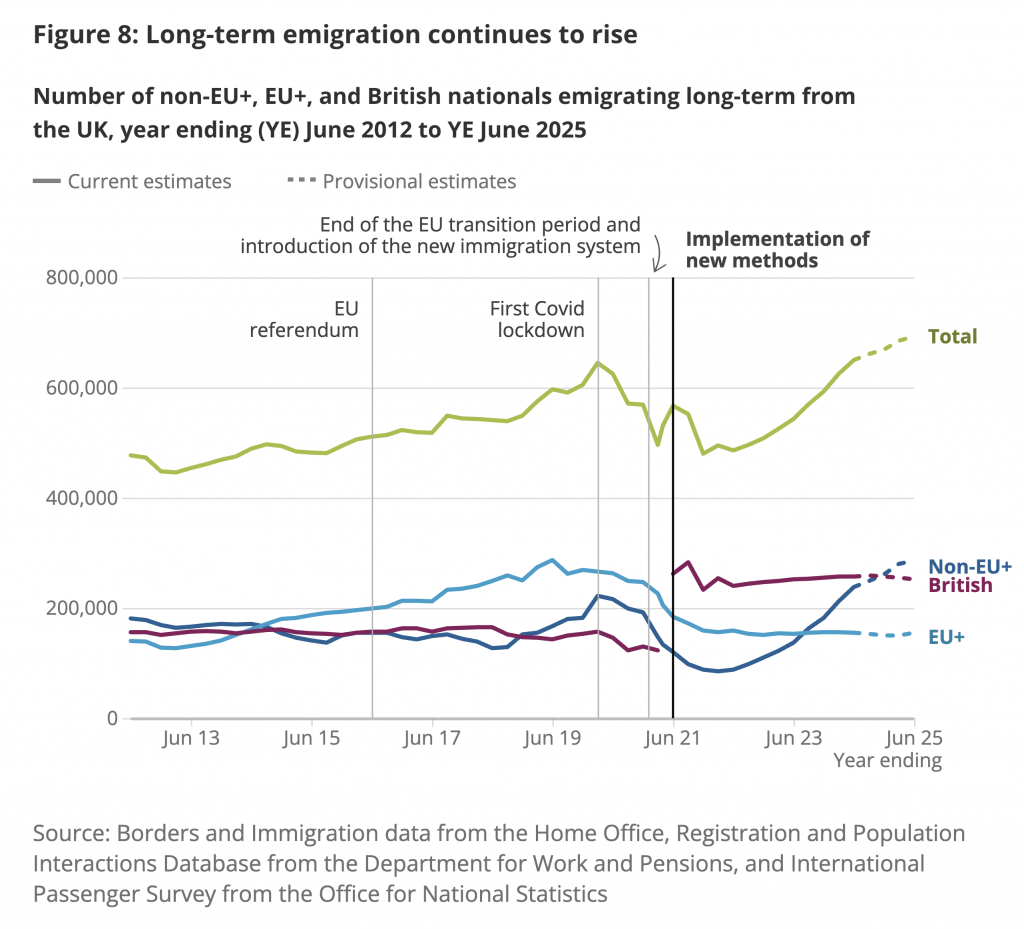
The greeline shows that the total number of people leaving the UK is the highest it has been, looking as far back as 2012. 

693,000 people of different nationalities left the UK.

Above is a split by nationality.

  • non-EU+ nationals (dark blue line) accounted for 41% of total emigration (286,000)
  • British nationals (purple line) made up 36% (252,000)
  • EU+ nationals (light blue line) made up 22% (155,000)

For Non-EU nationals leaving the UK, the top 5 are Indian, Chinese, Nigerian, Pakistani and Ukrainian. Here is a chart:
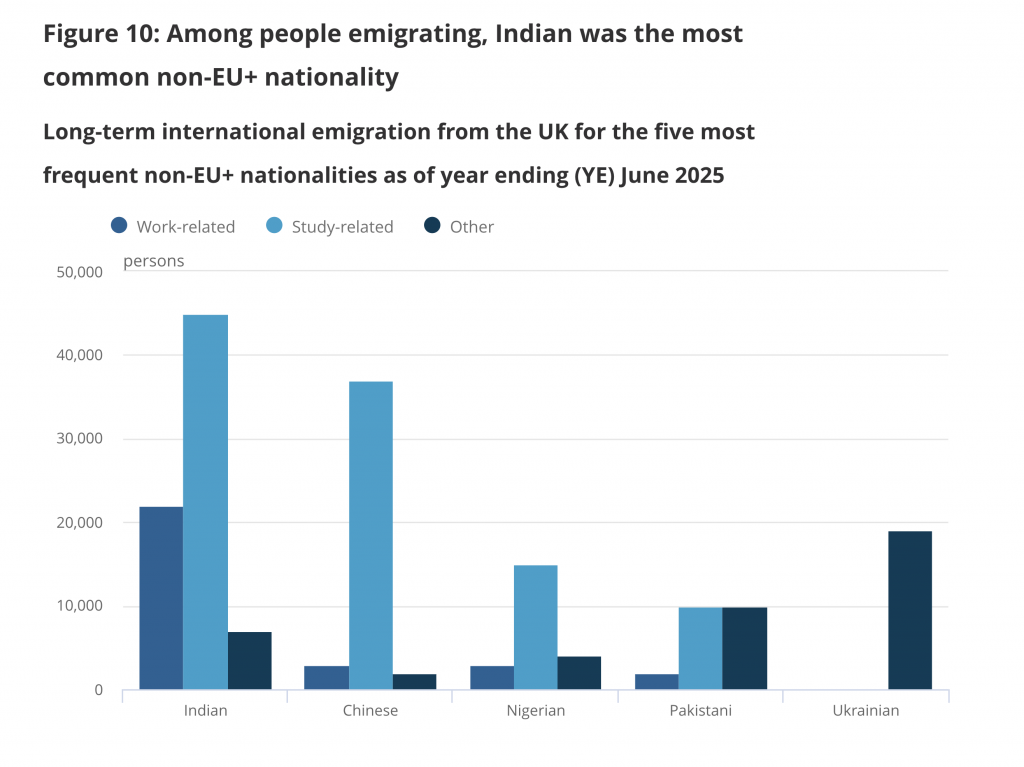
Leaving the UK

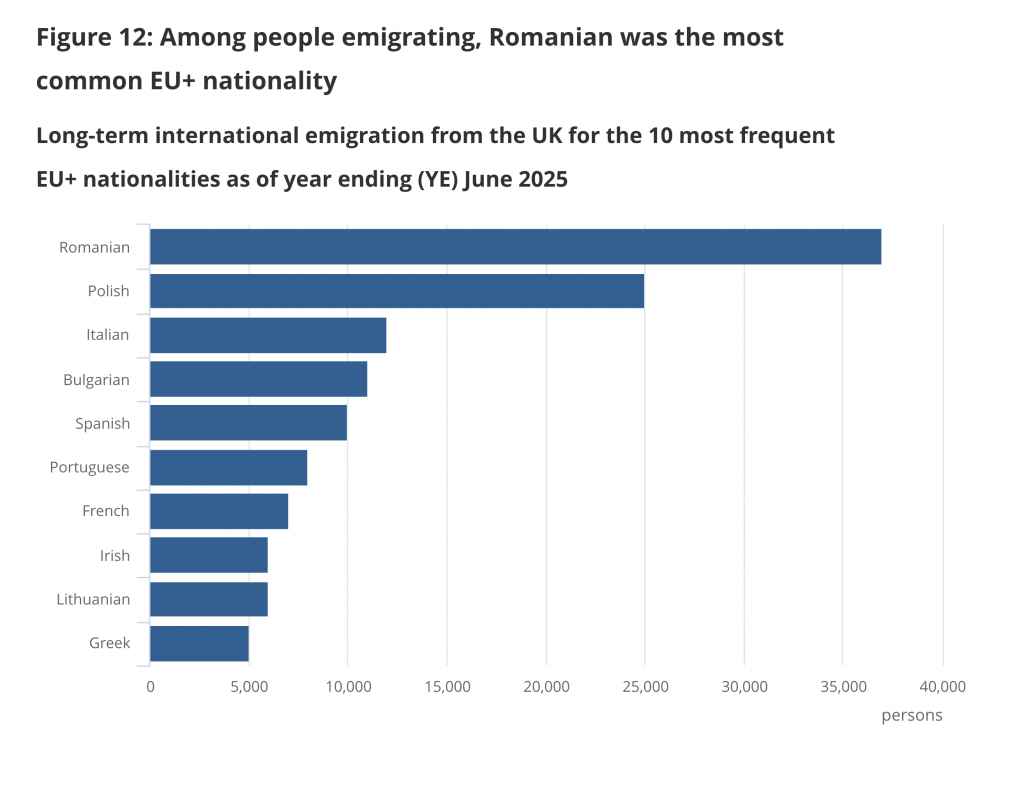
For EU citizens leaving the UK, here is a summary according to the Office for National Statistics (ONS):

The top 10 nationalities in order are Romanian (by far the largest), Polish (the next large number), then Italian, Bulgarian, Spanish, Portuguese, french, Irish, Lithuanian and Greek.
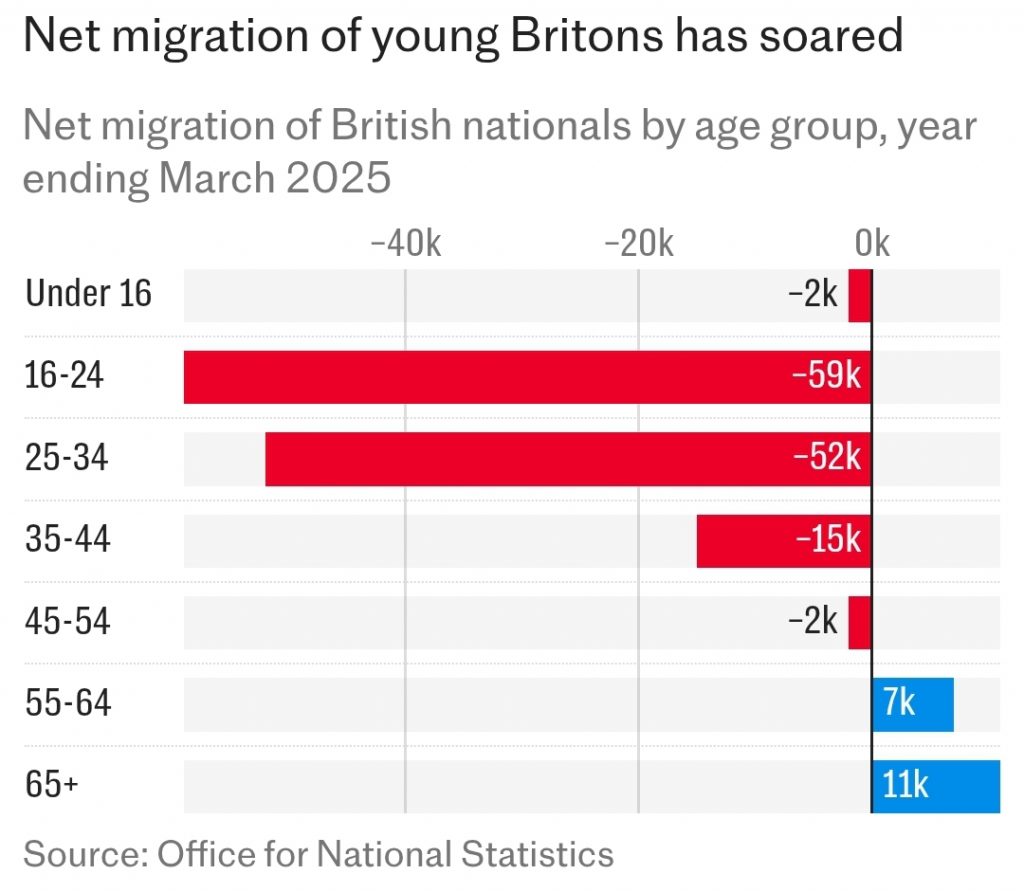
For the first time ever, the ONS has broken down exactly who is leaving Britain by age, revealing how Britain’s already ageing society is losing young people while drawing back the elderly. 

Below are the net migration numbers for Brits according to the ONS, as featured in the Telegraph.

And here’s the shocker:

👉🏽 According to the ONS, “around three-quarters of British nationals who emigrated in the YE June 2025 were under the age of 35.”

👉🏽 net of 110,000 young Brits left in one year.

This means the UK isn’t just losing people.

It’s losing the future — its workers, innovators and entrepreneurs, and taxpayers.
Leaving the UKMuch of this pain comes from long-standing structural issues such as a:

  • Weak job market
  • Stagnant wages
  • High housing costs
  • Rising employer costs under previous governments

Although the recent Labour Budget will most likely accelerate the number of young people leaving the UK, this isn’t a one-party issue. It’s a systemic one.

👉🏽 Meanwhile, older Britons are returning or not leaving. Net migration for 

➝35 to 44 year olds was only -15,000

➝45 to 54 year olds, it was only -2,000 

➝55 to 64 year olds, 7,000 more people actually moved back to the than left.

➝Over 65s, 11,000 more people moved back to the UK than left.

The 35 to 54-year-olds are likely already tied down with:

  • Marriages or being in a relationship where one person might want to move and the other in unsure.
  • responsibilities of raising children and their education (which they’d have to pay for if they moved abroad but they might get for free here in the UK), 
  • mortgages (which have a psychological burden), 
  • careers (which would be harder to start again in another country) and 
  • Extended Family and ageing parents.

Meanwhile, the over 55s who are returning more to the UK than they’re leaving are likely doing it because:

  • They’ve already had their fun and seen the world
  • They might miss family and friends
  • They might need the NHS more as they get older
  • They likely want access to their state pensions.


Part 2 – The Five Forces Pushing Young People Out 

Here are 5 reasons why young people are leaving the UK:

1. Stealth Taxes Eating Into Take-Home Pay

Frozen thresholds mean millions pay more tax without ever getting richer.

The Office for Budget Responsibility (OBR) says there will be:

  • 5.2m new taxpayers 
  • 4.8m dragged into 40% 
  • 600k dragged into 45% 

This has been building for years.

By 2030, almost 20% (1 in 5) employees will become higher-rate taxpayers compared to 8% in 2021 when the thresholds were frozen.

Plus, Student Loan Threshold Freeze = More Repayments, Sooner

Graduates start paying back earlier, even as wages stagnate.

This functions like another stealth tax.

2. Employers are Hiring Fewer Young People

From October 2024, employers’ National Insurance rose, and hiring slowed.

Graduates and school leavers were hit first.

Youth unemployment is now 15%, the highest in a decade outside the pandemic.

Over 700,000 young people are out of work.

3. Housing Costs Have Become Absurd

40–60% of income is spent on rent in major UK cities.

Then add food, utilities, transport, council tax…

Young people feel “stuck” before they’ve even started.

4. Cold Weather, Higher Crime and Rising Racism

These all speak to an environment that a lot of people don’t like.

The cold weather is balanced out by increasingly hotter Summers and we personally like to break up the winters with some time outside the UK somewhere warm, while also looking for small ways to appreciate and enjoy the changing seasons.

However, the higher crime and increasingly hostile environment are of great concern, and it’s clear why this is forcing people to move to other countries where they might feel more accepted.

That said, the grass is not always greener.

Take the weather, I was speaking to someone yesterday whose sibling recently moved to Australia, and she said that parts of Australia have a thin Ozone layer, meaning they have little protection from the Sun and a higher risk of skin cancers.

5. Global Mobility Has Shifted — Young People Are Leaving Because They Can

Remote working. Fast wifi. Easy video calls. Cheap European flights. English is a global business language.

The world has shrunk.

A young Brit today can build a life in Lisbon, work for a London startup, earn in pounds, operate entirely in English, and fly home in around two hours — something that simply wasn’t possible a generation ago.

Young people aren’t just being pushed out. They’re being pulled toward new possibilities.

Part 3 – Where They're Going and Why 

There are many countries, but Australia stands out, especially for White Brits.

Working holiday visas for Brits rose 80% in a single year.

Youth unemployment is under 10%.

Wages are often higher.

But beyond Australia:

Portugal has digital nomad visas.

Spain and Germany offer remote work routes. My brother recently moved to Malaga in Spain and is loving it there. 

We recently visited and couldn’t believe how good it was.

He pays 1500 Euros (£1300 a month), and for that he gets:

Warm weather all year round, 8 minutes walk to the beach, high-end 2-bedroom flat with 2 bathrooms, including a swimming pool, gym, jacuzzi, and co-working space, and the pace of life is slower, and people are really friendly. Really good vibes!

The UAE is also extremely popular and offers tax-free salaries. I’ll share more about the UAE in a minute.

Here is a table I found with the top 10 most popular destinations for Brits. Those destinations are:

Spain, United States, Australia, France (this was a surprise), Italy, Germany, United Arab Emirates, New Zealand, Ireland and Canada.
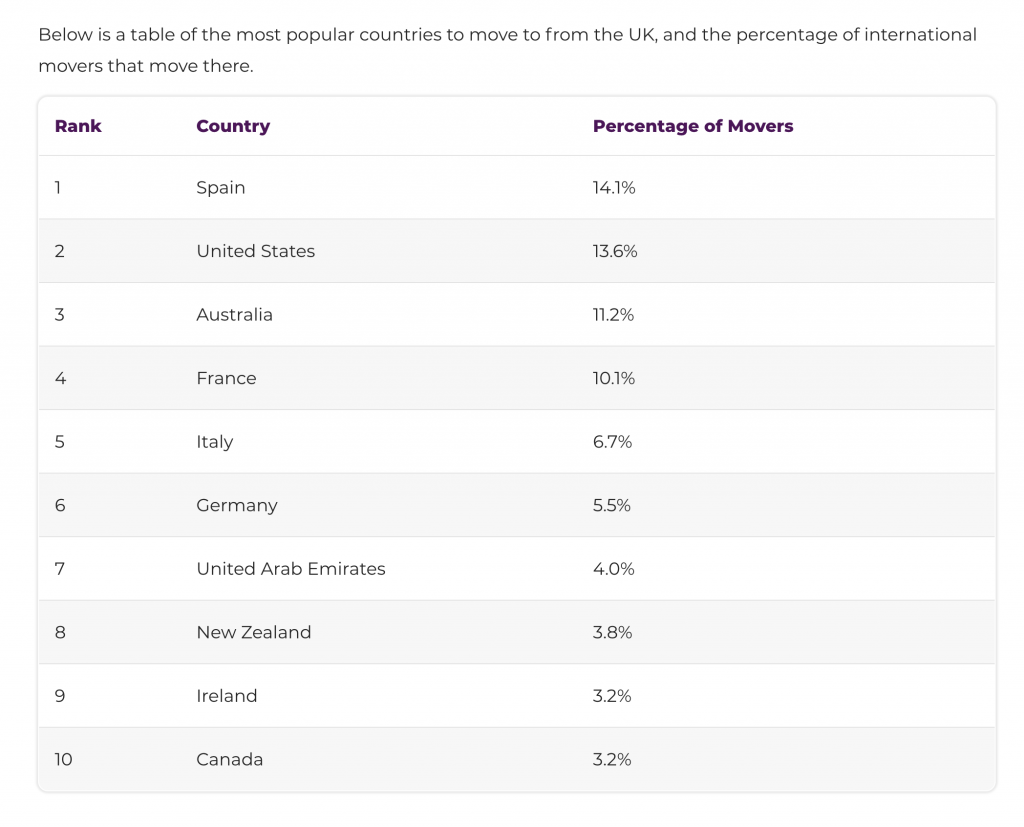
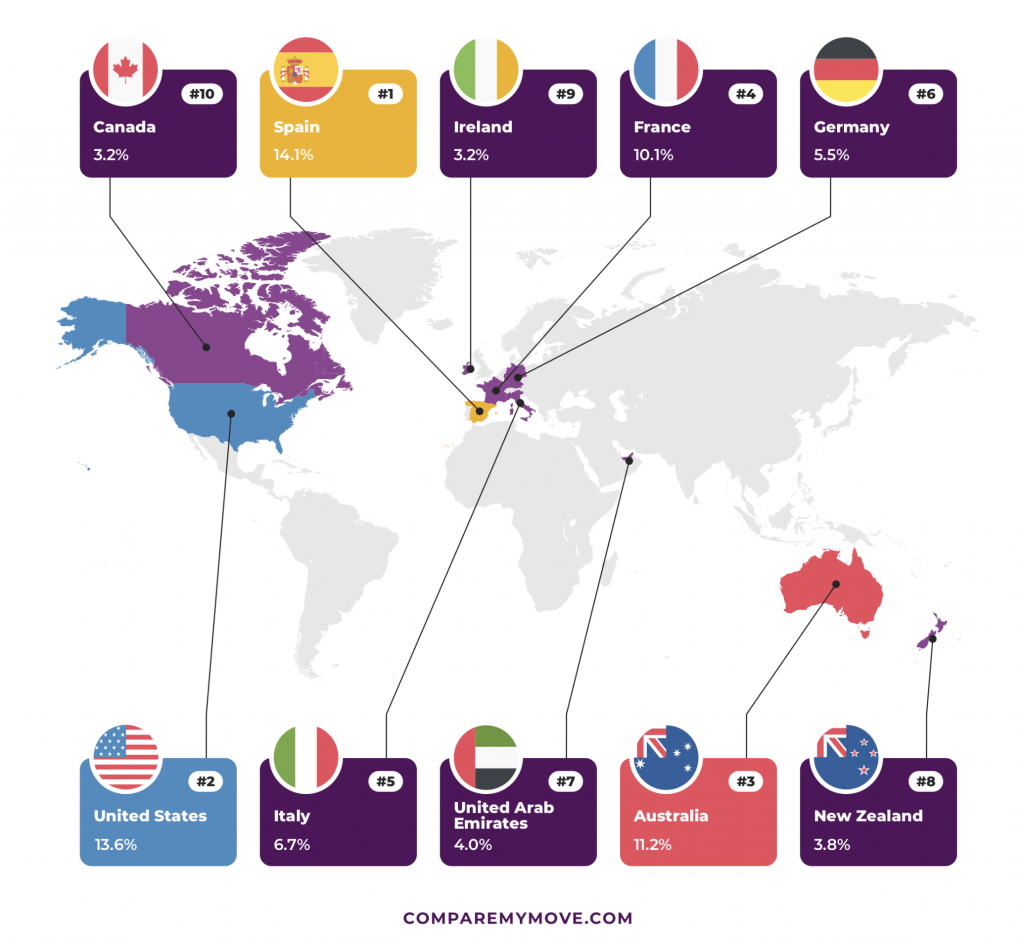
Leaving the UK Leaving the UK

Now, all that said, my lived experience as a Black person in the UK is that Black people are mostly looking at:

UAE (Dubai, Abu Dhabi and Sharjah are popular)

I have heard mixed stories about the UAE.

Some love it!

For example, 2 days ago, we met Jamelia, the award-winning singer, actress and television personality. 

Leaving the UK

She moved to Dubai in 2024, and we asked her about her experiences, and she loves it there.

She moved because she wanted a different environment. 

One tip she gave was that she worked for a whole year, saved up lots of cash and then moved.

We’ve previously done interviews with BrickzWithTipz (Dubai) and Dr Amina Yonis (Sharjah, which is cheaper), and they had very good things to say about the UAE.

Note that everyone I’ve spoken about so far is a public figure, so you might be wondering, what about everyday people?

I spoke with my friend (an Accountant) who moved there with all the perks before Dubai became very popular.

She lived and worked there for years, then got married, and they had 3 children.

However, recently, she moved back to the UK, and I asked why, and she said 2 main reasons.

  • It got too expensive to pay for private schools for our children, so we moved back for the UK State School system.
  • She moved back for the NHS, because paying for a family of 5 out there got too expensive.

Plus, all those perks she had for moving there had dried up because there are now too many people moving there, and they don’t need to offer those perks.

From other people, I’ve also heard that Dubai is very expensive and that people have a good lifestyle there, but at a cost. 

They never save any money there at all.

Some reliable sources living there now have said that Abu Dhabi is better than Dubai for families.

What do you guys think about this? What’s your personal experience? What have you heard from others?

Comment below and share.

Anyway, back to the list of places I’ve seen Black people move to (as well as Asians, Whites, etc), they are:

  • UAE
  • Qatar
  • Canada (a lot of NHS doctors move here)
  • Portugal
  • Bermuda (high-income area but high cost, too)
  • African countries like Ghana (quite a few of our friends have moved here), Rwanda, Kenya, Nigeria, South Africa, Gambia, and Tanzania.
  • Caribbean countries like Barbados, Grenada (we met a 37-year-old yesterday moving there), Jamaica, and St Lucia.
  • Asian countries like Singapore (we visited and loved it, and two of our friends moved here), Malaysia, and Thailand.

Jump in the comments and let me know what countries you’ve seen friends and family move to if they left the UK

Part 4 – But There's a Deeper Story – A National Mood Shift 

Let me know if this resonates with you… In the UK, there is a growing sense of drift.

A feeling that the UK has lost its spark and there is a cloud of negativity amplified by social media

Young people are losing belief that the country offers opportunities.

This is not just economic. It’s emotional, psychological, and cultural.

When a generation stops believing in its own country, migration simply accelerates.

Part 5: Why Older People Return and Why That Matters

Over-35s are:

  • Less likely to leave 
  • More likely to return 
  • More rooted 
  • More attached to community, family, stability 
  • Thinking about children, careers, and belonging
  • Thinking about their health (NHS) and their pensions. 

Modern communication also makes returning easier.

This generational contrast shows something important:

Freedom drives you out, Stability pulls you home. Your twenties are about exploration. Your thirties and forties and beyond are typically about being rooted.

This helps explain the earlier migration curve.

Part 6 – Before Leaving the UK – The Catastrophic Risks You Must Understand. 

Here’s the part nobody talks about.

Leaving the UK can be a smart move.

But for many people…

…it can also be catastrophic ⚠️ . Here are some reasons:

1. Working Abroad Without the Right Visa Can Destroy Your Future

Immigration lawyers warn that this is exploding.

You could face:

  • Fines 
  • Deportation 
  • Tax penalties 
  • Future visa bans 

Remote work ≠ permission to work.

2. Lower Living Costs Abroad Often Come With Lower Salaries

Cheaper rent means nothing if:

  • Your income drops 
  • Career progression slows 
  • You lack professional recognition 

People often underestimate that in many industries — healthcare, law, finance, engineering, teaching — your UK qualifications don’t automatically transfer abroad.

That means you might not be allowed to work in the job you trained for, or you might have to start again, sit new exams, or accept a lower role. 

This can set your career — and your finances — back by years.

3. You Lose the Financial Safety Nets You Understand

The UK has:

  • A generous tax-free ISA of £20k a year per person. So £40k a year for couples. Very few countries beat the UK’s ISA system. Just think about that.
  • The NHS, although far from perfect.
  • Strong worker protections
  • Predictable pensions (although the goal post keeps moving, which you also see in other countries)
  • Tax rules you can follow (though not always easy)
  • The state school system.

Some countries have none of this, or they’re of very poor quality, or you need to pay a lot for them, such that it wipes out some of the benefits of moving.

You might not feel the pain for a year, but you will over a decade.

4. Emotional Wealth Matters

Family, friendships, belonging, support systems, these are invisible wealth. You don’t realise how valuable they are until they’re gone.

5. You Can End Up In Jail

Popular countries in the Middle East offer sunshine, higher salaries, and a tax-free lifestyle, and that pulls in thousands of young Brits every year.

But what people don’t always realise is this:

👉🏽 The laws in the Middle East are very different from UK laws,
👉🏽 They are strictly enforced,
👉🏽 And breaking them — even unintentionally — can lead to arrest, detention, or deportation.

For example, in countries of these countries:

  • Public behaviour rules are much stricter 
  • Alcohol laws vary 
  • Cohabitation rules can apply 
  • Social media posts can be criminalised 
  • Late payments or unpaid debts can be treated as criminal offences, not civil ones 
  • And working without the correct visa is taken extremely seriously 

In the UK, missing a payment might lead to a letter.
However, in the middle East, for example, it can and does lead to criminal charges.

This means that young Brits who move there without fully understanding the legal system can find themselves in very serious trouble very quickly.

Migration advisers say:

“The biggest problem is people assuming UK norms apply abroad. In some Middle Eastern countries, they don’t — and the consequences can be severe.”

So the message is simple:

You must understand the legal system of the country you’re moving to — especially if it’s not aligned with Western norms.

Because a move meant to improve your finances can end up threatening your freedom if you don’t know the rules.

Part 7 – So Should You Leave The UK? (Biblical Perspective)

The real question is…

Are you leaving to escape? Or leaving to pursue something?

You know, whenever people talk about leaving the UK today — whether it’s because of the economy, the cost of living, or just feeling stuck — I’m reminded of two powerful stories in the Bible. 

And they teach something essential about big life decisions like migration.

Story 1: Isaac — He Had The Call to Stay

In Genesis 26, there was a severe famine in the land. 

The modern-day equivalent of economic pressure, cost of living crisis, lack of opportunity and so on.

People were moving.

Opportunities were drying up.

And Isaac was preparing to leave for Egypt — the place everyone believed had better prospects.

But then something unusual happens.

In Genesis 26:2–3:

2 The Lord appeared to Isaac and said, “Do not go down to Egypt; live in the land where I tell you to live. 

3 Stay in this land for a while, and I will be with you and will bless you. For to you and your descendants I will give all these lands and will confirm the oath I swore to your father Abraham.

Isaac listens. He stays.

And in the same year — while everyone else is fleeing — he prospers a hundredfold.

Genesis 26:12-13 says:

12 Isaac planted crops in that land and the same year reaped a hundredfold, because the Lord blessed him. 13 The man became rich, and his wealth continued to grow until he became very wealthy.

“Planted crops could mean that he invested in the land”

Sometimes the right move… is not to move at all. Not because the situation isn’t hard, but because your purpose for that season is in the place you’re tempted to run from.

Story 2: Jacob — He Had The Call to Go

Fast forward to Genesis 46. Jacob is older.

A door opens for him to relocate to Egypt — a completely different culture, a new economic system, a fresh start for his whole family.

But Jacob isn’t sure, and here is the key bit…

He pauses in Beersheba to seek God before taking such a big step.

And God said to him in a vision at night:

“Do not be afraid to go down to Egypt… I will go with you.” (Genesis 46:2–4)

3 “I am God, the God of your father,” he said. “Do not be afraid to go down to Egypt, for I will make you into a great nation there. 4 I will go down to Egypt with you, and I will surely bring you back again. 

And that move becomes the turning point for an entire nation.

Sometimes the right move… is to go.

Not out of fear, but because your next chapter is tied to a new environment.

The lesson from both stories is this:

There isn’t a “holy answer” of always staying… or always leaving.

Isaac was blessed by staying.

Jacob was blessed by going.

The wisdom is in knowing which season you’re in.

And here’s the part most people miss:

There’s a difference between a push-based migration and a purpose-based migration.

If you’re moving just because life is hard, that’s a push.

But if you’re moving because you’ve reflected, sought counsel, prayed, and genuinely feel led — that’s purpose.

And purpose always leads to provision.

So as you think about whether to leave the UK or stay, remember:

Some people are meant to stay and build.

Others are meant to go and grow.

The key is not the country — it’s the clarity.

Part 8 – How Young People Can Still Build Wealth In the UK and Similar Economies

Here’s how to build wealth even in a tough UK economy:

1. Build the 4 Pillars for building wealth

  • Build the mindset
  • Build the habits
  • Build the system 
  • Build the life

These are the 4 pillars of our new book, The Wealth Habit, and we show you exactly how to do it. 

This approach to building wealth is applicable no matter where you are in the world, and it will help to make wealth building effortless, inevitable and sustainable for life.

Order your copy of The Wealth Habit, and while you’re there, gift 🎁 a copy to a loved one.

2. Design your tax strategy intentionally

Use ISAs, pensions, salary sacrifice (while you still can), and side business structures.

3. Build global skills

Skills are mobile. Jobs aren’t.

4. Start investing early — even small amounts

Compounding is the great equaliser.

5. Focus on ownership, not just income

Income pays bills. Ownership builds freedom. The more global that ownership, the better.

Part 9 – Conclusion

The UK is changing. We’re entering a decade of higher taxes, low growth, low productivity and high cost of living.

Young people are responding by leaving. What will you do?

In case you’re wondering what we are doing, we still live in the UK, and our dream has always been to have a hybrid of living here while spending time in other countries (in Africa and beyond) during colder months. 

This is something a lot of Brits already do and have done for decades in places like Spain, Portugal, etc.

👉🏽Whether you stay or go, you can still design a life of freedom if you approach it strategically, not emotionally.

Let me know in the comments:

Are you thinking about leaving the UK? And why? And where are you considering moving to? Comment and let me know.

If you found this helpful, share it on WhatsApp with someone weighing their options.

Don’t go anywhere—check out these resources on building wealth in difficult times:

  • Book a Power Hour Financial Coaching Session
  • 10 Silent Wealth Destroyers In Your 30s and 40s
  • You're Trained To Be Poor (10 Shocking Money Traps)

Watch the video version of the real reason young people are leaving the UK:

As always, in all things, be thankful and seek joy!

The 10 Silent Wealth Destroyers in Your 30s and 40s

December 9, 2025 by The Humble Penny 6 Comments

Most people don’t realise this…Your 30s and 40s are the make-or-break decades of your financial life.

This is the stage where your responsibilities explode — career, kids, mortgage, ageing parents, lifestyle creep — and with it, the decisions that quietly shape your next 40 years.

But here’s the twist:

Most of the financial mistakes that cost people hundreds of thousands of pounds or dollars… are not the obvious ones. 

Not “don’t buy lattes” or “don’t buy a luxury car”.

I’m talking about hidden, silent, easy-to-miss decisions that compound into massive regret later.

So today, we want to break down the 10 biggest, least obvious money mistakes people make in their 30s and 40s, and how to avoid them — so you actually build real, lasting wealth.

My name is Ken of The Humble Penny and Financial Joy Academy. I’m a Chartered Accountant, Former CFO and Financial Coach.

Together with my wife, Mary, we achieved Financial Independence at the age of 34 and became mortgage-free in 7 years while raising two children.

We’re Sunday Times Bestselling Authors of our first book, Financial Joy.

📌 We recently announced our latest book, The Wealth Habit, which is a behaviour-driven mindset and habit system that rewires the way you think about money, turning financial success into a series of tiny, effortless, repeatable actions.

Whether you're struggling with money, looking to break free from the paycheck-to-paycheck cycle, or searching for a stress-free, automated way to build wealth, this book gives you a clear, habit-based roadmap to make financial success inevitable. 

Huge thanks to everyone who has ordered a copy already 🙂. 

Table of Contents

Toggle
  • The 10 Silent Wealth Destroyers in Your 30s and 40s
  • Mistake 1 — Sending Money Back Home to Build Houses That Mostly Remain Empty 
  • Mistake 2 — Marrying the Wrong Partner 
  • Mistake 3 – Staying in a Career That Pays You “Enough” but Doesn’t Scale 
  • Mistake 4 – Moving Into a Bigger House That Steals Your Freedom 
  • Mistake 5 – Not Having a “Resilience Fund” (Not Just an Emergency Fund) 
  • Mistake 6 — The Lost Years of Not Investing 
  • Mistake 7 — Avoiding Hard Money Conversations (Being Allergic to Conflict) 
  • Mistake 8 – Outsourcing All Financial Thinking to “Experts” or Your Partner
  • Mistake 9 – Raising Children Without a Wealth Plan 
  • Mistake 10 – Always Being “One Big Decision Away” from Freedom 
  • Conclusion 

The 10 Silent Wealth Destroyers in Your 30s and 40s

Let’s dive straight in and look at these one at a time:

Mistake 1 — Sending Money Back Home to Build Houses That Mostly Remain Empty 

This one is deeply personal and cultural.

For many in the African, Caribbean, Asian, and Eastern European diaspora, there’s a powerful emotional pull to “build back home.”

But here’s the harsh truth:

Many people spend tens of thousands — even hundreds of thousands  — building houses “back home”… that remain empty.

Worse still:

  • For some, the house is never completed or even built as family members steal the money.
  • Family issues can sometimes stop progress
  • Costs spiral due to high inflation
  • The builder disappears
  • Most people who build never move back, e.g. because of poor health facilities or infrastructure, or they’re just used to a certain lifestyle level
  • Many don’t rent theirs out, and some who do have a very bad experience from people who refused to pay rent as soon as they realise the owners live abroad. Some even trash the place.
  • For a lot of people, it becomes a monument of guilt, hope, and sunk costs! And it never produces a penny in return
  • Even where some people successfully build a house back home, there is no succession planning, and these properties or land in remote areas end up in other hands when parents pass away.

This is not a judgement. It’s just the reality of so many people I know.

So many live with this silently, and we need to talk about it more in our communities.

People build back home for many reasons:

  1. cultural duty or expections,
  2. guilt
  3. wanting to leave a legacy
  4. fear of being seen as “forgetting home”
  5. emotional attachment
  6. Fear of deportation, especially as politically, things get more hostile.

But financially, it can drain the very money needed to secure your financial future and have options. 

A lot of people, especially in ethnic minority communities, are poorly prepared for retirement.

Building a house is not enough.

A lot of people are struggling in the West and doing low-paying jobs.

A lot of people are still paying expensive rent in the UK, US, Canada and so on, and never go on the property ladder and feel stuck.

While building back home has worked for some people, especially those who built in a good location and managed to rent their properties out (well done if that’s you!), there are SO MANY more with disaster stories.

Take this example:

That is absolutely mindblowing! These are real-life stories. 

Please comment below and share your own examples related to building back home and what you’ve learned. 

Has it been successful? Or do your family have regrets?

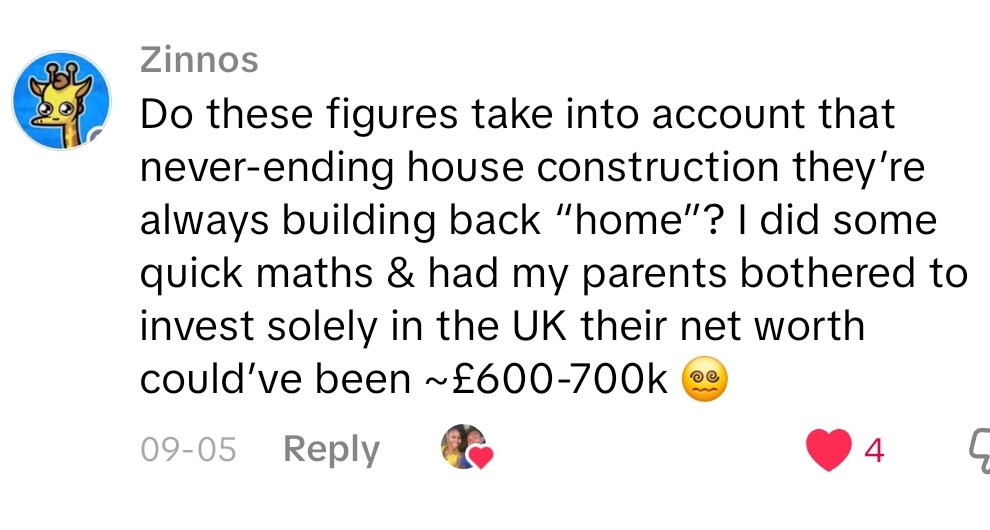
This other comment said:

I’ve had so many comments from people all over the world (US, Canada, Australia, Africa, Europe, etc) on this topic because I posted a short clip about it on Instagram, TikTok and YouTube, and it went viral.

This is a complex topic, and there is so much to say, but before you send another pound or dollar or Euro back “home” to build, ask:

Do I have a plan for this property, or am I paying for a dream I may never live?

Building back home can be a very good thing if done properly, as it can be a way of investing back into your home country and generating a return. 

It can also be a lot cheaper than buying in the West.

However, there are alternatives that cost very little to get started with and can be done tax-free, and that’s where investing in the stock market comes in.

100k returning 8% a year doubles every 9 years to 200k, 400k, 800k and so on and can create enough in returns to have financial security and the option to also invest back home in a smart way if you want to.

It’s a win-win situation as you can achieve both!

Recommended: ISA Millionaires: How Ordinary People Built £1m Tax Free

A recent reader of The Humble Penny shared their story of how they built a 7-figure tax-free ISA investment portfolio and generate 6-figures in dividend passive income annually:

Mistake 2 — Marrying the Wrong Partner 

This is one of the most expensive financial decisions you will ever make, and society rarely talks about it.

Your choice of partner affects:

  • your spending habits 
  • your earning potential 
  • your stress levels 
  • your career moves 
  • your ability to take risks 
  • your long-term wealth trajectory 

If you marry someone abusive, financially controlling, irresponsible, constantly spending or in debt, secretive, threatened by your success or unaligned in goals or values, your finances will always be in chaos.

Your 30s and 40s are the years where people often say: “I should have left sooner.”

Choosing the right partner is not just about love; it’s about building a future where both lives expand together, and not shrink.

If I may add, a strong foundation for an ideal partner is someone who puts God first. 

You will always know the ideal ones and the ones to avoid by their fruit.

Choose very wisely and look for all the signs.

Mistake 3 – Staying in a Career That Pays You “Enough” but Doesn’t Scale 

Most people in their 30s and 40s don’t have an income problem — they have a trajectory problem.

Your income might go from £45k → £55k → £60k… But the issue is: it’s not compounding.

The biggest hidden mistake?

Staying in a role that doesn’t meaningfully increase your earning power.

People stay because they're:

  • “comfortable” 
  • scared of trying something new 
  • loyal to a company that wouldn’t blink before making them redundant 
  • too busy to think strategically about career moves 

But here’s the truth:

A stagnant income combined with poor money habits and a lack of systems is one of the fastest ways to sabotage long-term wealth.

In these decades, the big financial wins come from:

  • switching to industries with higher lifetime earnings 
  • upgrading skills with real ROI (data, tech, leadership, AI literacy) 
  • negotiating every 24–36 months 
  • moving towards roles with equity, bonuses or profit share 

If your income doesn’t grow faster than inflation AND your lifestyle… You’re slowly sinking.

Mistake 4 – Moving Into a Bigger House That Steals Your Freedom 

This mistake is almost invisible.

People go from:

Starter home → stretching too much for the “forever home”.

Others do this out of pure lifestyle creep. This leads to a bigger mortgage → bigger bills → bigger pressure.

It feels like progress, but often locks families into:

  • higher debt (which you will work another 20 to 30 years to pay off) 
  • slower investing 
  • less flexibility 
  • needing bigger salaries just to stay afloat 

In your 30s and 40s, the opportunity cost of buying the biggest house (especially with a lot of debt) is enormous.

You sacrifice:

  • early investing compounding 
  • entrepreneurial risk 
  • career freedom 
  • savings rate 
  • optionality 

Your house becomes a golden cage — beautiful on the outside, financially suffocating on the inside.

Before you upgrade, ask:

Does this home serve my goals, or my ego?

Mistake 5 – Not Having a “Resilience Fund” (Not Just an Emergency Fund) 

Everyone talks about the “3–6 months emergency fund”.

But I’ve realised that’s no longer enough.

People in their 30s and 40s face completely different risks:

  • income shocks 
  • childcare costs 
  • sudden redundancy that takes longer to recover, especially with AI displacing jobs 
  • ageing parent responsibilities 
  • cost-of-living volatility 

You need something bigger: a Resilience Fund.

It’s not just cash. It’s a system that keeps you standing when life hits hard.

Your Resilience Fund includes:

  • cash buffer 
  • short-term investment buffer 
  • income-diversification buffer 
  • low-cost lifestyle lever you can pull anytime 
  • affordable insurances (critical illness, income protection) 

Most people fail financially because they only prepare for surprises, not storms.

Mistake 6 — The Lost Years of Not Investing 

This is the quietest wealth destroyer.

Not “not investing”… But the lost years.

Those years spent saying:

  • “I don’t know where to start.” 
  • “I’m afraid of losing money.” 
  • “I’ll invest when I earn more.” 
  • “I’ll start once things calm down.” (They never do.) 

People wait so long for clarity… that they lose the only advantage you can’t recover — time.

And the truth is: Even investing £50 or $100 a month can radically change your financial future.

The people with the biggest regrets later in life aren’t those who invested small amounts… They’re the ones who waited for the “perfect moment”.

That moment never comes.

Recommended: Access all our investing and income growth classes at Financial Joy Academy

Mistake 7 — Avoiding Hard Money Conversations (Being Allergic to Conflict) 

Most divorces, debt spirals, and money mistakes begin with silence.

People avoid conversations like:

  • “Are we underestimating our spending, and overestimating what’s left?” 
  • “We can’t keep going. We need to reduce our lifestyle.” 
  • “This school fee is too much. Why are we doing this? Is it time to pivot?” 
  • “Your spending and mine need alignment.” 
  • “I’m drowning but afraid to tell you.” 

Avoidance compounds faster than interest on debt does.

Those who build wealth don’t avoid tension; they address it early, kindly, and consistently.

Talking about money won’t break your relationship. Avoiding it will.

Mistake 8 – Outsourcing All Financial Thinking to “Experts” or Your Partner

People in their 30s and 40s are busy. Work, family, life… It’s overwhelming.

So they outsource thinking:

  • “My pension is being handled.” 
  • “My financial adviser knows best.” 
  • “My accountant will sort it.” 
  • “HR must have explained the benefits.” 
  • “The bank wouldn’t advise me something that isn’t good, right?”
  • “My partner handles all our finances” 

This is dangerous, not because advisers are bad, but because no one cares about your financial freedom more than you.

The subtle mistake is blind delegation instead of informed partnership.

Your financial adviser cares about his or her fees.

Your bank cares about the interest you’re paying on your debt.

Your accountant might not offer you the most tax-efficient advice, but demand his/her fees.

If you’re in a terrible relationship, your partner will be putting money into their investments or pensions and not yours.

If you don’t pay attention, everyone else will get paid except for you.

You need to educate yourself, then get advice.

The average person does the opposite: They get advice, then assume they’re educated.

Those who win financially in their 40s, 50s and beyond always keep their brain switched on.

You cannot outsource stewardship. You can outsource tasks, but never the thinking.

Mistake 9 – Raising Children Without a Wealth Plan 

Kids are a blessing, but most parents massively underestimate the financial impact.

The hidden mistake? Raising children reactively instead of strategically.

You need a plan for:

  • school choices 
  • activities 
  • savings for them 
  • your own retirement (Yes, yours first!! most people sacrifice this!) 
  • boundaries on financial expectations 
  • lifestyle choices that don’t sabotage your future. If you can’t survive, it doesn’t help your children very much. 

Families who thrive financially do one thing well: They make decisions based on values, not pressure.

Mistake 10 – Always Being “One Big Decision Away” from Freedom 

This is a silent killer. People say things like:

  • “Once I get this promotion…” 
  • “Once we buy the house…” 
  • “Once the kids start school…” 
  • “Once the mortgage drops…” 
  • “Once the business takes off…” 

They delay financial action because they believe freedom will come from one big event.

It never does.

Freedom comes from small habits, tiny margins, automated investing, simple systems, early decisions and consistent execution. 

The people who win at money aren’t smarter; they’re simply consistent.

Never gamble your financial future on one big moment.

Design it with small, daily steps.

📌 Read our brand new book, The Wealth Habit, which is a mindset and habit system that will help you create a system that makes wealth building effortless, inevitable and sustainable for life.

Conclusion 

These mistakes are rarely spoken about.

They’re not the typical “stop buying coffee” advice.

They are deeper. Emotional. Structural. Cultural. Identity-level decisions.

But if you avoid them, the next 10 to 20 years of your life will look completely different.

And remember: Wealth isn’t about perfection, it’s about small, consistent, smart moves that compound quietly in the background.

If you found this helpful, comment below and share this with someone in their 20s, 30s or 40s who needs this message today.

Let me know in the comments: Which of the 10 mistakes spoke to you the most?

Don’t go anywhere, check out this next post on:

  • The Most Overlooked Habits That Quietly Build Wealth
  • Why YOUR FIRST £100k Is The MAGICAL Number For Reaching £1m or $1m
  • How to Make It In The UK (Even When It Feels Impossible)

As always, in all things, be thankful and seek joy.

The 3 Most Overlooked Habits That Quietly Build Wealth

October 1, 2025 by The Humble Penny 10 Comments

The 3 Most Overlooked Habits That Quietly Build Wealth

Over the years, we have studied what it actually takes to produce long‑term financial freedom.

We’ve read the research, interviewed people who built lasting wealth, and reflected on our own journey to financial independence aged 34.

Although life has many challenges, what we've learned is that most people never build wealth because they’ve never created a system for it.

They might save a bit here, invest a bit there, cut back when things feel tight, but without consistent habits, wealth never takes root.

Think of your body.

Your heart, lungs, and digestive system each work quietly in the background, keeping you alive without you even thinking about it.

Wealth works the same way. Your habits are the subsystems of your financial body.

On their own, each habit seems small.

But together, they form a powerful system that quietly keeps your financial life alive and strong, and over time, makes wealth inevitable.

The truth is, wealth isn’t about luck, timing, or even intelligence.

It’s about systems, and systems are powered by habits.

Build the right ones, and your money will work in the background just like your body does: silently, consistently, and for life.

Today, we'll share three habits, among others, that are frequently overlooked but transformational when applied consistently.

We’ll tell real, memorable stories that illustrate each habit, explain why they work, and give practical steps you can use to make these habits part of your life.

Note: We’ll be revealing something we’ve been creating quietly behind the scenes, designed to help you create systems for building wealth and transform the way millions approach their money. You’ll be among the very first to see it. Stay tuned.

We are Ken and Mary, founders of The Humble Penny and Financial Joy Academy. and authors of the Sunday Times Bestseller, Financial Joy, a 10-week plan to help you banish debt, grow your money and unlock financial freedom.

habits

Table of Contents

Toggle
  • The 3 Most Overlooked Habits That Quietly Build Wealth
  • Habit 1 — Engineer your own luck
  • My own “engineer your luck” moment
  • Habit 2 — Stubborn consistency
  • Habit 3 — Bouncing back
  • Putting the three habits together: a simple 12‑week plan
  • Common myths and mistakes
  • How to measure progress
  • Final thoughts

The 3 Most Overlooked Habits That Quietly Build Wealth

Let's dive in and unpack the 3 overlooked habits that quietly build wealth.

Habit 1 — Engineer your own luck

Wealthy people don’t just wait for opportunities to fall into their laps. They create them.

They get into rooms where important conversations happen, they experiment with bold approaches, and they build relationships deliberately.

In short: they make it easier for opportunity to find them.

Luck is preparation meeting opportunity.

Here are three stories that bring this to life:

Story 1 — Sir Richard Branson and the paper aeroplane

At a book launch for Richard Branson, someone wrote a business pitch on a sheet of paper, folded it into a paper aeroplane and tossed it toward the stage.

It landed on Branson. He opened it, read the pitch, admired the boldness, and promised to pass it to his team.

That paper plane opened a door because the person did something unusual and memorable.

Story 2 — Sitting By The Loo For Opportunity

Simon Squibb wanted to meet Richard Branson but found the normal routes ineffective.

A team member's girlfriend discovered Branson would be on a particular flight she worked on.

That team member took the initiative to book a seat in the upper class with his own money and then camped near the toilet for the duration of the flight.

8 hours later, when Branson got up to use the restroom, he noticed this team member working on his laptop and asked him, “young man, what are you working on?”.

That moment, engineered by careful thinking and a little patience, became the conversation that led to a relationship.

Story 3 — Steven Spielberg and the bathroom

Steven Spielberg, as a young person, once visited Universal Studios on a tour with others.

While on a tour break, he hid in a restroom at Universal Studios and let the tour continue.

He then came out and mingled with staff, and over time, even secured a pass with the librarian that gave him access throughout the summer holidays. 

Doing this helped him to create unusual proximity to the people who mattered and he used that proximity to learn, to connect, and to make opportunities happen for his career.

My own “engineer your luck” moment

I recently attended a business event, where several speakers I wanted to meet in person were presenting: Daniel Priestley, Simon Squibb, Rory Sutherland, Piers Linney, Lottie Whyte and others.

Planning for the event, I decided to take a very deliberate approach.

I brought five signed copies of our book Financial Joy, visualised my introductions while driving there, and arrived early for front‑row seats.

After each talk, I followed the speaker towards the VIP area where they were being led away and introduced myself.

I handed over a signed copy and a brief thank‑you.

All it took was just intentional presence, preparation and follow‑through.

Because I had shown up in person, the conversations that followed were deeper and will lead to new relationships and potential collaborations.

How to start engineering your own luck

Step 1: Decide whom you want to meet and why.

Identify three people who could genuinely change your trajectory in the next 12 months. Be specific about the value you could provide to them.

Step 2: Create an unusual approach.

Boldness stands out. A genuine, well‑thought‑out, unconventional approach, e.g. an unexpected gift, a creative pitch, or a memorable line, can open a door faster than a bland cold message.

Step 3: Be in the right rooms.

Pay and attend events, conferences, meetups, podcasts and workshops where the people you want to meet are likely to be.

Get there early. Sit near the front row and be visible.

Step 4: Prepare a short, natural pitch.

Don’t wing it. Rehearse a 15‑second intro: who you are, what you do, and a concrete reason you wanted to meet them.

Personalise it to the person and be ready to hand over something tangible (a book, a one‑page note, a small case study).

Plus, how you can serve or contribute to their work (so important!).

Step 5: Follow up with value.

After the meeting, send a brief note that references the moment you shared and provides something useful: a link to an article, a warm introduction, or a practical idea that solves a problem they mentioned.

Step 6: Measure proximity, not vanity.

Track how many meaningful conversations you have each month, not how many likes your post got.

Meaningful = a phone call, an exchange of resources, or a committed next step.

Common mistakes when trying to “engineer luck”

  • Doing something unusual without thought e.g. quirky for quirks’ sake rarely works. Make sure your approach is intelligent and considerate.
  • Trying to take without giving. The best connections are reciprocal. Always offer something first.
  • Confusing quantity with quality. It’s far better to cultivate a handful of deep relationships than hundreds of shallow contacts.

Habit 2 — Stubborn consistency

Wealth is rarely built by one‑off brilliance.

More often it’s the compound effect of small actions performed repeatedly. I call this habit “stubborn consistency.”

It’s the willingness to keep showing up, month after month, even when the progress looks slow or invisible.

Stubborn consistency is the difference between someone who tries once and someone who builds a business, a following, or a financial freedom pot.

Lottie Whyte’s example

Lottie White, a co‑founder of MyoMaster and a former guest on Dragon's Den, was turned down 300 times before raising her first million.

Imagine being told again and again that you're not good enough or that your product is not one they want to invest in. Most people will be crushed.

But those 300 rejections are proof that persistence plus learning will find an opening.

Lottie obsessively focused on things other founders might ignore: she still took customer service calls as CEO to understand pain points, she drilled ad optimisation until returns improved, and she treated rejections as data, not verdicts.

This kind of gritty consistency created momentum.

Today, her business is on track to generate around £10m in revenue, and it wasn’t because of a single lucky break, it was because of repeated effort and refinement.

Why stubborn consistency works

  • Compound interest of action. Monthly savings, ongoing content production, repeated outreach — each small input compounds into exponential results over time.
  • Learning loops. Consistency allows you to gather feedback faster. The tenth version of your pitch is almost always better than the first, because you’ve learned what works and what doesn’t.
  • Trust signals. Showing up over time builds credibility. Customers, investors and partners notice reliability.

How to cultivate stubborn consistency

Below are practical steps you can adopt this week to develop stubborn consistency in your finances, career or business.

i) Create a minimum viable routine.

Decide on a small, non‑negotiable action you can commit to daily or weekly.

Examples: automatic £200 or $300 monthly investment, publish one article per week, reach out to five prospects every Monday.

ii) Use systems, not willpower.

Automate savings and investments.

Schedule blocks in your calendar for content creation and networking.

Systems free up willpower for harder decisions.

iii) Track leading indicators.

Instead of obsessing over outputs only (revenue, net worth), measure behaviours: number of meals cooked at home vs takeaways, return visits from customers, ad optimisation tests run.

iv) Find accountability.

A partner, coach or mastermind helps you keep going on days when motivation dips.

v) Set horizons and milestones.

Don’t expect overnight change—plan 6, 12, 24 months and measure progress at those intervals.

Examples of stubborn consistency in everyday life

  • Investing: set up a monthly direct debit into an ISA or investment account and increase it each year.
  • Business: test one paid ad campaign per month, refine, and keep the winning campaigns running.
  • Career: build a portfolio by contributing one high‑quality case study or project every quarter.
  • Content: publish one blog/video every week for a year—give it time to compound and find an audience.

Habit 3 — Bouncing back

Even the best plans go sideways.

Investments fail, businesses stall, relationships break.

What separates those who ultimately build wealth from those who give up is not immunity to setbacks, but the ability to recover quickly and learn from them.

Resilience is not merely a trait you either have or don’t.

It’s a habit you can cultivate: a set of practices that make recovery faster and growth more likely.

Example: The Atomic Kitten story

One speaker I met used to be in a hugely successful girl band.

On the surface, she had a glamorous career.

Behind the scenes, she experienced postnatal depression, her career stalled, and many friendships evaporated.

Faced with a mountain of bills and little income, she could have given up entirely.

Instead, she took small steps to rebuild: seeking support, taking time to heal, learning new practical skills and relaunching herself by creating an independent record label.

That new venture didn’t erase the past but used lessons from it to form a stable, owned future.

Principles for bouncing back

  • Acceptance without denial. Acknowledge the setback honestly. Denial wastes precious time.
  • Diagnosis, not self-pity. Analyse what went wrong and what you control. Identify three specific lessons.
  • Stabilise finances first. Triage cashflow: freezing non‑essential spending, negotiating bills, pausing discretionary payments, and finding urgent temporary income streams if needed.
  • Rebuild with micro‑wins. Small, frequent successes rebuild confidence: a solved customer complaint, a paid coaching client, or a completed course.
  • Secure the safety net. Build or rebuild an emergency fund, consider insurance where appropriate, and create redundancy in income streams.
  • Prioritise recovery routines. Sleep, movement, social support and therapy or coaching speed emotional and cognitive recovery.
  • Reframe failure. Treat setbacks as experiments with data—what didn’t work, why, and what you’ll do next differently.

A 30/60/90 recovery framework

First 30 days — stabilise.

Assess cash flow, freeze non‑essential spending, confirm immediate income sources, and create a 30‑day survival budget.

Next 60 days — rebuild skills and small wins.

Do one thing that results in income or progress each week: a freelance job, a pitch, or a product MVP. Reconnect with supportive people and professionals who can help.

90+ days — scale and harden your foundation.

Automate savings, rebuild reserves, set new consistent routines, and document lessons so you don’t repeat past mistakes.

Putting the three habits together: a simple 12‑week plan

These habits are most powerful when stacked and combined.

Below is a practical 12‑week blueprint to start making these habits work together.

Weeks 1–4: Engineer your luck.

  • List five people who can help your trajectory and why.
  • Plan two events to attend and prepare your 15‑second pitch for each person.
  • Execute one unusual outreach (creative note, thoughtful video message, or a personalised gift) and track the response.

Weeks 5–8: Build stubborn consistency.

  • Choose one behaviour to automate: investing, content creation, sales outreach.
  • Create a calendar and block time for the behaviour each week.
  • Set a measurable goal and a leading indicator (e.g., publish 4 pieces of content; invest £X per month; send 40 outreach emails).

Weeks 9–12: Harden resilience and recovery plans.

  • Create a 30/60/90 recovery plan so that if things go wrong, you can act fast.
  • Build or top up an emergency fund (aim for one month’s essential costs initially).
  • Schedule a monthly personal review to capture learnings, adjust habits and plan next steps.

Templates to use right away

Here are three short templates you can adapt this week.

Elevator pitch (15 seconds)

“Hi, I’m [Name]. I help [target audience] solve [specific problem] by [what you do]. I’ve [short proof point]. I’d love to share one idea that could help you [specific benefit].”

Follow‑up note after an event (two lines)

“Hi [Name], lovely meeting you at [event]. I enjoyed our chat about [topic]. I promised to share this [article/idea/intro]—thought it might help with [problem]. Would you be open to a quick 15‑minute call next week?”

30‑day survival finance checklist

  • List essential vs non‑essential monthly expenses.
  • Pause unproductive subscriptions you can do without for 30 days.
  • Contact big creditors to request temporary pause if needed.
  • Find one quick income source (part‑time gig, sell unused items, freelance work, rent out spare room).
  • Automate a £25 p/m or $50 p/m transfer to start rebuilding an emergency fund.

Common myths and mistakes

Myth 1: You need a high income to build wealth.

Not true. Income helps, but consistent saving, compounding and habit patterns are the engine.

People with modest incomes who automate savings and cultivate the right habits often outperform those with higher incomes but poor financial routines.

Myth 2: Wealth is only about investing.

Investments matter, but so do relationships, skills and resilience.

The three habits above show that soft skills and behaviours create the context for profitable decisions.

Mistake 1: Chasing shiny objects.

A new course, app or strategy isn’t a substitute for consistency.

Commit to systems first and evaluate tools that genuinely support those systems.

Mistake 2: Treating rejection as final.

Rejection is feedback. Track it, learn from it, and move on with improved approaches.

How to measure progress

Wealth building isn’t only a balance on a spreadsheet. Use both financial and behavioural metrics.

Financial metrics: savings rate (% of income saved), diversified investments, emergency fund size, debt reduction rate, and net worth trajectory.

Behavioural metrics: number of meaningful conversations per month, number of consistent weekly actions completed (investing, content published, calls made), and number of recovery practices implemented after a setback.

Emotion and energy metrics: quality of sleep, stress levels, and confidence scores—simple weekly check‑ins that help you know when to rest or push.

Final thoughts

Wealth isn’t an accident, and you don't need a rich dad to gradually become wealthy.

We know this, having come from a financially poor background and with many challenges you likely face today and more, but over many years, gradually built wealth for our family.

You can do the same, too, no matter your ethnicity, age, gender, location, etc.

It begins with a shift in mindset and is powered by daily habits and systems.

Today, you've learned three of the often overlooked ones, but there is so much more, and gradually we'll teach you the frameworks to make them real in your life.

The stories we’ve shared aren’t just entertaining anecdotes.

They’re proof that unusual thinking, persistent effort and resilience are repeatable, teachable habits.

If you want a practical starting point this week, pick one action from each habit and schedule it into your calendar: one bold outreach (engineer your luck), one small routine to commit to for 30 days (stubborn consistency), and one concrete step to protect yourself from setbacks (bounce back).

We’d love to know which of the three habits speaks to you most. Comment below.

Are you going to try an unusual outreach, double down on a small routine, or build a recovery plan? Share which habit you’re choosing and your first action, habit 1, 2, or 3, and take the step.

Don't go anywhere. Here are more resources to help you on your wealth-building journey:

  • Laid Off, In Debt & AI Is Here: How to Survive the Next 5 Years
  • UK vs US Median Wealth By Ethnicity: The Shocking Truth
  • ISA Millionaires: How Ordinary People Built £1m Tax-Free and How You Can Too

Here is the video version of the 3 most overlooked habits that quietly build wealth:

As always, in all things, be thankful and seek joy.

UK vs US Median Wealth by Ethnicity: The Shocking Truth

September 4, 2025 by The Humble Penny 4 Comments

UK vs US Median Wealth by Ethnicity: The Shocking Truth

Did you know that in both the UK and the US, your ethnicity is one of the strongest predictors of your financial net worth?

And the wealth gaps are far bigger than most people realise, even among people doing all the “right” things.

We're sharing this for education and, most importantly, so we can focus on solutions

Some of these wealth gaps are the result of decades, sometimes centuries, of unequal opportunity and without intentional action, these gaps only widen over time.

Seeing these wealth gaps can be disappointing, and we’re not writing this post to make you feel like you are behind in life.

We’re also not making it to call out any specific ethnicities.

Instead, we’re making it so that we can learn what the official stats say, as well as learn what you can do, no matter your ethnicity, to move forward financially and build wealth.

We’re of Black African ethnicity, and our journey defies the statistics we’re going to share today. 

We achieved Financial Independence at the age of 34 and became mortgage-free in 7 years while raising 2 children.

This is with the added challenge of me (Ken) being a first-generation immigrant with no money and my wife, Mary, being born to immigrant parents.

We’re sharing that to say that these stats don’t define your future. 

You can still build wealth no matter your ethnicity, and if you approach this with that mindset, you will, over time, and we’re here to help.

Recommended: Join our global community platform, get coaching & build wealth with our tailored wealth paths 

(The link above includes 15% off monthly for the first 25 people only. New members only.)

We’d welcome your views respectfully in the comments as you read today’s post, so please jump in and react to these stats.

Let’s dive straight in!

If we only looked at the stats, we wouldn't be where we are today. You can rise above these stats if you choose to.

Table of Contents

Toggle
  • UK vs US Median Wealth by Ethnicity
  • Part 1: UK Wealth By Ethnicity
  • Part 2: Why Do The Wealth Gaps Exist by Ethnicity?
  • Part 3: US Wealth By Ethnicity
  • Part 4: Conclusion
  • Frequently Asked Questions About The Wealth Gap

UK vs US Median Wealth by Ethnicity

Let's start with part 1 on UK wealth by Ethnicity:

Part 1: UK Wealth By Ethnicity

The latest research, Household wealth by ethnicity, for Great Britain was published by the Office for National Statistics in 2020 for the period from April 2016 to March 2018.

We’ll focus on the median (rather than average) as a preferred measure of central tendency for wealth because it is less affected by a small number of very wealthy households.

As at the time this ethnicity wealth data was put together by the ONS, Median Household Wealth for Great Britain as a whole was £286,600.

That number is made up of 4 components of wealth, which are:

  • Net Property Wealth i.e. property values less mortgages
  • Net Financial Wealth i.e. financial assets (for example, savings and investments) less financial liabilities (such as outstanding credit card balances and loans).
  • Physical Wealth i.e. the value of household contents, vehicles, possessions and valuables.
  • Private Pension Wealth i.e. value of any pension pots accrued that are not related to the State Pension.

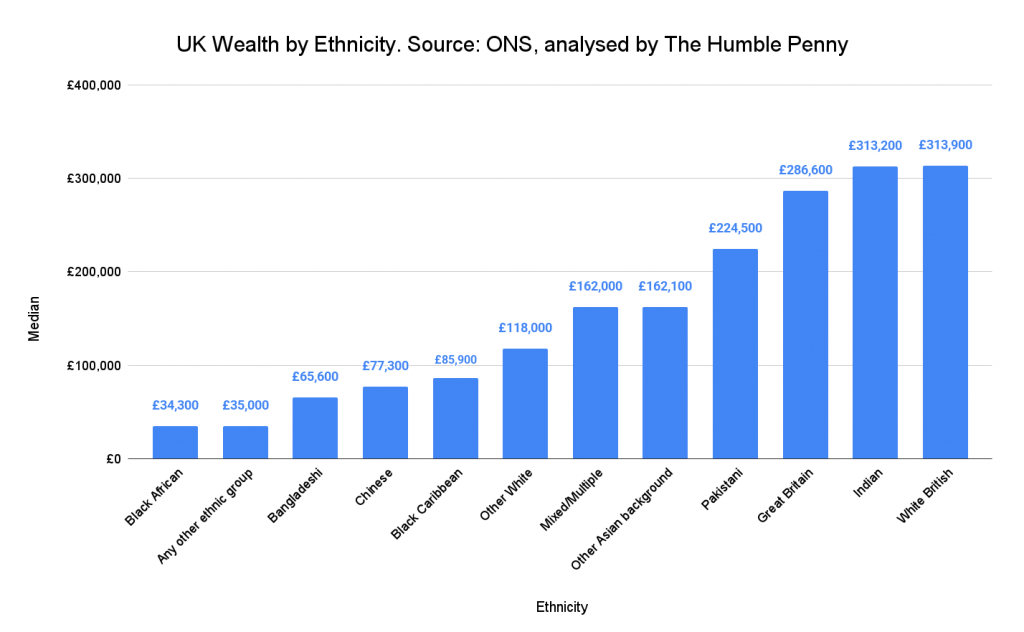
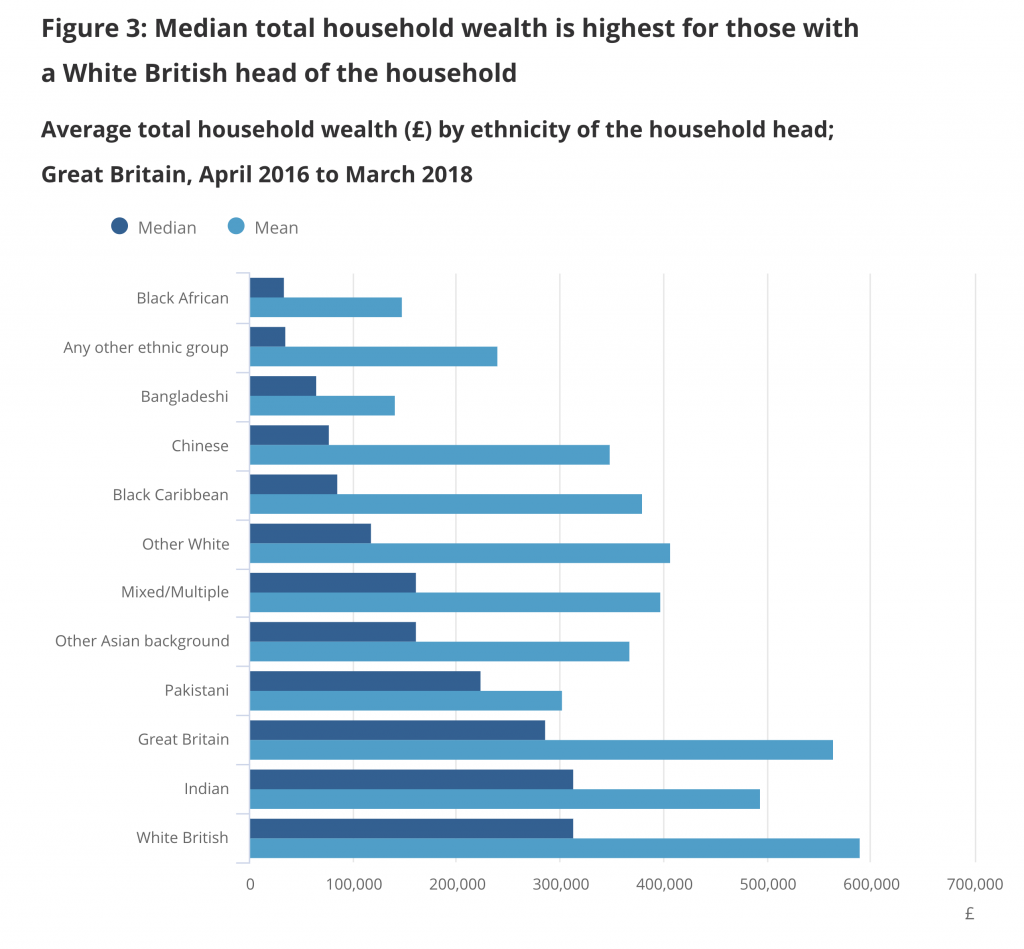
Here is what Median UK Wealth By Ethnicity looks like according to the ONS:

wealth by ethnicity

White British and Indians are pretty much at the same wealth level, although I suspect Indians will be ahead on more recent numbers, which are not yet published. Black Africans are right at the bottom, which is both shocking and sad for us to see.

Black Caribbean are not far off the bottom either.

The Black African numbers did surprise me because Nigerians and Ghanaians are smashing it in the UK and globally in so many dimensions from music to sport to business, to the corporate space, etc

Please jump in the comments and react to these stats in a respectful way. Why are these wealth gaps by ethnicity so vast? 

Why are Indians on par with White British people from these wealth stats? What are they doing differently?

Why are Pakistani, Bangladeshi and Chinese people so far behind Indian and White British households?

Why are Black households so far behind most other ethnicities? 

We welcome comments from anyone of any ethnicity anywhere in the world.

Here are some reactions from others on our YouTube channel:

Interlude: Please take a moment to share this post with a friend or family member on WhatsApp, etc,  if you are enjoying it.

Part 2: Why Do The Wealth Gaps Exist by Ethnicity?

We’re going to speak from our perspective as a UK Black African couple for a minute.

It's important to acknowledge historical issues of slavery, colonialism and institutional racism that have contributed to economic inequality.

Also, there are present-day structural inequalities in housing, employment and education that have made it harder for Black people to get access to the resources and opportunities for wealth creation.

But here are some other reasons why Black communities are behind other ethnicities in these wealth stats:

1. Immigration Timing

Many Black African families are recent immigrants with less time to build wealth.

Indians, for example, arrived much earlier and had more time and opportunity to accumulate assets.

Caribbeans via the Windrush generation also arrived a lot earlier than most Black Africans.

2. Education vs Income Gap

Chinese and Indians have the highest proportion of working adults educated to a degree level or higher in the UK.

Whilst 36% of Black Africans are educated at a degree level or above, this has not always translated into higher incomes.

3. Lower Household Income

Ethnicity pay gaps remain large.

Indian households, for example, earn over twice as much per adult as Black Caribbean households (DWP).

4. Low Property Ownership

Wealth is closely tied to homeownership.

Only 22% of Black Africans and 31% of Black Caribbeans own property vs. 68% for Indians, 55% for Pakistanis, and 70% for White British.

Indians and Pakistanis hold 46% and 44% of their wealth, respectively, in property vs. 13% and 19% for Black Africans and Black Caribbeans.

Up on the screen are the 2025 official home ownership stats by various ethnicities:

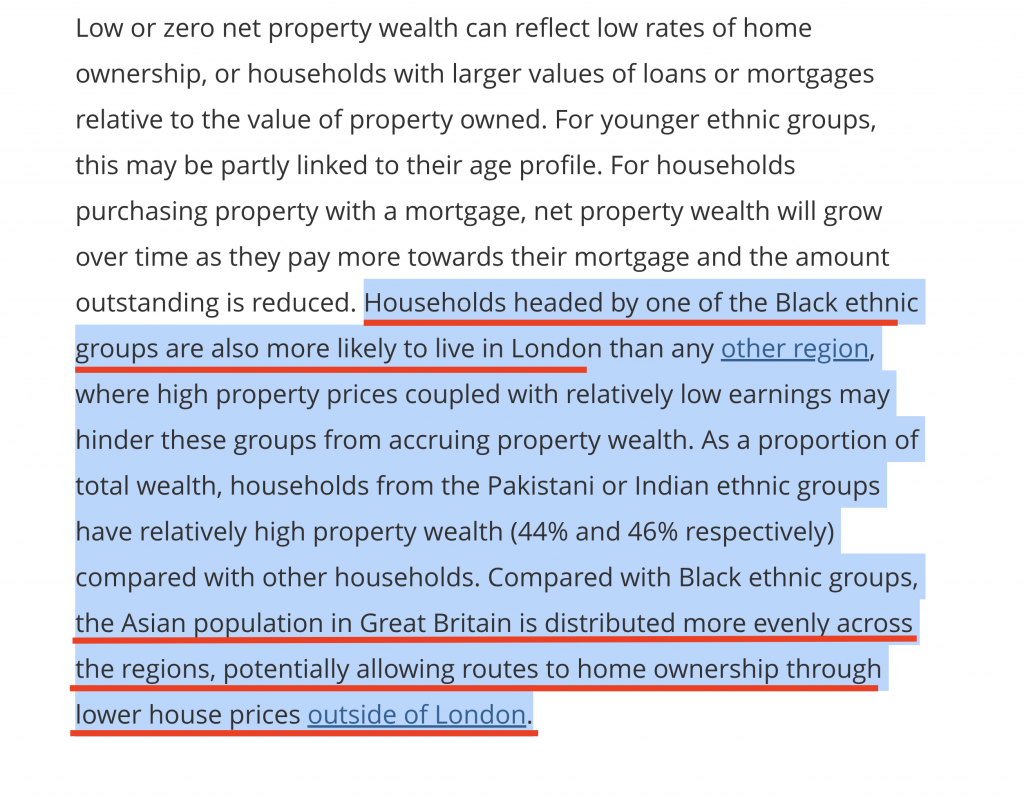
One other interesting Home ownership factor that jumped out from the research is the impact of location on ethnicity wealth:

Households headed by one of the Black ethnic groups are also more likely to live in London than any other region, where high property prices coupled with relatively low earnings may hinder these groups from accruing property wealth. 

You can read the rest below:

This is basically saying that the choice of living in London without home ownership is reducing wealth outcomes for Black people in the UK. 

5. The “Black Tax” and Sending Money Back “Home”

The ongoing financial support to extended family does reduce the ability to save/invest. Some even give while they’re in debt.

This creates a cycle of intergenerational financial pressure.

One thing that the ONS stats won’t have captured is how many Black Africans and Caribbeans have their wealth back in their home countries e.g. through land and property they might have purchased there.

This would apply to other ethnicities where someone has another country they also call home and choose to spend time and money there.

e.g. White British people owning holiday homes in Spain, Portugal, etc. or Indians and Pakistanis owning land and property in their home countries.

6. Higher Debt Burden

Black households have a significantly higher ratio of debt relative to assets.

The cost of servicing this debt often limits opportunities to build wealth.

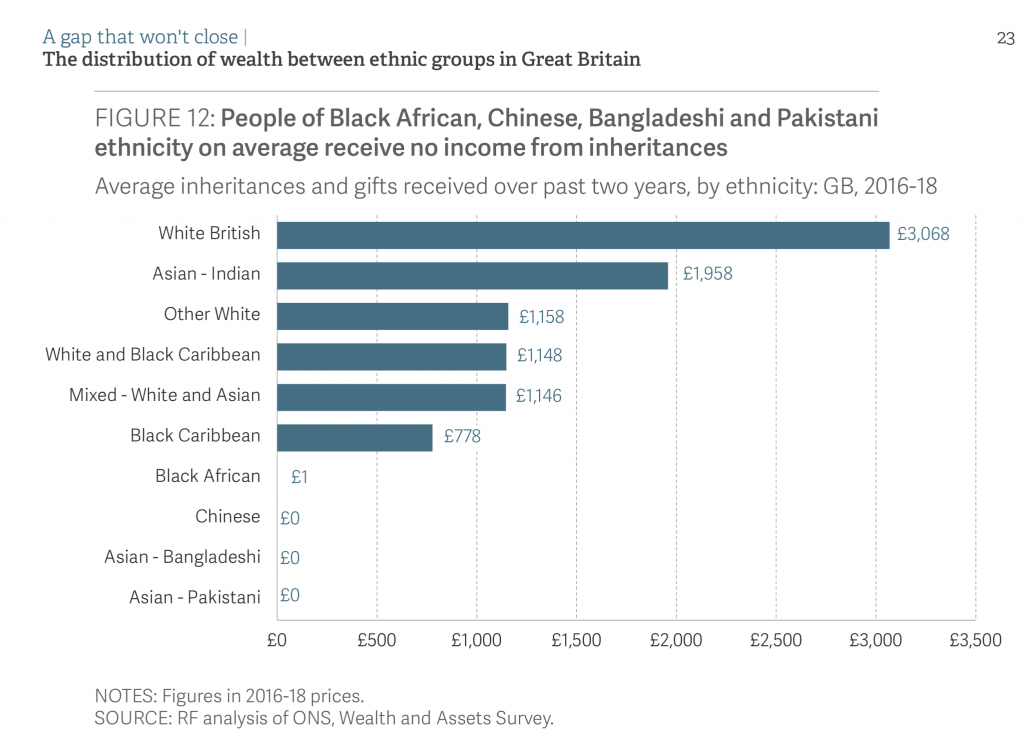
7. Little to No Inheritance

Average inheritance by ethnicity, according to the Resolution Foundation, analysing ONS data, is:

Inheritance continues to widen the wealth gap across generations.

8. Entrepreneurship

Entrepreneurship is a powerful tool for wealth creation, especially for those who have historically faced barriers in the job market.

Research by the Resolution Foundation found that all things being equal, a £1 increase in household income is associated with household wealth being £16 higher.

Starting a business allows individuals to create their own opportunities and build their own wealth.

Asian communities are very entrepreneurial.

They also seem to be able to raise capital within their communities because they’re able to keep more of their money within their communities, which you don’t see as much within Black communities, for example.

You also see Asians in all kinds of businesses, everything from the corner shop or cash and carry to property businesses to massive family owned businesses. 

They even own Black hair and food shops.

In addition, they also seem to do things together, which we suspect is a value passed down from grandparents and so on.

9. Cultural Values and Community Support

Many ethnic minority communities have a strong sense of identity and culture that has helped to build solidarity and support for one another.

But Black people seem to be divided among ourselves. 

Black Africans and Caribbeans had a history of working against each other, though that is not so much the case today.

A house divided against itself cannot stand.

We might not be working against each other, but are we working with each other for real?

We should look to our own strong cultural heritage and values as a source of strength and inspiration for building our own wealth.

Examples of such heritage and values include creativity, community, education, identity, faith and resilience.

10. Lack of Financial Literacy and Poor Lifestyle Choices

Adopting the mindset that wealth is mostly unseen and focusing on living a simpler lifestyle will help a lot of people live within their means and avoid lifestyles sponsored by expensive debt.

Every household needs to have a basic understanding of budgeting and saving as well as investing and debt management strategies.

Prioritising saving and investing at least 10% to 20% per month into Stocks and Shares ISAs combined with Lifetime ISAs will help families build considerable wealth over time.

Sadly, this is not the reality for a lot of households who instead prioritise Physical Assets like expensive cars and other wasting assets over assets that don't appreciate in value.

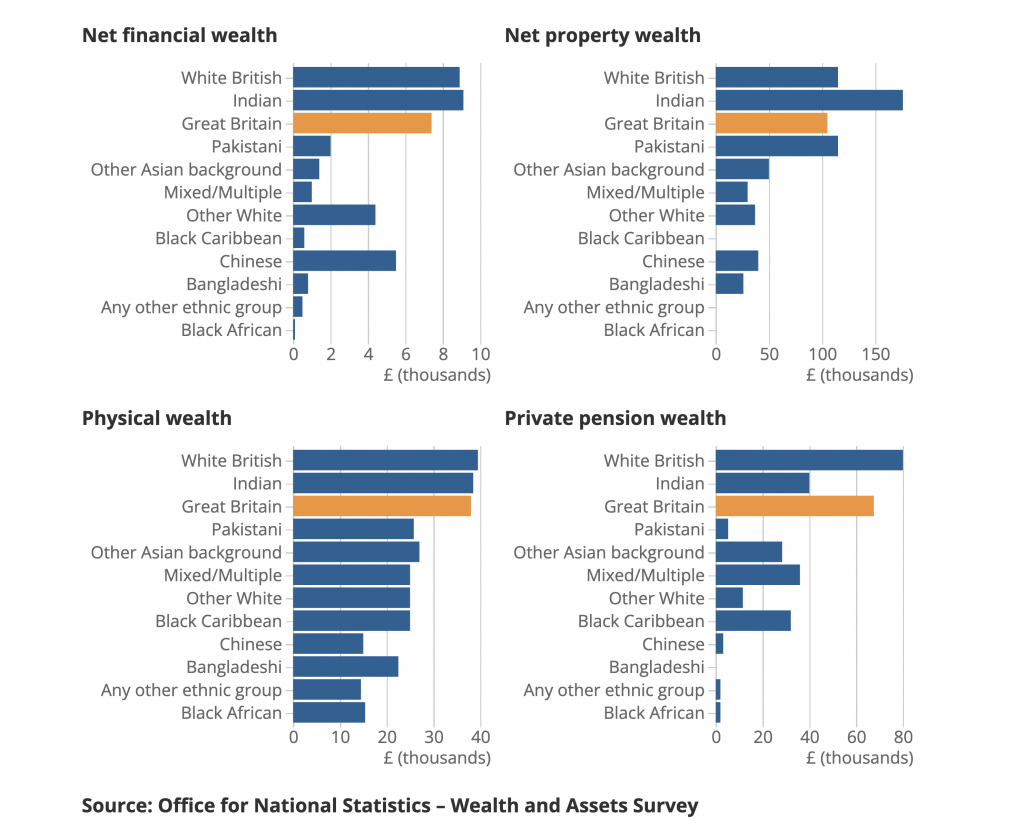
Here is what the ONS stats show for UK wealth by ethnicity and asset type:

wealth by ethnicity

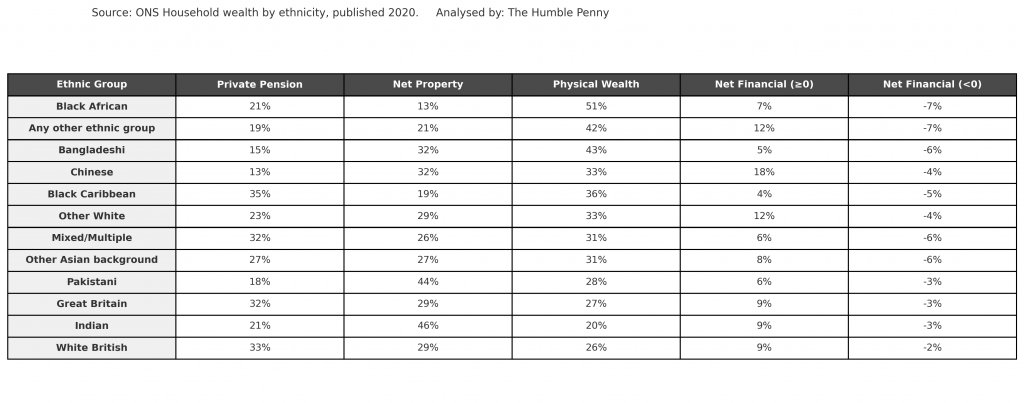
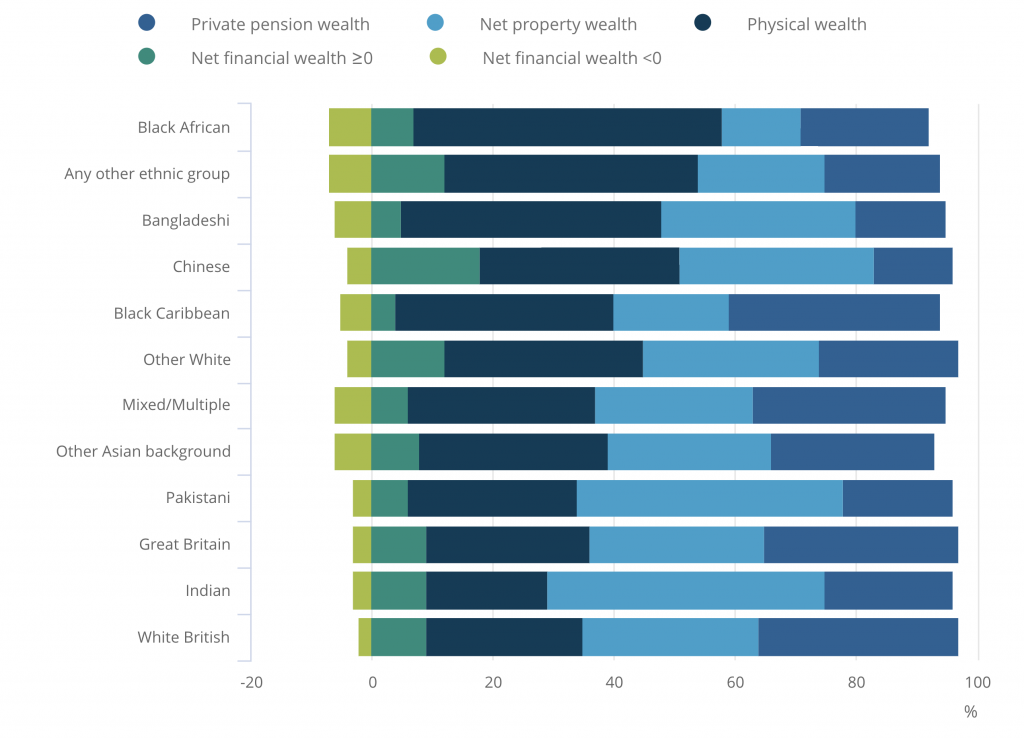
We have also analysed this data in percentage per asset class by ethnicity, so that you can easily see where a typical household has most of its wealth.

For Net Financial Wealth, you need to add the last two columns below as one shows financial assets and the other net financial liabilities. Here it is:

wealth by ethnicity


Let’s start with Black Africans first. You can see that across the 4 dimensions of wealth, most of their wealth is in Physical Wealth (51%), like cars and household content.

Writing as someone from a Black African household in the UK, this is not a good look.

Black Africans also have 21% in Pensions, 13% in property and net zero in Net Financial Wealth, i.e. 7% in savings less 7% in debts:

Black Carribbeans also have their highest wealth in Physical wealth at 36%, but have a bit more in Pension Wealth, i.e. 35% due to lots of public sector jobs.

However, they have a negative Net Financial Wealth of minus 1%. This presents a challenge during times of emergencies.

White British people have most of their wealth in Pension wealth at 33%, Property at 29% and also a high proportion on physical wealth of 26%. Only a net of 7% in Net Financial Wealth.

Chinese people show some really interesting stats. It appears they don’t trust pensions as much, with only 13% in pensions.

A massive 33% in Physical Wealth, Net Property at 32% and interestingly, a Net Financial Wealth of 14% (18% in savings less 4% in debt). 

Chinese people appear to have the highest allocation to net Financial Wealth among all ethnicities.

Here is the actual table from the Office for National Statistics with all other ethnicities included:

wealth by ethnicity

Part 3: US Wealth By Ethnicity

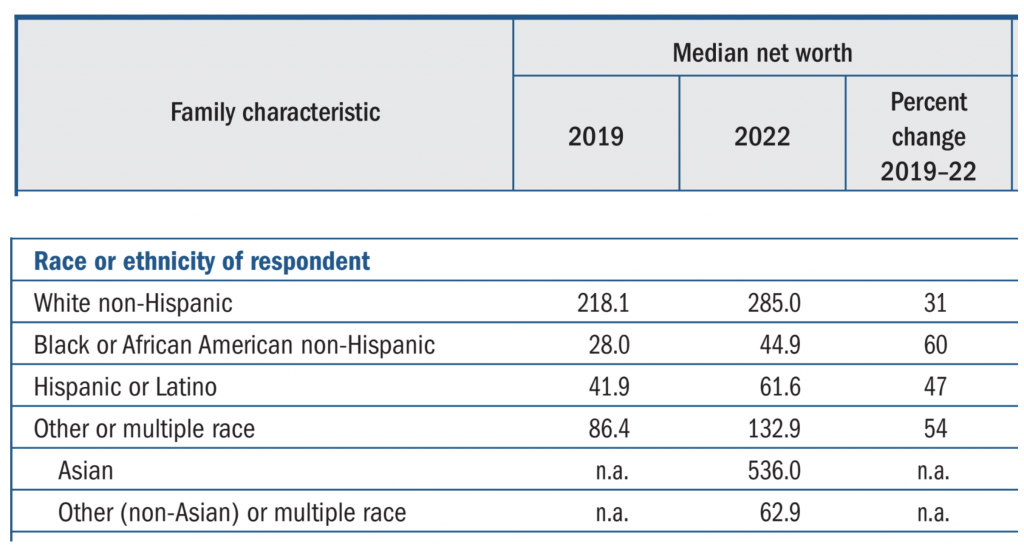
For the US Wealth by Ethnicity, we looked at the latest figures from the US Federal Reserve Survey of Consumer Finances: 

You can see that by far, the most financially wealthy ethnic group in the USA are the Asians, which, interestingly, is the same in the UK.

Asians had a median net worth of $536,000, which is almost twice that of $285,000 by White non-hispanic. Wow!

Although Black or African American non-hispanic had a 60% increase in their net worth (the highest percentage change) in the 3 years, they have by far the lowest net worth.

wealth by ethnicity

Again, this is sad to see because it points to many years of systemic racism, among other things, which means a lot of black households in America remain massively behind.

In fact, looking at those numbers, the Median Asian net worth is 11.9X that of a Black or African American non-hispanic.

Wow! This is absolutely shocking!

If you want to see a good example of such systemic racism in housing, watch the recent Netflix documentary, Katrina: Come Hell and High Water.

We welcome your reactions in the comments, no matter your ethnicity or location.

Please comment respectfully, as we're reading published official numbers here.

Why are these wealth gaps so massive? What have the Asians done to have such a massive net worth?

Please drop comments that we can all learn from below.

Part 4: Conclusion

The one thing we’ve learned on our journey is that although one’s ethnicity can and does present challenges to building wealth, if you’re determined to build wealth, you absolutely can, no matter your ethnicity.

We are proof that it is possible, and we’re not alone. 

Lots and lots of other people are doing it, too, and if you’re one of those people who feel like they’re progressing financially, no matter how small, jump on the comments and let us know.

Wealth building requires certain ingredients:

First, wealth is about adopting the right money habits. It’s not about luck or earning a high income. We know many high earners who are broke and living paycheck to paycheck. 

But with the right habits, you can make weath building inevitable.

Building wealth is also about focusing on improving your mindset. 

If you’re all about scarcity, you won’t build wealth. You’d need to have a growth and abundance mindset.

Next, wealth is about doing what most others aren’t doing. 

By this, we’re talking about living significantly below your means and forgetting the default lifestyle creep.

Plus, making sure your money is invested without fail each month. Make investing a priority!

Wealth building is about building the right combination of skills, building a network and having a bias for taking some risks.

In summary, no matter your circumstances right now, even if you feel you’re behind in life, don’t let the stats define you. 

You deserve a life of financial security, more freedoms and more options, and it is possible for you. 

Keep believing it and, most importantly, start making those small changes in your money habits.

Please take a moment to share this post with one friend or family member via email, WhatsApp, etc.

We’d love to hear from you in the comments: What one action step do you think you need to take from reading this post? Why are Asian households ahead in both the UK and the US? 

Don’t go anywhere—check out these resources to help you close that gap and build wealth:

  • Follow our Tailored Wealth Paths to Build Wealth (15% off monthly included, first 25 people only)
  • How Ordinary People Became Tax-Free Millionaires
  • UK vs US Median Wealth By Age

Frequently Asked Questions About The Wealth Gap

1. Are there other contributors to these ethnicity wealth gaps?

One area we'll explore in another post is the impact of single-parent households vs households headed by a couple (e.g. married) and what impact this has on the wealth outcomes above.

Gender differences are an obvious one that we hope to explore.

Age is also another major factor that's directly correlated with wealth across ethnicities. The older you are, the more likely you are to be wealthy.

Finally, we'd like to drill deeper into the differences within similar groups e.g. Chinese and Korean vs Indians vs Bangladeshi, or Nigerians vs other Black Africans. We expect to find key differences.

Watch out for other detailed blog posts covering these topics.

For now, you can read UK vs US Median Wealth By Age

2. Does being an ethnic minority in the UK or US, or anywhere else in the world, mean that you will not be able to build wealth in the future?

No, absolutely not!

There are, and there will continue to be challenges linked to ethnicity.

The truth? Wealth building is possible for anyone over time, but it requires:

  • The right money habits and creating a system for wealth
  • A growth and abundance mindset, believing it's possible
  • Building valuable complementary skills, networks
  • Making counter-cultural lifestyle moves that others aren't willing to make
  • Having a willingness to take calculated risks and invest wisely

These apply no matter your location in the world.

Yes, ethnicity matters. History matters. But your actions and habits (small changes that compound) matter more. You can defy the stats 😀

Recommended: Join our global community platform, get coaching & build wealth with our tailored wealth paths 

(The link above includes 15% off monthly for the first 25 people only. New members only.)

Here is the video version to watch and share with others:

As always, in all things, be thankful and seek joy.

UK vs US Median Wealth By Age – Richer Than Others Your Age?

August 21, 2025 by The Humble Penny 7 Comments

UK vs US Median Wealth By Age

Do you know if you’re wealthier or poorer than the typical person of your age?

In the UK and the US, the numbers are in and they might surprise you.

Today, we’re breaking down exactly how much people actually have in wealth by age group and what that means for you.

Read this all the way through, and by the end, you’ll know exactly where you stand and what to do next.

If you are new here, we run this blog as husband and wife with a small team.

We achieved Financial Independence at 34, including mortgage-free in 7 years while raising two children in the UK.

Ken: I’m a Chartered Accountant, a Financial Coach and Business Coach and a former Chief Financial Officer.

Mary: I’m an Entrepreneur and former E-business Analyst.

Together, we’re the founders of The Humble Penny and Financial Joy Academy.

In addition, we are Sunday Times Bestselling Authors of Financial Joy, a 10-week Plan to help you Banish Debt, Grow Your Money and Unlock Financial Freedom.

Please jump in the comments and react to the stats as you read from anywhere in the world.

wealth by age
Wealth means more than money to us. It is health, time with family and friends, community, culture and heritage, well-being, options, etc. What about you?

Table of Contents

Toggle
  • Why We Published This Post on Wealth By Age
  • Part 1: UK Wealth and How It Is Split By Asset and Location
  • Part 2: Wealth Inequality and How Wealth Differs for Different Groups, e.g. the Top 10% and Top 1%
  • The Top 1%. How much UK wealth do they have?
  • Part 3: How UK Wealth Inequality Compares to Other Countries
  • Part 4: UK Median Wealth By Age
  • Part 5: US Median Wealth By Age
  • Part 6: Wealth By Ethnicities – UK vs US
  • Part 7: UK vs US Wealth Side By Side
  • Part 8: Differences in UK vs US Wealth
  • Part 9: How to Build Your Wealth Intentionally, Starting Now
  • Part 10: Conclusion

Why We Published This Post on Wealth By Age

The goal of this post is not to make you feel like you’re behind in life.

Instead, the goal is to educate us all, give you a space to pause and reflect on your own personal finances and beyond that, feel empowered to take action.

I started economically poor when I moved to the UK with my family in 1998, and every single one of us is thriving financially today. I know it is possible for you, too.

The stats are not your destiny. If I had only looked at the stats 5 or 10 or 20 years ago, I wouldn’t have achieved anything.

You have it within you to choose a path that leads to financial security and, over time, financial freedom.

It’s not easy or overnight, but it starts with belief and action.

Money is only one dimension of wealth. True wealth is also your health, community, relationships, time with loved ones, heritage, etc.

So, although you might be financially behind, you’re rich in life in many other ways.

This is ultimately about your own journey rather than comparison to others.

If that sounds good, please take a moment to share this post with a loved one on WhatsApp, email, etc.

Let’s jump straight in.

Part 1: UK Wealth and How It Is Split By Asset and Location

Throughout this post, we’ll be using Median rather than Average as a measure.

Looking at the median, or the midpoint value, is a more accurate representation of the everyday person, rather than Average, which is skewed by numbers from the super rich.

Median is the middle number in a set of wealth values when those values are arranged from smallest to largest.

So, what is wealth in the UK?

Wealth in the UK is made up of 4 components:

  • Net property wealth: the value of all properties minus mortgage debt. Net property wealth can be negative.
  • Net financial wealth: the value of savings or investments minus financial liabilities (financial debt). Net financial wealth can be negative. 
  • Physical wealth: the value of vehicles, collectables, and household contents.
  • Private pension wealth: the value of occupational and personal pensions already accrued.

According to the Office for National Statistic (ONS) latest research on Household total wealth in Great Britain:

from April 2020 to March 2022 (published in 2025) Median household wealth in Great Britain was £293,700.

This is slightly higher in real terms than in April 2018 to March 2020.

The increase was due to an increase in pension wealth: excluding private pensions, household wealth fell slightly.

Here is what UK Median Household Wealth looks like by region:

wealth by age

The South East leads In Median Household wealth, but it’s interesting to see that Median Household Wealth in London is lower than in Wales, East Midlands, West Midlands, Yorkshire and so on.

This is likely driven by a much higher cost of living in London; even though Londoners earn more, they’re keeping less of it.

So what makes up this Median Household Wealth?

The research shows that:

  • Property wealth makes up 40%
  • Pension wealth makes up 35%
  • Financial wealth makes up 14%
  • Physical wealth makes up 10%

That adds up to 99% but when you factor in rounding differences, it will add to 100%.

Let’s look at these individually.

1. Property Wealth

62% of households owned their main residence (including 33% who owned outright and 29% who had a mortgage), and 11% of households owned other property.

2. Pension Wealth
Here is what Median pension wealth looks like in the UK by age for individuals:

Notice that 70% of individuals do not hold a pension. For those with a pension, the amounts are smaller than we expected.

3. Financial Wealth
Again, here is a snapshot of financial wealth in Great Britain.

Around 20% of households had negative net financial wealth (they had more financial debt than savings or other financial assets).

This was especially sad to see as it’s one area of wealth that one can easily fall into a negative on.

There are many reasons why one might have negative financial wealth.

Some are within one's control (e.g. habits and behaviours, lifestyle choices, etc) and some outside their control (e.g. job loss, rising cost of living, higher taxes, etc.)

But we also like to flip that script here and see it as an opportunity to help people turn the state of their finances around.

Just because you have negative financial wealth today doesn’t mean that is where you’re doomed to remain. It can and will improve.

wealth by age

Recommended: To grow your financial wealth, we recommend reading Financial Joy as a starting point. More on habits for building wealth soon.

The data also showed that 17% of households had net financial wealth of £100,000 or more, which was inspiring to see.

4. Physical Wealth

Looking at this one, we were pretty amazed by how much physical wealth people have.

Remember this is the value of cars, collectables and household contents.

Here is the summary of physical wealth.

It is clear that some people will have more in physical assets than they might have in Financial or Pension wealth, which speaks to the culture of keeping up with the Joneses.

Looking at this table, a total of 48% of households have physical assets worth £40,000 or more. Wow!

18% have physical wealth worth more than £80,000!

If this includes appreciating assets like art, gold and so on, then great.

Otherwise, we’d much rather see that wealth in easily accessible financial wealth, where it is invested and compounding.

If you are enjoying this post, take a moment to share it with friends or family.

Part 2: Wealth Inequality and How Wealth Differs for Different Groups, e.g. the Top 10% and Top 1%

Wealth inequality remains a very popular topic, but what does the data actually say?

Let’s look at what the research says over the last 30 years. I’ll put this up on the screen.

Pause for a moment and react in the comments. Does this surprise you?
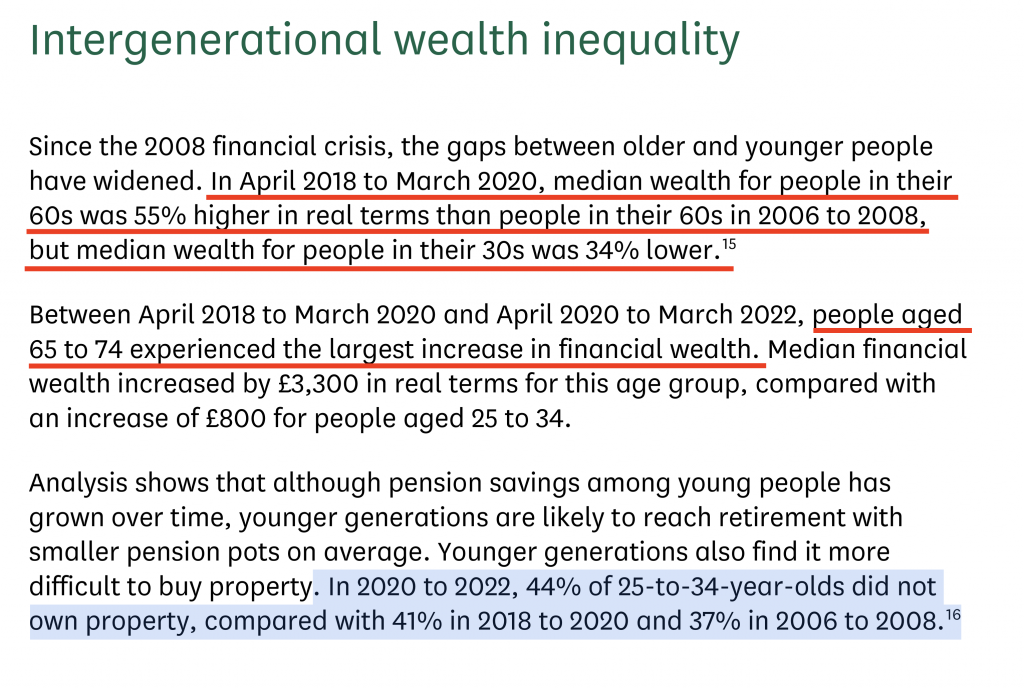
I was surprised to see that the share of wealth by the top 10% was 57% and compares fo 56% in 1980! I expected a much bigger gap.

The research went on to say:

“As discussed in section 3.5, wealth inequality between age groups has increased, but a fall in wealth inequality within older age groups meant that headline figures were unaffected.”

Here is what it says in section 3.5 about intergenerational wealth inequality:

Reading the last paragraph might make you think, property is the most unequally distributed type of wealth in the UK, but it isn’t.
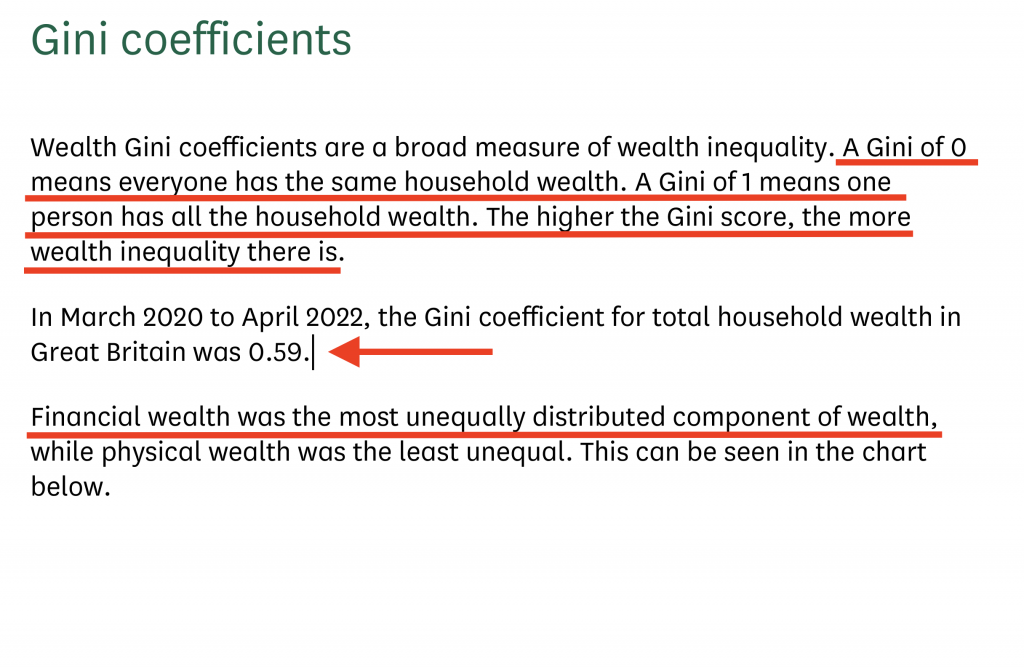
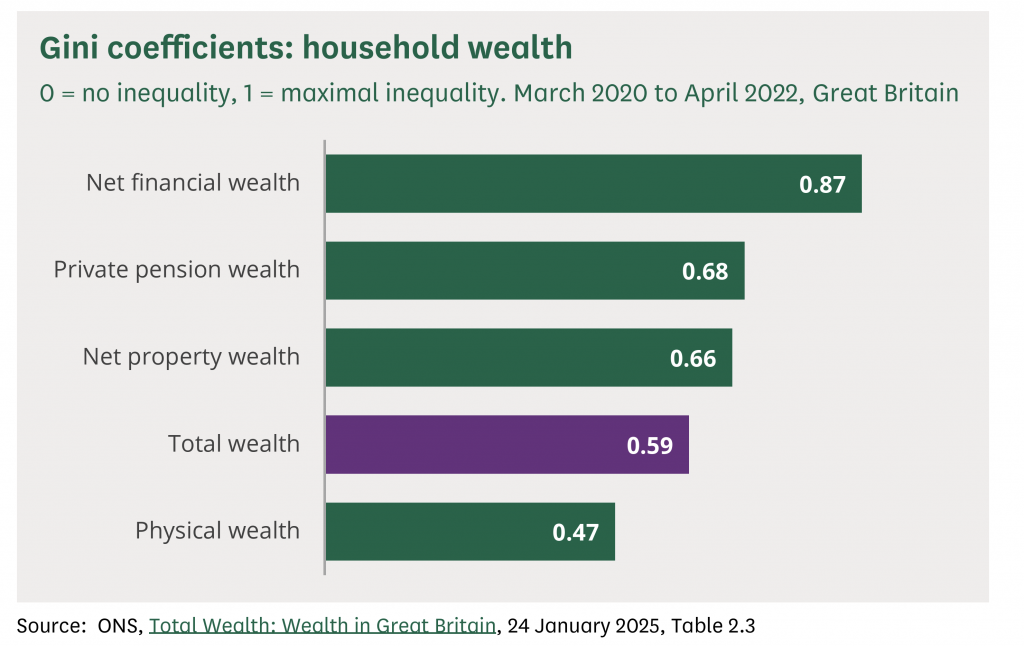
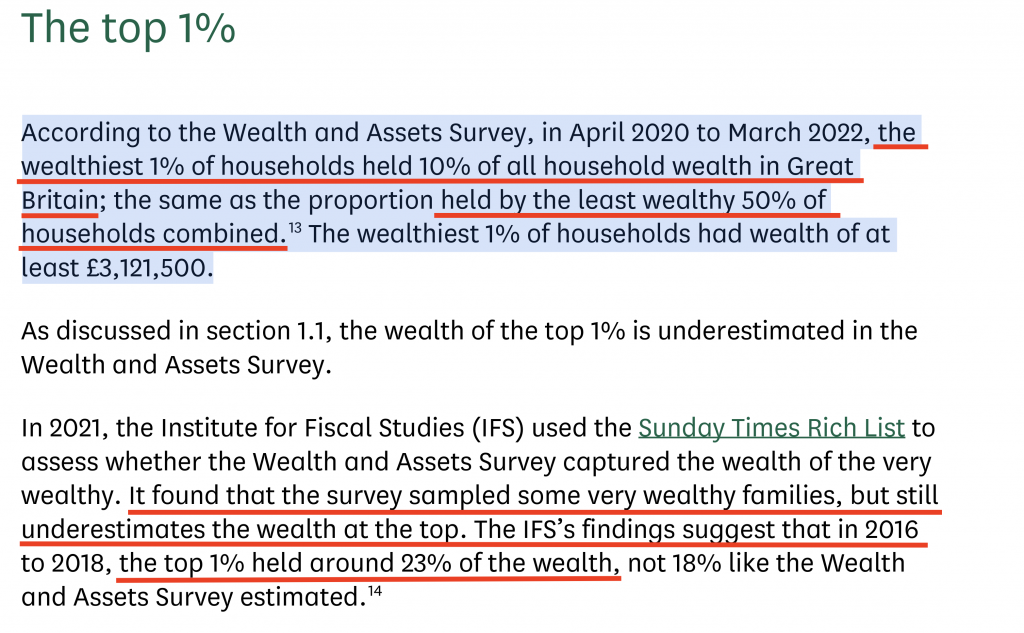
Before I share more on that, let’s talk briefly about how wealth inequality is measured.

They use what’s called the Gini Coefficient:

  • A Gini of 0 means everyone has the same household wealth.
  • Gini of 1 means one person has all the household wealth.
  • The higher the Gini score, the more wealth inequality there is.

In March 2020 to April 2022, the Gini coefficient for total household wealth in Great Britain was 0.59. More on this shortly.

Financial wealth (not property) was the most unequally distributed component of wealth, followed by Private Pension Wealth, then Net Property Wealth in 3rd place and then physical wealth was the least unequal.

Here is what it looks like by wealth component. Did this surprise you? Jump in the comments and let us know:

wealth by age

The Top 1%. How much UK wealth do they have?

According to the Wealth and Assets Survey, in April 2020 to March 2022, here it is:

The wealthiest 1% of households held 10% of all household wealth in Great Britain; the same as the proportion held by the least wealthy 50% of households combined.

Wow!

At first, I thought, 1% owns 10%, that’s not as high as I expected.

But then, when they say it is equivalent to the proportion held by the least 50% of households combined, it’s even clearer that we have a problem at the extreme ends of the wealth curve.

Having some wealth is not the problem. Everyone wants some wealth to enjoy a good standard of living and have a comfortable retirement.

The system has been designed to make very, very extreme wealth possible and, as a result, puts power and control in the hands of very few people.

Some have more wealth than they can even need or spend, while others are struggling to pay their bills and remain in debt. It is clearly unsustainable.

While this remains a problem with various potential solutions (including the suggestion of wealth taxes), the data also tells us that this is not a new problem or a problem that is unique to the UK.

I’ll share stats on wealth inequality in other countries shortly, so you can see where the UK sits compared to the US and other OECD nations.

The information on the Top 1% went on to say:

Part 3: How UK Wealth Inequality Compares to Other Countries

In case you’re wondering, how unequal the wealth in the UK is compared to the other OECD countries, the research is available.

The UK is in the bottom half of OECD countries and has around the same Gini coefficient (between 0.72 and 0.74) as 13 other OECD countries.

At the top of the list are countries like the USA, Chile, Ireland, Greece and so on.

The US is way worse than the UK in terms of wealth inequality.

We’d welcome some comments from Americans who are reading this post.

Again, it was a surprise to see the facts on how the UK compares to these other countries.

Part 4: UK Median Wealth By Age

Ok, let’s now look at what UK wealth looks like by Age.

We’ll be looking at the Median as it’s a more accurate reflection of what the wealth of a typical person is by age rather than looking at the average.

Here is the UK wealth by age. Remember, these numbers include property wealth:

The median UK Wealth by age per household (not individual), including property equity:

  • 16 to 24 it is £15,200
  • 25 to 34 it is £109,800
  • 35 to 44 it is £209,600
  • 45 to 54 it is £301,900
  • 55 to 64 it is £496,500
  • 65 to 74 it is £502,500
  • 75 and over, it is £373,100

My first reaction to these numbers is that they are smaller than I would have expected, and bear in mind, these numbers include property equity.

If you were looking at Average rather than Median, some of these numbers would be over £1m, and that’s because they’d be skewed by the Super Rich.

Jump in the comments and let me know how you feel your net worth compares for your age group.

Are you ahead or behind the government figures for a typical person of your age?

To calculate your number, it is the same as working out your Financial Networth:

Add up the value of all your assets to get one number in total, and do the same for the value of your liabilities.

Then, take the value of your liabilities from the total of your assets to get one number. That is your net worth.

Networth = Total Assets less Total Liabilities.

Feel free to watch this video: How to 

But note that as mentioned before UK Median Household Wealth includes property.

Here is an estimate of UK Median Wealth By Age without Property equity:

wealth by age

We were told that Property makes up 40% of Median Wealth, so we’ve stripped that out so that you can see an estimate on the right-hand side in the yellow block.

Someone aged 16 to 24 won’t likely have property wealth, so it’s likely most of their wealth is in Net Financial or Physical wealth.

My table does a straight allocation to all age groups for Property, Financial, Physical and Pension wealth, hence why the column in yellow is an estimate.

Where you live in the UK will dictate the split of your wealth across Property, Financial, Pension and Physical Wealth.

People in London, for example, typically have 51% of their wealth in property, 15% in Financial Wealth, 7% in Physical wealth and 28% Pension wealth.

Here is a split by location:

Part 5: US Median Wealth By Age

To get the median Net Worth of households in America, I looked at the latest publication of the Evidence from the Federal Reserve Survey of Consumer Finances (SCF) published in October 2023 for the period 2019 to 2022:

  • Under 35: $39k (143% rise)
  • 35 to 44: $135,600 (28% rise)
  • 45 to 54: $247,200 (27% rise)
  • 55 to 64: $364,500 (48% rise)
  • 65 to 74: $409,900 (33% rise)
  • Over 75: $335,600 (14% rise)

This over-75 group will likely have care costs, etc, but we're surprised their net worth still increased.

Here on the screen is the same information in a bar chart format. Note that these numbers like the UK numbers includes property!

The numbers will be smaller of course without property equity.

Overall, Median household wealth in the USA was $192,900 as at the 2022 report (same period as the UK).

The Survey of Consumer Finances (SCF) report says that:

“Between 2019 and 2022, real median net worth surged 37 percent, and real mean net worth increased 23 percent. These patterns imply some narrowing of the wealth distribution between surveys. Indeed, the 2019–22 growth in median net worth was the largest three-year increase over the history of the modern SCF, more than double the next-largest one on record.”

So it would appear that Americans experienced better economic times in those years.

Part 6: Wealth By Ethnicities – UK vs US

You notice very interesting patterns when you dig a bit deeper to see which Ethnicities have the largest net worths in America:

You can see that by far, the most financially wealthy ethnic group in the USA are the Asians, which, interestingly, is the same in the UK.

Asians had a median net worth of $536,000, which is almost twice that of $285,000 by White non-hispanic. Wow!

Although Black or African American non-hispanic had a 60% increase in their net worth (the highest percentage change) in the 3 years, they have by far the lowest net worth.

Again, this is sad to see because it points to many years of systemic racism among other things, which means a lot of black households in America remain massively behind.

In fact, looking at those numbers, the Median Asian net worth is 11.9X that of a Black or African American non-hispanic.

Wow! This is absolutely shocking!

We welcome your reactions in the comments, no matter your ethnicity or location.

Please comment respectfully, as we're reading published official numbers here.

Why are these wealth gaps so massive? What have the Asians done to have such a massive net worth?

Please drop comments that we can all learn from below.

For the UK wealth by ethnicity numbers, here is the latest ONS release. Focus on the median:

wealth by age

Here are the specific numbers for UK median household wealth by ethnicity:

  • Black African – £34,300
  • Any other ethnic group – £35,000
  • Bangladeshi – £65,600
  • Chinese – £77,300
  • Black Caribbean – £85,900
  • Other White – £118,000
  • Mixed/Multiple – £162,000
  • Other Asian background – £162,100
  • Pakistani – £224,500
  • Great Britain – £286,600
  • Indian – £313,200
  • White British – £313,900

White British and Indians are pretty much at the same wealth level, although I suspect the latter will be ahead on recent numbers (unpublished yet).

Why are these wealth gaps by ethnicity so vast? 

We are Black African (the lowest wealth group), yet we've defied the odds to surpass multiple times all the numbers above. 

This isn't a show off at all, we're sharing for context.

On a personal level, it confirms what we know: you can build wealth if you want to, and your ethnicity (although challenging for some) isn't what's going to stop you.

Part 7: UK vs US Wealth Side By Side

Here is the comparison between UK and US Median household net worth based on the latest figures reported as at 2022:

wealth by age

Although we're doing a comparison here, it’s more for illustration purposes only and the UK and US can’t be a direct comparison for a number of reasons we'll explain shortly.

It’s also worth noting that although the data for both relate to the same period up to 2022, UK numbers were published in January 2025 and US numbers in October 2023.

So there are also inflation adjustments to consider.

Part 8: Differences in UK vs US Wealth

Here up on the screen is a difference between the UK and US Median Networth numbers.

The key difference is that:

  • Pensions: The US do not include Defined Benefit pensions but the UK do.
  • Student Loans: The US does include student loans but the UK does not.
  • Business: The US numbers include business equity but the UK numbers do not.
  • Cryptocurrency: This is not included in the UK wealth numbers, however, this asset class is included in the US numbers.
  • Employment-related stock options: Neither the UK nor the US include these in their numbers.

Part 9: How to Build Your Wealth Intentionally, Starting Now

Rather than just comparing yourself to the national median, ask yourself these 3 questions:

1) Are you improving your net worth year-on-year?

This way, you’re focusing on your own journey.

2) Is your liquid net worth (cash + investments – debt) increasing?

The focus here is on Financial Wealth e.g. your ISAs in the UK or Roth IRAs in the US.

I think liquidity and access to your money will be a massive area of focus in the next 5 years.

Of course, still keep growing your pension wealth where you can but the order of your investing will matter massively depending on your goals.

i.e. ISA vs Pension/SIPP/401k vs GIA for Employed vs Self-employed

Read pages 288 -292 of Financial Joy for more details.

3) Are you developing the right mindset, skillset and toolsets?

Mindset Example:

Believing you're not “behind” — you’re just starting from a different place.

Many people see these net worth stats and immediately feel shame.

But someone who owns their story and decides, “I can still close the gap,” is already shifting from scarcity to growth.

It’s not about beating everyone else — it’s about becoming the best financial version of you.

Skillset Example:

Learning how to track your net worth monthly and actually doing it.

This isn’t something most people are taught. But knowing your number and seeing it go up even by £500 or £500 — builds confidence and long-term discipline.

Toolset Example (Money Habits)

Automating £50/month into a SIPP or Stocks and Shares ISA or Roth IRA and never missing a payment

This tiny habit, even if you start late, compounds massively over time. It’s less about the amount and more about building the habit of paying your future self first.

We cover all this and more in our book, Financial Joy.

In addition, you can connect and learn from us directly and our community daily via our global learning platform at Financial Joy Academy.

There, we offer you coaching, classes on investing, how to create multiple income streams, a daily Lunch Time Club, Accountability, Mastermind and in-person meetups.

Part 10: Conclusion

There are two important conclusions we want to make. First,

Wealth is more than money.

Wealth is health, it’s your community, your relationships and social connections, it’s time with your lived ones, etc.

Money is only one dimension of wealth.

So although you might be behind financially, you’re rich in life in different ways.

Here is the second conclusion.

There isn’t only one pie out there that we are all fighting over.

This is borne out of a scarcity mindset.

To build wealth, you need an abundance mindset. More pies can be made, and more opportunities can be created or discovered.

Overall, stay positive and keep enjoying your life one day at a time.

If you enjoyed today’s post, please take a moment to share it with others.

We’d love to hear from you in the comments:

What aspect of today’s post surprised you the most? Did the UK or US wealth by age surprise?

Or was it the wealth inequality stats in the UK and around the world? Or was it something else?

Comment below.

Don’t go anywhere—check out these next posts to help your wealth building journey:

  • ISA Millionaires: How Ordinary People Built £1M Tax-Free – And How You Can Too!
  • You Are Trained To Be Poor. 10 Shocking Money Traps
  • ESCAPE PLAN: How to Stop Living Paycheck To Paycheck

Watch the full video on wealth by age here:


AS ALWAYS, IN ALL THINGS, BE THANKFUL AND SEEK JOY!

Laid Off, In Debt & AI Is Here: How to Survive Next 5 Years

August 13, 2025 by The Humble Penny 0 Comments

In recent months, I've been having the same difficult conversations repeatedly with friends, family, readers and viewers, all asking the same question: What happens if my job disappears tomorrow due to AI?

The uncomfortable truth is we're already in the early stages of a structural change in the jobs market.

Millions are looking for work, household finances are stretched by inflation, taxes and lifestyle choices, and artificial intelligence (AI) is accelerating the pace of disruption.

This post unpacks the problem and, more importantly, gives practical, realistic things you can do now to protect yourself and your family over the next five years 🙂.

AI

About me: I’m a Chartered Accountant, a Financial Coach and Business Coach and a former Chief Financial Officer (CFO).

Together with my wife, Mary, we’re the founders of The Humble Penny and Financial Joy Academy.

In addition, we are Sunday Times Bestselling Authors of Financial Joy, a 10-week Plan to help you Banish Debt, Grow Your Money and Unlock Financial Freedom.

♻️ Please take a moment to share this post with friends and family.

Table of Contents

Toggle
  • Why this matters right now: a short, clear wake-up call
  • Part 1. The silent wave: job losses at all levels
  • Part 2. The golden cage: a lifestyle that traps you
  • Part 3. The AI threat: it’s not ten years away, it's here
  • Two sides of the AI story
  • Part 4. What to do now: immediate, practical actions
  • Part 5: Your Concrete 90-day plan
  • How to think about retirement and long-term security
  • Community matters: your network is a lifeline
  • What I would do if I were in your shoes
  • Common objections and how to respond
  • FAQ
  • Final thoughts. Urgency without fear

Why this matters right now: a short, clear wake-up call

Companies are still making significant redundancies across sectors.

On LinkedIn, over 220 million people globally have the status “open to work”, and that figure increased by 35% from last year.

Those numbers are not just statistics; they represent families, mortgage/rent payments, school fees and anxiety for people who thought their career ladders were a safe bet.

I'm not trying to create panic. My goal is urgent clarity.

In this post, I'll lay out the trends I'm seeing and give you a practical plan to start defending your household finances and future earning power today.

If you're reading this and thinking “that's not me”, please read on anyway; the effects ripple further and faster than most people expect.

Part 1. The silent wave: job losses at all levels

Layoffs are no longer a story limited to junior positions or cyclical roles.

I'm seeing cuts in tech, finance, media, law, accountancy and marketing, etc, literally across seniority levels.

This is not a handful of companies trimming staff.

There is a broader adjustment in how businesses operate, invest and structure teams.

I recently spoke to a friend, a highly skilled senior professional, who spent nine months unemployed last year before finding another role. Nine months!

He's not alone. 

Recruitment cycles are longer, hiring is more selective, and employers are looking to automate or contract out tasks they previously assigned to headcount.

Pause and reflect: if a mid-career, experienced person can be out of work for that long, what does that tell you about hiring dynamics for the rest of us?

The answer: you must take responsibility for protecting your income and options now, rather than assume “it won't happen to me”.

By the way, there's a knock-on effect with professionals losing their jobs.

They book fewer plumbers, builders, electricians, joiners and reduce the number of times they might visit the barber/hairdresser per month.

We've seen people from these typically in-demand professions also reporting a decline in bookings.

Part 2. The golden cage: a lifestyle that traps you

We've been sold a dream: study hard, climb the career ladder, earn more.

But with each rung we often increase our fixed costs e.g. mortgage, private school fees, car leases, and lifestyles that require a constant inflow of cash.

The result for many people is not freedom, but a golden cage.

Examples I've heard recently include households paying £3,000+ per month on housing, or families spending £1,500 to £2,000 (+VAT) per month per child on private education.

No judgement, just an observation.

Add vehicle leases costing £400–£600 per month, childcare bills, buy-now-pay-later holidays and other subscriptions, and you can see why a single missed paycheck becomes existential.

These pressures affect all income bands.

I know people on six-figure salaries who are terrified of redundancy because their cost base rose in step with income. High salary does not equal financial resilience.

One of the clearest examples I heard recently was someone in Sweden who hates their job but can't quit because their mortgage debt exceeds €500,000.

When debt is that large, mobility evaporates, even if the job is damaging to their well-being.

That lack of choice is precisely what I mean by the golden cage.

Part 3. The AI threat: it’s not ten years away, it's here

Now let’s address the third leg of this stool: AI.

This isn't science fiction. It's altering the nature of work right now.

McKinsey estimates that up to 30% of work hours could be automated by 2030.

The UK government has echoed similar figures, up to 30% of all jobs are expected to be replaced or automated.

Those are big numbers.

That means up to one in three people could see the nature of their work change materially within five years.

AI will not affect everyone equally.

It will be particularly disruptive in roles that involve repetitive tasks, predictable outputs or easily codified rules.

That includes many administrative roles, data processing positions, some types of marketing work, content production and certain elements of finance and law.

Equally, it will reshape creative and professional work too, but often as an augmentation rather than a full replacement.

And we need to acknowledge equity in impact: those who are already underpaid or in precarious positions, often ethnic minority groups and those in lower-paid manual or semi-skilled jobs, are more vulnerable.

Without proactive steps, AI can widen existing inequality, including bigger wealth gaps.

Two sides of the AI story

Yes, AI brings enormous opportunity for creative entrepreneurs, skilled technicians and those able to harness tools.

But opportunity doesn't magically distribute itself.

Those who act strategically, learning skills that complement AI and building digital assets or communities, will thrive.

Others who wait or deny the change may get left behind. That divergence is the risk I want you to guard against.

Recommended: Have you read the book: Who Moved My Cheese?

It helps you deal with change in your work and your life. We recently got our sons to read it and share how they're navigating change in their lives, too.

Part 4. What to do now: immediate, practical actions

If you've made it this far, thank you.

Now let's move from diagnosis to solutions. Below are steps I've been recommending to family, friends and coaching clients, practical moves you can start immediately.

Treat this as a checklist to revisit monthly until your financial position improves.

1. Declare a household state of emergency (without panic)

This is not about fear-mongering, it's about prioritisation.

Put this at the top of your conversation and to-do list.

Call a family meeting. For real. Get talking.

Share the reality with your partner and immediate household, and if relevant, speak with siblings or trusted friends.

I've been chatting with my brother and sisters about this, and we're combining our skills, knowledge and resources to stay ahead.

Make planning collective.

Financial resilience is social as well as individual; communities will matter more as disruption grows.

In practical terms: set one or two concrete actions for the coming week and month.

Review upcoming large payments and any discretionary spending.

Are these going to move you forward rather than set you back?

Communication reduces surprise, increases confidence and buys time for better decision-making.

It reminds you that you are not alone in a more uncertain world.

2. Cut lifestyle bloat ruthlessly and honestly

Start by listing all fixed monthly costs. Get specific and be brutal.

Rent/mortgage, private school, car leases, unproductive subscriptions, childcare, buy-now-pay-later repayments,  they all count.

Ask these questions:

  • Which payments can be paused, reduced or negotiated?
  • Can we downsize or move to a lower-cost area?
  • Can car leases be returned or renegotiated?
  • Is private schooling essential now, or are there alternatives? Watch this video

Having a high income but equally high fixed costs leaves you fragile.

The aim is to reduce your break-even point, i.e. how much you need to cover expenses each month, so a short period of unemployment is survivable.

3. Think investment-first and build a financial fortress

Long-term resilience requires capital working for you.

Maximise tax-advantaged accounts (ISAs in the UK, Roth IRAs in the US, workplace pensions, or whatever tax-efficient vehicles you have).

If you can contribute even a small amount each month, compound interest works in your favour over time.

Don’t let fear of markets stop you from investing.

Focus on consistent, diversified contributions and use tax wrappers effectively.

If you're unsure where to start, begin with small, regular amounts and educate yourself.

There are many trusted resources and communities you can join to learn.

I believe liquidity (i.e. access to your money) and flexibility will be one of the most underrated advantages in a more AI-driven world.

Recommended: 8 Investments You Must Have By Age 45

4. Build an emergency buffer

An emergency buffer (three to six months of essential expenses at a minimum) is a game-changer.

If you have no buffer, your options after redundancy are narrower: you may need to take the first job that comes along, sell assets at the worst time, or fall into high-interest debt.

Build this buffer by cutting spending, selling non-essential items, and channelling bonus or extra income directly into savings.

If you can't reach three months immediately, focus on a smaller target (£1,000–£3,000) as an interim emergency fund while you scale up.

5. Start an income stream AI cannot kill

AI excels at repetitive, scalable tasks.

The antidote is human connection: services built on trust, presence and community.

Think about building your personal brand, creating community memberships, coaching, teaching or specialist services with high relational value.

Practical examples:

  • Create a niche newsletter or membership for colleagues in your industry.
  • Teach a practical skill you do well e.g. build short courses or run workshops.
  • Freelance in consulting roles where relationships and judgement matter.
  • Offer local services that rely on physical presence and trust.

These income streams won't always scale like software, but they are resilient.

They also give you options to pivot if your main job changes.

Recommended: Join our community to learn how to start creating AI-enabled income streams step-by-step.

6. Learn skills that work with AI, not against it

AI is a tool. Learn to use it.

Examples of high-value skills include:

  • Prompt engineering and prompt strategy: getting reliable results from AI systems.
  • Automation design: using automation tools to produce workflows that businesses want to buy.
  • Data interpretation: turning outputs into actionable business decisions.
  • Creative direction: editing and shaping outputs so they fit the human context.

Don't wait for perfection.

Spend 10–20 minutes daily experimenting.

Use ChatGPT, Perplexity, Midjourney, and automation platforms.

Don't be afraid of these tools even if you might say, “I'm not a tech person”.

Create. Fail (many times). Learn. Iterate. The goal is to combine your domain expertise with tools to produce unique value.

I'm reminded of this quote:

AI will not replace you, but a person using AI will.

Are you the person using AI or the one sceptical of it?

Other human-centred skills that AI cannot replace are:

  • Creativity
  • Critical thinking
  • Empathy
  • Adaptability
  • Emotional intelligence
  • Problem solving
  • Communication, etc.

Recommended: Book a 121 Financial Coaching session with me

7. Know your numbers. Become the CFO of your own finances

Far too many households operate on autopilot: salary in, bills out, no clarity beyond the next pay date.

Become obsessed with the key metrics:

  • How many months of essential expenses do you have saved?
  • What is your total debt and interest rates?
  • How much is in tax-efficient accounts (ISAs, pensions)?
  • What is your realistic monthly break-even number?
  • How much could you earn from side hustles this month?
  • Is the liquid proportion of the financial net worth growing?

When you know these figures, you can make tactical decisions quickly.

E.g. pause a recurring expense, sell an asset, negotiate an interest rate, instead of reacting emotionally when pressure hits.

I think the next 5 years will be economically challenging for households without a plan and a bit of a financial fortress. Applying these 7 steps will keep you ahead.

Part 5: Your Concrete 90-day plan

If you want a compact action plan, here’s a 90-day roadmap that captures the above steps.

  1. Week 1: Call the household meeting. List fixed costs and identify three quick savings (e.g. negotiate one bill, pause a discretionary spend, shop around).
  2. Weeks 2–4: Build a £1,000 emergency fund by diverting savings and selling non-essentials. Start logging every small expense for a month.
  3. Month 2: Open or top up an ISA/pension. Set up automated contributions, even a small amount monthly. Start learning an AI tool for 10 minutes daily.
  4. Month 3: Launch a simple income experiment: a micro-course, a 1:1 coaching offer, or a paid newsletter. Aim to get a paying customer within 30 days of launch.

This is intentionally practical.

The goal is not perfection but momentum.

Small, consistent steps compound into real resilience.

AI

How to think about retirement and long-term security

One of the quieter effects of job displacement is delayed or diminished retirement outcomes.

If you lose a long-term job and withdraw savings or delay contributions, your future retirement pot shrinks.

That compounds across millions of people and creates pressure on public finances in the long run.

So keep contributing to pensions and tax-efficient accounts where possible.

If a redundancy occurs, consult a financial coach or adviser to analyse your situation carefully before making rash decisions.

I'd recommend doing this sooner to get a concrete plan in place for your retirement if you feel like you are behind.

Recommended: No Retirement Savings at 40+? Retire In 10 Years Doing This

Community matters: your network is a lifeline

During disruption, your network is one of your most valuable assets.

That includes family, professional contacts, neighbours, alumni and community groups.

Share your situation, be generous with help where possible and ask for help when needed.

I want to emphasise again: survival will be more communal than it used to be.

Practical ways to leverage community:

  • Set up a WhatsApp group for professionals in your area or industry to share job leads, contract work and opportunities.
  • Exchange skills locally e.g. barter a tutoring session for childcare, for example.
  • Join or create a co-working or peer coaching group to maintain momentum while you pivot.

What I would do if I were in your shoes

If I were advising a close friend or a family member today, here’s my short, direct checklist:

  1. Declare a household emergency meeting and reduce break-even costs.
  2. Build or top up an emergency fund to at least £1,000 immediately.
  3. Stop borrowing for lifestyle i.e. freeze new debt and prioritise high-interest repayments.
  4. Automate a small monthly investment into a tax-efficient account.
  5. Start a one-person income experiment that focuses on human relationships (coaching, teaching, community).
  6. Spend 10–20 minutes a day learning an AI tool related to your field.
  7. Track and review your key financial numbers weekly.

These are simple but effective actions.

They don’t require a major life overhaul overnight; they require priorities, honesty and consistent application.

Common objections and how to respond

I've heard the usual pushback: “I don't have time”, “I'm too old”, “I'm not techy”, “This is just scaremongering”. Let me answer them briefly.

  • I don't have time. Everyone has pockets of time: replace 20 minutes of social media scrolling with learning or a practical task. Small daily actions beat large, infrequent ones.
  • I'm too old. Age is an asset: experience, judgement and networks matter. Pair those with new tools, and you become uniquely valuable.
  • I'm not techy. Tech is a set of learnable tasks. Start with a single tool and a single outcome e.g. use ChatGPT to draft outreach emails and build from there.
  • This is scaremongering. I hope so. But given the data and the lived examples I see, denial is riskier than action. Acting now gives you options; waiting narrows them.

FAQ

Q: Will AI take my job?

A: It depends on the role.

Tasks that are repetitive, rule-based or easily codified are most at risk.

Roles that require complex human judgement, deep relationships, creative leadership or physical presence are more resilient.

The safe strategy is to augment your role with skills that AI struggles to replicate: empathy, complex decision-making, contextual judgement and relationship-building.

Q: What's the fastest way to start protecting my finances?

A: Begin with three things this week:

(1) list your fixed monthly costs and identify three items to reduce or cancel;

(2) open a basic emergency savings pot and stash any spare cash into it;

(3) set up a small recurring investment into a tax-efficient account.

Q: What side hustles are least likely to be automated?

A: Coaching, teaching, specialist consulting, community-based services, and any business built on relationships and trust.

Digital creators who build niche audiences and monetise via membership, subscriptions or services can also be well-positioned if they combine human connection with platform tools.

Q: How do I learn AI tools without getting overwhelmed?

A: Pick one tool (e.g. ChatGPT), choose a small, practical outcome (e.g. write a CV, draft an outreach email), and spend 10–20 minutes daily experimenting.

Use online tutorials, join a community and iterate. Progress trumps perfection.

Q: Should I move house or downsize if I'm worried about job security?

A: If your housing costs are a significant portion of your income and you have little buffer, downsizing or moving to a lower-cost area can be a prudent, long-term insurance policy.

It’s a personal decision, but reducing your fixed obligations increases your flexibility and resilience.

Final thoughts. Urgency without fear

We are not five years too late. We are at a critical window of opportunity.

The next five years will change who benefits from AI and who loses out.

Those who prepare by lowering fixed costs, building buffers, learning complementary skills and creating human-centred income streams will be much better placed.

This post isn't meant to terrify. It's meant to wake you up.

Think of this as a family emergency drill. Call that meeting. Start that buffer. Launch the income experiment. Pause the lifestyle bloat. Learn a tool. Know your numbers.

The small actions you take today compound into real resilience tomorrow.

If you read this and want to take one action right now, here it is: ask yourself the question I ask my audience: if my job disappeared tomorrow, which one bill would I be most worried about?

Write the answer down. For a lot of people I've spoken to, the answer is their mortgage or rent.

That single question helps you prioritise the very next actions that protect your household.

Be strategic, be deliberate, and use the next five years to build durable options rather than fragile habits.

Start today and be bold. Don't stand in your own way. Make unusual decisions.

Here are some additional resources to help you thrive in a more AI-driven world:

  • Book a 121 Financial Coaching session with me
  • Escape Plan: How to Stop Living Paycheck to Paycheck
  • Invest THIS In an ISA to Earn £2,000 Monthly Passive Income (Tax-Free!)

Watch the video version about surviving and thriving in an AI world:


And as always: in all things, be thankful and seek joy along the way 💛.

  • « Go to Previous Page
  • Go to page 1
  • Go to page 2
  • Go to page 3
  • Go to page 4
  • Interim pages omitted …
  • Go to page 49
  • Go to Next Page »

Primary Sidebar

About-the-humble-penny

We are Ken and Mary Okoroafor, founders of The Humble Penny®.

Learning how to take control of our finances, grow our money and develop healthy money habits has transformed our lives since our early days as a young couple with little money having started out as immigrants. It enabled us to become mortgage-free in 7 years and also achieve Financial Independence aged 34!

Today we live purposefully to help others achieve Financial Freedom and ultimately create meaningful lives of Financial Joy.

Follow us

  • mail
  • facebook
  • twitter
  • instagram
  • youtube

Popular Posts

  • BEST SIDE HUSTLE IDEAS UK | 50 Ways to Make Extra 1000 a Month
  • 7 Guaranteed Ways On How To Make An Extra £1000 A Month (2022)
  • 12 Best Income Generating Assets for Passive Income (2022)
  • How To Prepare For a UK Recession 2022 (ACT NOW)
  • BEST VANGUARD FUNDS: ETFs and Index Funds For Financial Independence
  • How To Start An Online Business In 7-DAYS

Create a financial life you love. Subscribe via email:

Menu
  • HOME PAGE
  • About
    • About Us
  • Blog
  • Course
  • Programmes
  • Workshops
  • Free Resources
    • Free Courses
    • Start a Blog Tutorial
    • Best Resources
    • Books We Love
  • PRIVACY POLICY
  • COOKIE DISCLOSURE
  • DISCLAIMER
  • CONDITIONS OF USE
  • Contact Us
Tiktok

To help you remove money stress and achieve financial independence

logo fja

Create a financial life you love.
Subscribe via email:

Menu
  • HOME PAGE
  • About
    • About Us
  • Blog
  • Course
  • Programmes
  • Workshops
  • Free Resources
    • Free Courses
    • Start a Blog Tutorial
    • Best Resources
    • Books We Love
  • PRIVACY POLICY
  • COOKIE DISCLOSURE
  • DISCLAIMER
  • CONDITIONS OF USE
  • Contact Us
Tiktok